Art! Art! Art! › Works
The Musicians
 Caravaggio, 1595
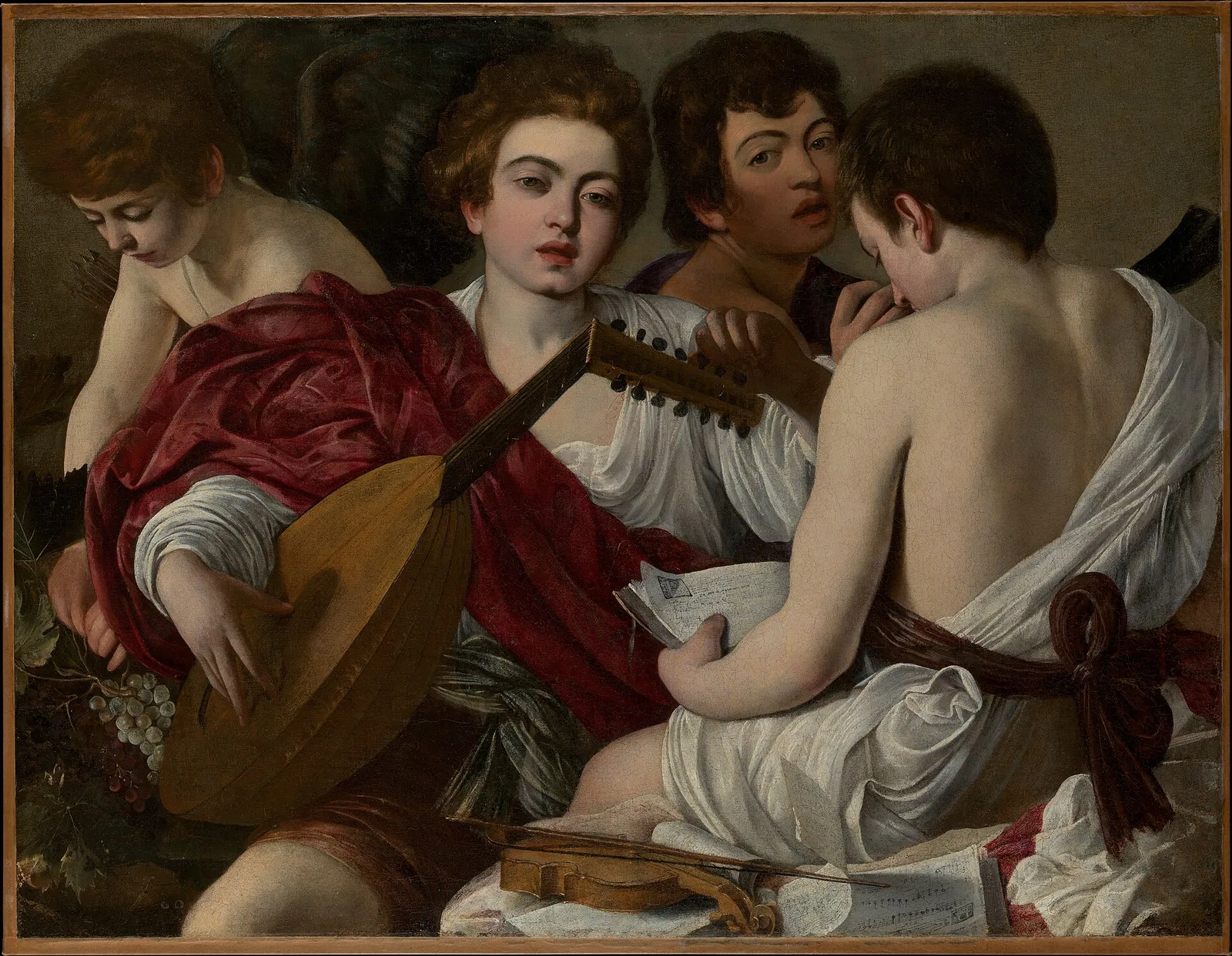
Caravaggio's The Musicians, dated 1595, is in the collection of the Metropolitan Museum of Art. It is an early work from the artist's years in Rome, showing four youths crowded together with instruments, sheet music and a winged Cupid. In person, it rewards slow looking at faces, fabrics and the objects scattered in the foreground.
Where to see it
The Musicians is held by the Metropolitan Museum of Art, which is both its collection and its listed location. Display arrangements can change because of rehangs, conservation work or loans, so check the Metropolitan Museum of Art's official website for current display status before you visit. The canvas measures 92.1 cm high by 118.4 cm wide. That is large enough for the half-length figures to feel close to you, but small enough that it is worth stepping near to study the details.
What to look for in person
Four figures in a tight space
Start by noticing how little room Caravaggio gives his figures. Four young men are pressed into a shallow space close to the picture surface, almost overlapping one another. At the centre a youth tunes a lute and turns toward the viewer. In the right foreground another figure, seen from behind, studies a sheet of music. Behind them a third holds a horn and looks out at us. At the left, a fourth reaches toward a bunch of grapes. Follow how the glances and gestures lead your eye around the group.
Cupid and the link between music and love
Look closely at the boy on the left. His small wings identify him as Cupid, which tells you this is not simply a scene of musicians rehearsing. Art historians generally read the painting as an allegory connecting music and love, a theme suited to a cultivated audience. The grapes he reaches for suggest pleasure and the senses. Notice also the loose, classical-looking drapery the youths wear in place of everyday clothing of the time. It places the scene somewhere between real life and an idealised, poetic world.
Still-life details and the painting's condition
Lower your gaze to the foreground, where a violin and sheets of music lie close to the edge of the picture. Caravaggio was closely attentive to objects as well as faces, and these details show his interest in still life within a figure painting. As you look, keep in mind that the canvas has suffered damage and losses over the centuries and has been restored. Some passages therefore look softer or less crisp than others. Comparing the better-preserved faces with more worn areas is part of seeing it honestly.
About the painting
The Musicians belongs to the early phase of Caravaggio's career in Rome, when he painted half-length pictures of youths, often with musical or allegorical themes. The fact sheet dates it to 1595. It is widely accepted that the painting was made for Cardinal Francesco Maria del Monte, an important early patron of the artist and a man with a strong interest in music. Works of this kind were made for private enjoyment by educated collectors rather than for churches, and their subjects invited conversation about the senses, love and the arts.
What stands out in this picture is the closeness of the figures. Rather than setting musicians in a deep room, Caravaggio pushes them forward so that they almost fill the canvas, which measures 92.1 by 118.4 cm. The effect is intimate: you seem to be standing at the edge of the group, with the instruments and music almost within reach. The direct gaze of the lute player and the horn player draws the viewer into the scene.
The winged boy on the left shifts the meaning from a simple concert to an allegory of music and love, a pairing with a long tradition in European art and poetry. At the same time, the youths' faces and hands are observed with the attention to real models that would become central to Caravaggio's later work.
The painting has a complicated physical history, including damage and restoration, which affects how some areas read today. It is now in the collection of the Metropolitan Museum of Art, where it offers a clear view of the artist's early interests before his more dramatic religious commissions.
Key facts
| Artist | Caravaggio |
|---|---|
| Date | 1595 |
| Size | 92.1 × 118.4 cm |
| Medium | oil paint, canvas |
| Collection | Metropolitan Museum of Art |
| Gallery | Gallery 620 Checked in the museum's open data on 2026-11-12 (galleries can change) Source |
How to visit: Metropolitan Museum of Art
New York City, United States · Museum guide
| Opening hours | Sun, Mon, Tue, Thu 10:00–17:00 Fri, Sat 10:00–21:00 |
|---|---|
| Closed | Wednesdays; Thanksgiving Day, 25 December, 1 January and the first Monday in May |
| Admission | Adults USD 30 Seniors (65 and over) USD 22 Visitors with a disability (in person only) USD 22 Students USD 17 Children (12 and under) free Care partners of visitors with a disability (in person only) free New York State residents; NY, NJ and CT students: pay what you wish (minimum USD 0.01). Online requires a NY State billing address; NJ/CT students in person with student ID |
| Free entry | Free for children 12 and under, Members and Patrons, and care partners of visitors with a disability. Pay what you wish for New York State residents and NY/NJ/CT students. |
| Booking | No reservation is required and there is no timed entry. |
The Cantor Roof Garden, the Modern and Contemporary Galleries, and the Ancient West Asia and Ancient Cyprus Galleries are closed for renovation.
Official ticket page
Official website
View on map
Hours and prices can change. Please check the official website before you go. (Checked on: 2026-11-09)
More by Caravaggio
 The Fortune Teller
 Bacchus — Uffizi Gallery
 Basket of Fruit
 Medusa — Uffizi Gallery
 Self-Portrait as Bacchus — Galleria Borghese
 Boy Peeling Fruit
 The Fortune Teller — Louvre Museum
 Boy with a Basket of Fruit — Galleria Borghese
 Saint Catherine of Alexandria — Thyssen-Bornemisza Museum
 David with the Head of Goliath — Galleria Borghese
 Penitent Magdalene
 Supper at Emmaus — National Gallery