Art! Art! Art! › Works
Boy with a Basket of Fruit
 Caravaggio, 1590s
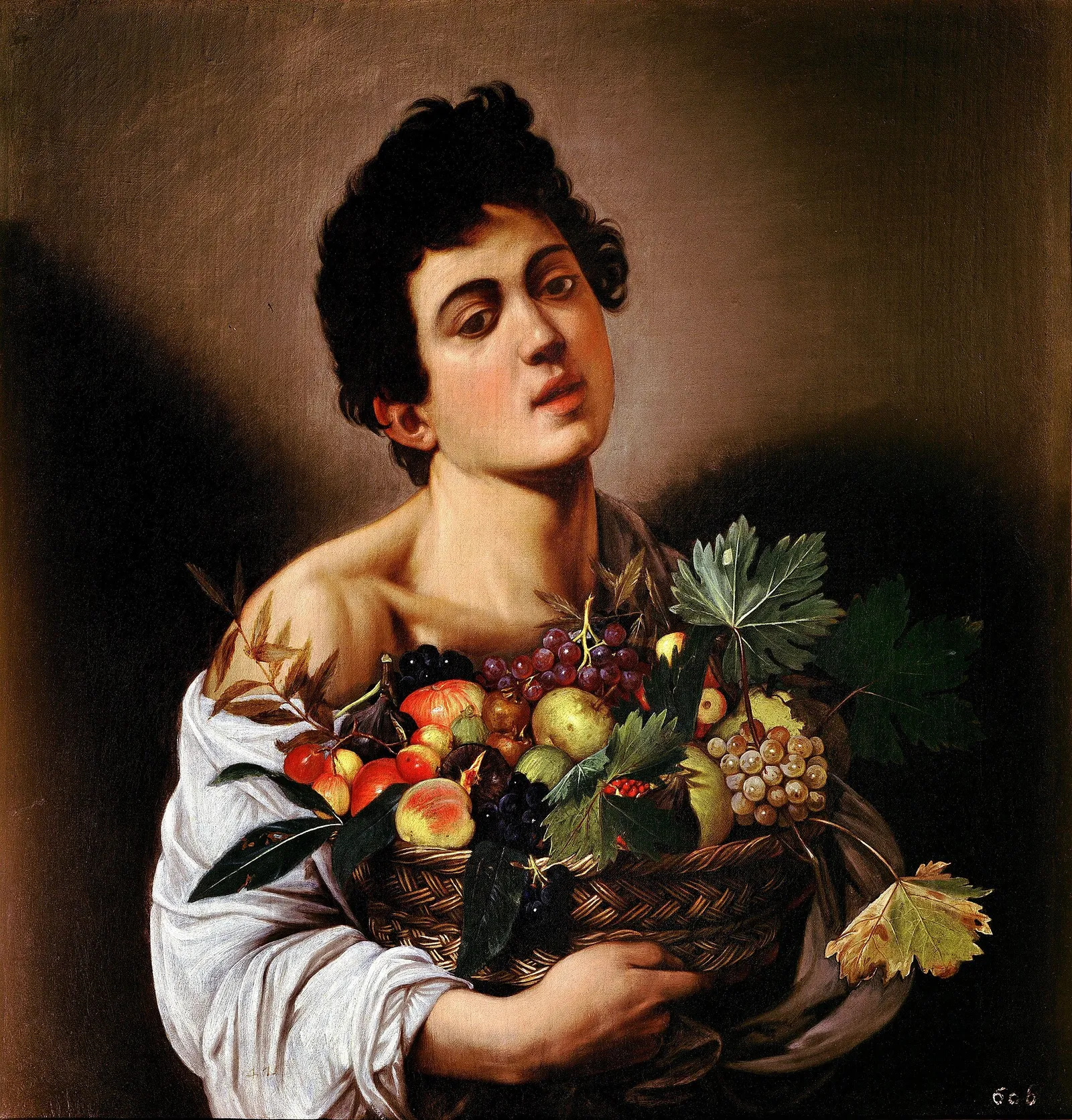
Caravaggio's Boy with a Basket of Fruit is held by the Galleria Borghese. Painted in the 1590s and measuring 70 by 67 cm, it pairs a half-length youth with a basket of fruit painted in close, careful detail. In person, look for the contrast between the softly lit figure and the sharply observed fruit and leaves.
Where to see it
Boy with a Basket of Fruit is in the collection of the Galleria Borghese, which is also its listed location. Paintings can be moved, lent or temporarily taken off view, so check the Galleria Borghese's official website for current display status, opening hours and ticketing arrangements before you plan your visit.
What to look for in person
The basket of fruit
Move close to the basket first. Caravaggio paints grapes, peaches, figs and other fruit with attention to texture: the bloom on the grapes, the soft skin of the peaches, the gloss where light catches. Look at the leaves too. Some are fresh and green, while others are curled, spotted or drying at the edges. That mix of ripe and fading growth is part of what makes the still life feel observed rather than idealised, and it rewards slow looking at close range.
The boy's pose and expression
Step back to take in the figure. The youth holds the basket against his chest, his head tilted and his lips slightly parted. A loose white garment slips from one shoulder, leaving it bare. His gaze and expression are open to interpretation; some viewers read them as wistful, others as inviting. Notice how the painting places the fruit and the face close together in the composition, so your eye moves back and forth between the two centres of attention.
Light and the plain background
Light falls on the figure from one side, picking out the shoulder, neck and face and modelling them in soft gradations. Behind him the background is plain, with a shadow crossing the wall. There is no landscape or interior detail to distract you. This restraint makes the figure and basket stand out sharply. Compare how the light behaves on skin, cloth and fruit: each surface is described differently, and that variety is one of the painting's quiet pleasures.
About the painting
Boy with a Basket of Fruit dates from the 1590s and belongs to the early part of Caravaggio's career, when he produced a number of half-length pictures of young figures, often combined with still-life elements such as fruit, flowers or musical instruments. These works helped establish his reputation for painting directly from a model and for rendering objects with unusual fidelity. At 70 by 67 cm, the canvas is close to square and of modest size, which suits an intimate, close-up viewing experience. The composition is simple: a single youth, seen from about the waist up, holding a basket overflowing with fruit and leaves against a plain wall. What holds attention is the treatment of surfaces. The fruit is painted with such care that the basket could almost stand as an independent still life, and the inclusion of imperfect, withering leaves sets it apart from purely decorative arrangements. The figure, by contrast, is rendered with softer modelling, his pale shoulder and face catching the light. Visitors familiar with Caravaggio's later, darker religious works may be struck by how bright and secular this picture feels. It nonetheless shows features that run through his art: a strong, directional light, an emphasis on the physical presence of the sitter, and a refusal to idealise natural things. The painting is now held by the Galleria Borghese, whose collection includes several works by Caravaggio, making it possible to compare this early picture with others by the same artist during a single visit. When viewing it, give yourself time both close up, for the fruit, and at a few steps' distance, to see how figure and still life work together as one image.
Key facts
| Artist | Caravaggio |
|---|---|
| Date | 1590s |
| Size | 70 × 67 cm |
| Medium | oil paint, canvas |
| Collection | Galleria Borghese |
How to visit: Galleria Borghese
Rome, Italy · Museum guide
| Opening hours | Tue–Sun 09:00–19:00 (entry at the start of each hourly slot, max 180 visitors per slot; visits last 2 hours, last slot shorter) |
|---|---|
| Closed | Mondays; 25 December and 1 January |
| Last entry | 17:45 (some official information gives 17:50 for the last same-day slot) |
| Admission | Adults EUR 16 (plus EUR 2 reservation fee; may rise during temporary exhibitions) Adults, last time slot EUR 11 (plus reservation fee) Ages 18–25 EUR 2 (plus reservation fee; valid until 25th birthday) Under 18 free (EUR 2 reservation fee still applies) Reservation fee (all tickets) EUR 2 (mandatory, including free tickets) |
| Free entry | Free for under-18s, ICOM members, MiC staff, certain students and faculty (humanities, architecture, fine arts), EU school groups and authorised guides/interpreters. Free for everyone on the first Sunday of the month and on 25 Apr, 2 Jun and 4 Nov (EUR 2 reservation fee applies; tickets released 10 days ahead; no last-minute tickets). |
| Booking | Reservation is required for timed entry. Tickets for free days (first Sunday etc.) are released 10 days in advance. |
Official ticket page
Official website
View on map
Hours and prices can change. Please check the official website before you go. (Checked on: 2026-11-09)
More by Caravaggio
 The Fortune Teller
 Bacchus — Uffizi Gallery
 Basket of Fruit
 Medusa — Uffizi Gallery
 Self-Portrait as Bacchus — Galleria Borghese
 Boy Peeling Fruit
 The Fortune Teller — Louvre Museum
 Saint Catherine of Alexandria — Thyssen-Bornemisza Museum
 David with the Head of Goliath — Galleria Borghese
 Penitent Magdalene
 Supper at Emmaus — National Gallery
 Amor Vincit Omnia — Gemäldegalerie Berlin