Art! Art! Art! › Works
Basket of Fruit
 Caravaggio, 16th century
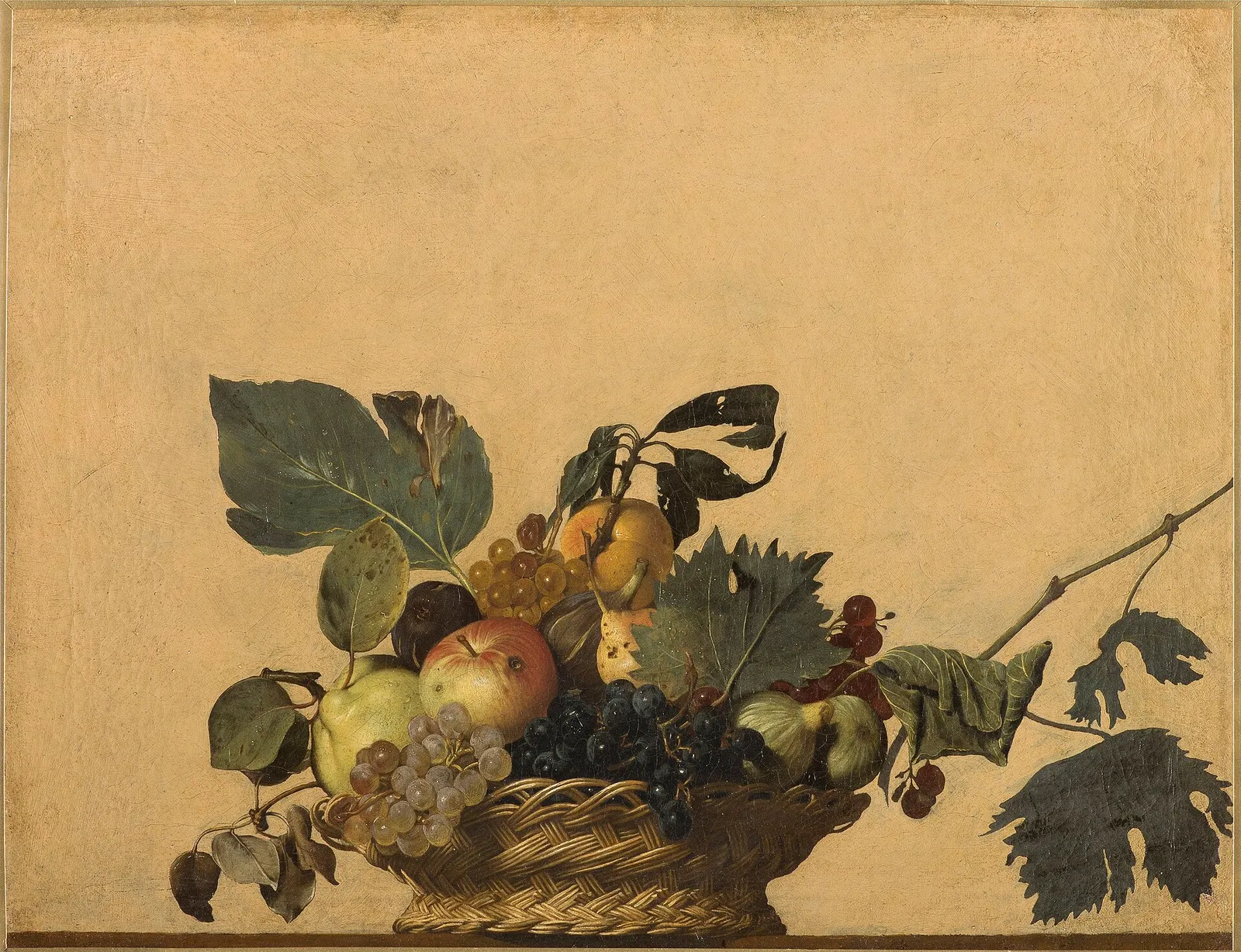
Caravaggio's Basket of Fruit is a 16th-century still life held by the Pinacoteca Ambrosiana. A single woven basket of fruit and leaves sits on a ledge against a plain, light ground, and it rewards close, slow looking. This page explains where to find it and what to notice when you stand in front of it.
Where to see it
Basket of Fruit is in the collection of the Pinacoteca Ambrosiana, which is also its listed location. According to the fact sheet, the work measures 67.5 cm high by 54.5 cm wide, so plan to view it at close range to take in the detail. Paintings can be moved, rotated off view or lent, so check the Pinacoteca Ambrosiana's official website for current display status, opening hours and ticket information before you visit.
What to look for in person
The ledge and the basket at eye level
The woven basket rests on a narrow ledge seen almost exactly at eye level, so you look at it straight on rather than from above. Notice how the base of the basket seems to project slightly beyond the edge, casting a shadow and nudging the fruit toward your own space. Stand at the center, then step a little to one side: the shallow stage and frontal view are what make such a modest subject feel so immediate. Look, too, at the weave of the basket, rendered strand by strand.
Fruit that is not perfect
Look closely at the apple and you will find a wormhole. Around the fruit, some leaves are fresh while others curl, dry out or show spots of decay. Grapes, figs and a pear sit among them, several with bruises or blemishes. Caravaggio did not idealize his produce; he painted it as it looks after it has been picked and left to sit. Many viewers read this mix of ripeness and decline as a reflection on time passing. Either way, the surface detail is best appreciated from close up.
The plain, light background
Instead of a dark interior or a landscape, the fruit stands against a flat, pale, warm-toned ground. This empty field throws the outlines of leaves and tendrils into sharp relief, especially along the top edge, where they break free of the basket's mass. Compare this even, light setting with the deep shadows often associated with Caravaggio's figure paintings. Here colour and texture carry the picture, and the shadow beneath the basket is one of the few strong dark notes in the composition.
About the painting
Basket of Fruit is one of the best-known still lifes associated with Caravaggio, and it is widely discussed as an early example in Italian painting of fruit treated as a subject in its own right rather than as a detail within a larger scene. The painting is in oil on canvas and is dated to the 16th century. It is closely connected with Cardinal Federico Borromeo, the founder of the Ambrosiana, from whose collection it came. That link is part of why the work belongs to the Pinacoteca Ambrosiana today. What sets the picture apart for many visitors is its directness. There is no table setting, no figure and no story, only a basket, its contents and a ledge. Caravaggio's attention to particular, imperfect objects, such as the wormhole in the apple, the withering leaves and the varied skins of grapes and figs, reflects the close observation of nature that runs through his work more broadly. The low, frontal viewpoint places the basket at roughly the height of the viewer's eyes, which makes the objects feel present rather than displayed. When you visit, give the painting a few minutes. First take in the overall silhouette against the pale ground, then move closer to study individual leaves and fruit, and finally notice how light models each rounded form. Viewers have long debated how much symbolic meaning to read into the decaying elements. It is equally rewarding to look at the picture simply as a study of things seen carefully. The fact sheet gives its size as 67.5 cm high by 54.5 cm wide.
Key facts
| Artist | Caravaggio |
|---|---|
| Date | 16th century |
| Size | 67.5 × 54.5 cm |
| Medium | oil paint, canvas |
| Collection | Pinacoteca Ambrosiana |
How to visit: Pinacoteca Ambrosiana
Milan, Italy
Hours and prices can change. Please check the official website before you go.
More by Caravaggio
 The Fortune Teller
 Bacchus — Uffizi Gallery
 Medusa — Uffizi Gallery
 Self-Portrait as Bacchus — Galleria Borghese
 Boy Peeling Fruit
 The Fortune Teller — Louvre Museum
 Boy with a Basket of Fruit — Galleria Borghese
 Saint Catherine of Alexandria — Thyssen-Bornemisza Museum
 David with the Head of Goliath — Galleria Borghese
 Penitent Magdalene
 Supper at Emmaus — National Gallery
 Amor Vincit Omnia — Gemäldegalerie Berlin