Art! Art! Art! › Works
David with the Head of Goliath
 Caravaggio, 1605
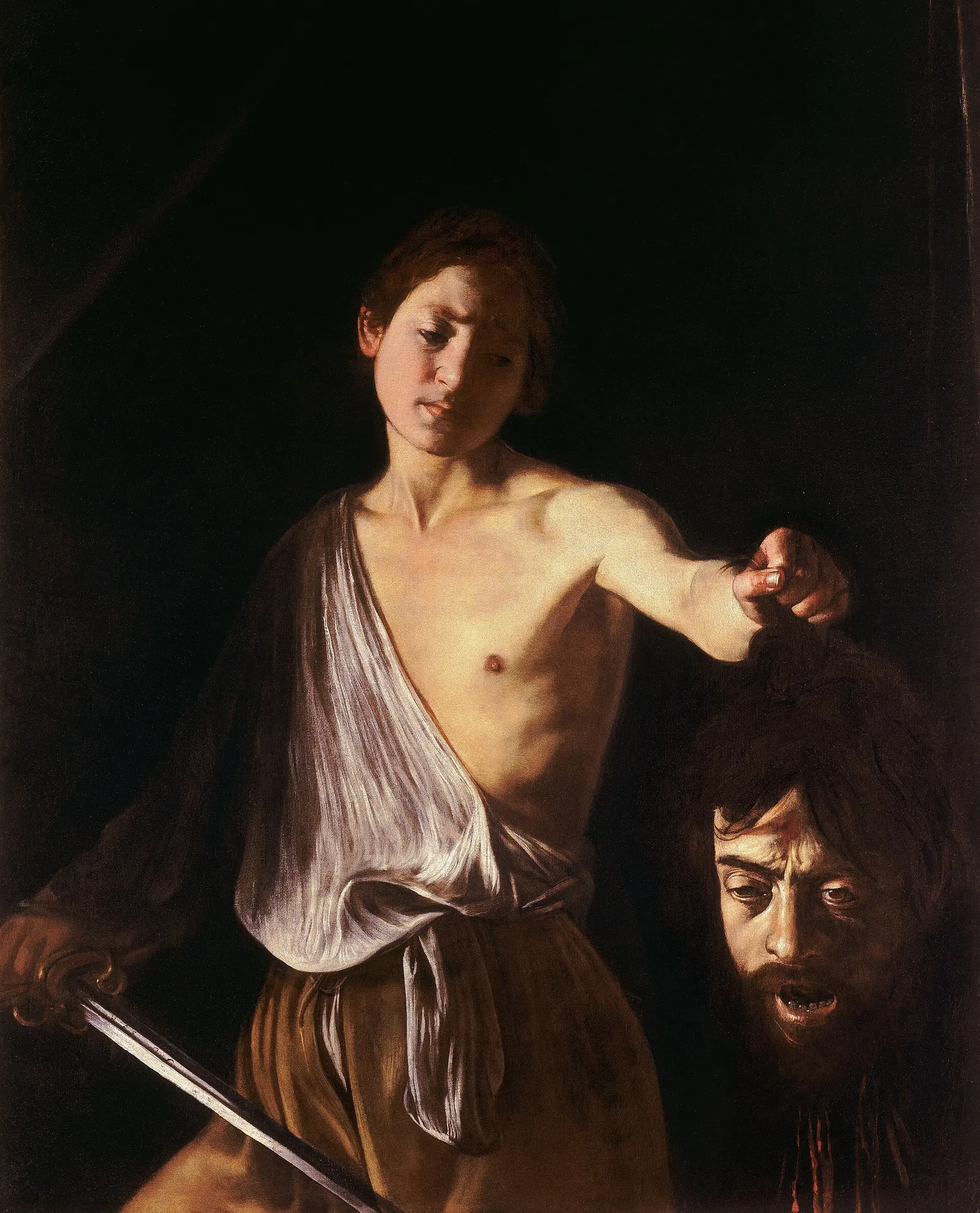
Caravaggio's David with the Head of Goliath, dated 1605, is held by the Galleria Borghese. The painting shows the young David holding up the severed head of the giant, set against deep darkness. It is a work that rewards slow, close looking at faces, gestures and light.
Where to see it
David with the Head of Goliath is in the collection of the Galleria Borghese, which is also its listed location. Works in museum collections can be moved, rehung, sent on loan or taken off view for conservation, so please check the Galleria Borghese's official website for current display status, opening hours and ticketing information before you plan your visit.
What to look for in person
The severed head
Look first at the head David holds out by the hair. Goliath's eyes are half-open and unfocused, his mouth hangs slack, and blood still runs from the neck. Art historians widely identify this face as a self-portrait of Caravaggio, which turns a biblical trophy into something far more personal. Stand close enough to see how the face is modelled: the brow is furrowed, the skin is shadowed and lined, and the two eyes do not seem to match, giving the head an unsettling sense of life lingering after death.
David's restrained expression
Instead of a triumphant hero, Caravaggio shows a young David who looks down at his victim with a downcast, almost pensive expression. His lips are slightly parted and his brow is drawn together. Notice how he holds the head out at arm's length, away from his body, while his other hand keeps the sword lowered at his side. The pose reads less as celebration than as reflection. Take a moment to compare the two faces: youth and age, life and death, placed side by side within the same composition.
Light against darkness
The figures emerge from an almost black background, lit by a strong light coming from the left. This sharp contrast of light and shadow, often called tenebrism, is a hallmark of Caravaggio's mature style. Follow the light as it falls across David's bare shoulder and chest, the pale fabric of his open shirt, the blade of the sword and Goliath's face. Everything outside the light sinks into deep shadow, with no landscape or setting to distract you. The effect focuses attention entirely on the two figures and their silent exchange.
About the painting
The story of David and Goliath comes from the Hebrew Bible: the young shepherd David defeats the Philistine giant Goliath with a sling stone and then cuts off his head with the giant's own sword. Painters had long shown David as a confident victor, but Caravaggio approached the subject in a quieter, more unsettling way. Here there is no crowd, no battlefield and no landscape, only two figures emerging from shadow. The painting is dated 1605 and measures 125 by 101 centimetres, a size that lets the figures appear close to life-scale and brings the viewer near to the scene. Caravaggio was known for painting directly from models and for grounding religious stories in physical, everyday reality, and that approach is visible here in David's rumpled shirt, the plain rope-like belt and the heavy weight of the head in his grip. The widely accepted identification of Goliath's face as Caravaggio's own features adds a personal dimension that has made the painting one of the most discussed works in his output. Rather than presenting a simple victory, the picture invites reflection on violence, guilt and compassion, with David appearing to regard his enemy with something closer to sorrow than pride. When you visit, give yourself time to stand at different distances. From further back, the strong diagonal from David's arm to the head structures the whole composition. Up close, the details of skin, blood and fabric show how carefully Caravaggio controlled the fall of light. The Galleria Borghese holds the painting today.
Key facts
| Artist | Caravaggio |
|---|---|
| Date | 1605 |
| Size | 125 × 101 cm |
| Medium | oil paint, canvas |
| Collection | Galleria Borghese |
How to visit: Galleria Borghese
Rome, Italy · Museum guide
| Opening hours | Tue–Sun 09:00–19:00 (entry at the start of each hourly slot, max 180 visitors per slot; visits last 2 hours, last slot shorter) |
|---|---|
| Closed | Mondays; 25 December and 1 January |
| Last entry | 17:45 (some official information gives 17:50 for the last same-day slot) |
| Admission | Adults EUR 16 (plus EUR 2 reservation fee; may rise during temporary exhibitions) Adults, last time slot EUR 11 (plus reservation fee) Ages 18–25 EUR 2 (plus reservation fee; valid until 25th birthday) Under 18 free (EUR 2 reservation fee still applies) Reservation fee (all tickets) EUR 2 (mandatory, including free tickets) |
| Free entry | Free for under-18s, ICOM members, MiC staff, certain students and faculty (humanities, architecture, fine arts), EU school groups and authorised guides/interpreters. Free for everyone on the first Sunday of the month and on 25 Apr, 2 Jun and 4 Nov (EUR 2 reservation fee applies; tickets released 10 days ahead; no last-minute tickets). |
| Booking | Reservation is required for timed entry. Tickets for free days (first Sunday etc.) are released 10 days in advance. |
Official ticket page
Official website
View on map
Hours and prices can change. Please check the official website before you go. (Checked on: 2026-11-09)
More by Caravaggio
 The Fortune Teller
 Bacchus — Uffizi Gallery
 Basket of Fruit
 Medusa — Uffizi Gallery
 Self-Portrait as Bacchus — Galleria Borghese
 Boy Peeling Fruit
 The Fortune Teller — Louvre Museum
 Boy with a Basket of Fruit — Galleria Borghese
 Saint Catherine of Alexandria — Thyssen-Bornemisza Museum
 Penitent Magdalene
 Supper at Emmaus — National Gallery
 Amor Vincit Omnia — Gemäldegalerie Berlin