Art! Art! Art! › Works
The Fortune Teller
 Caravaggio, 1594
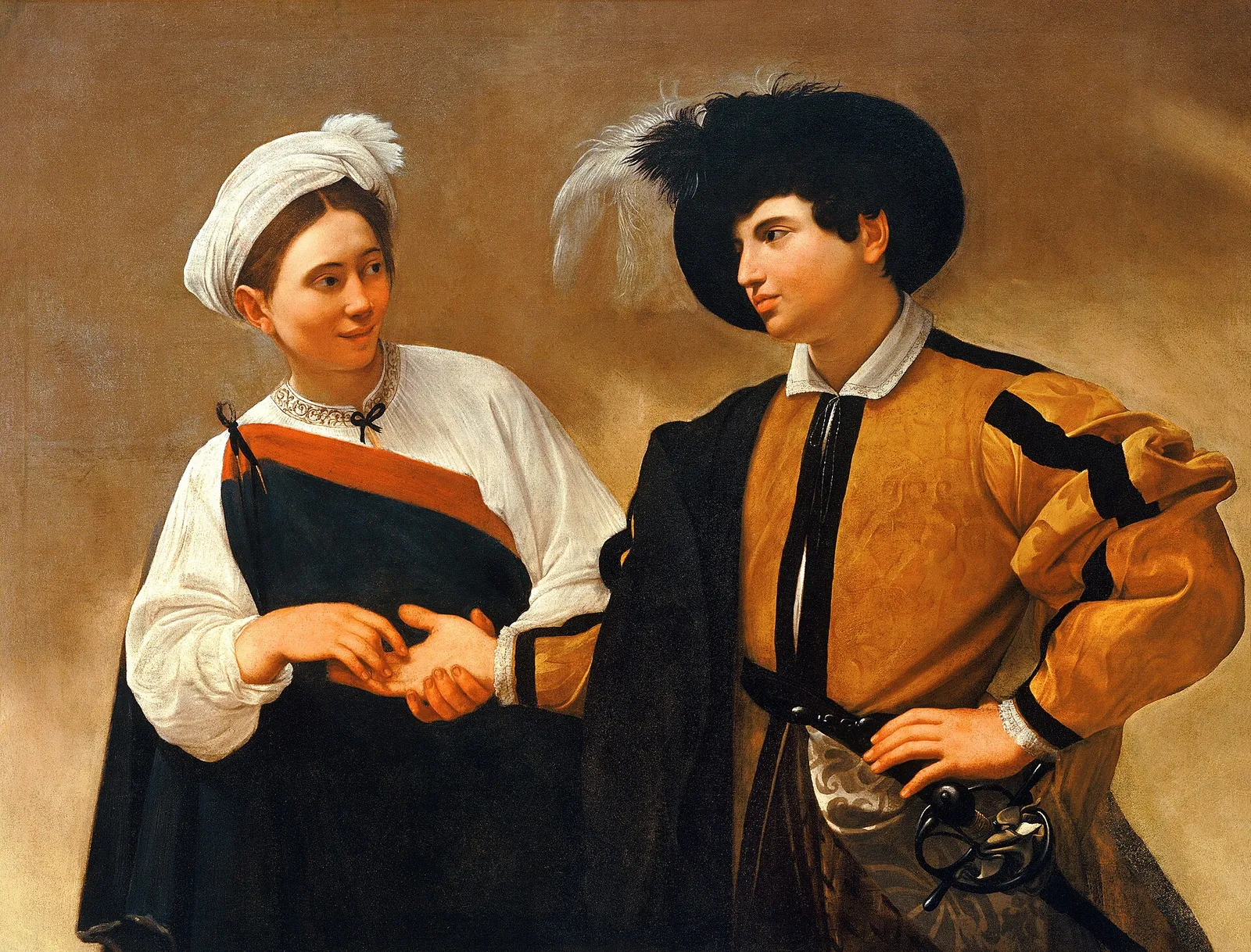
Caravaggio's The Fortune Teller, dated to 1594, is in the collection of the Capitoline Museums. It is a close-up scene from street life: a fashionably dressed young man holds out his hand to a fortune teller, who reads his palm while quietly slipping the ring from his finger.
Where to see it
The Fortune Teller is held by the Capitoline Museums, which is also the location listed for the work. Displays can change because of rehanging, conservation or loans, so check the Capitoline Museums' official website for current display status, opening hours and ticket information before you visit.
What to look for in person
Watch the hands
The story of the painting is told through the hands. The young man offers his palm, expecting to hear his future. Look closely at the fortune teller's fingers. While she appears to be reading his hand, she is easing the ring off his finger. Neither figure acknowledges the theft, so the viewer is the only one who sees it happen. Stand close enough to follow the small, deliberate gestures, then step back and see how calm the scene looks from a distance.
Faces and glances
Compare the two faces. The young man's expression is open and self-assured, and his attention is fixed on the woman. Her gaze meets his and holds it, a look that keeps him occupied while her hands do their work. Caravaggio places the figures at half-length and close to the picture surface, which brings you almost into the conversation. Notice how little else is in the picture. The meaning comes from the exchange of looks between two people, not from setting or props.
Costume, light and a plain wall
Look at the clothing: the young man's plumed hat, gloves and sword mark him as a well-off gallant, while the woman wears a simpler wrapped garment and headcloth. Caravaggio renders fabric, feathers and skin with careful attention to texture. Behind the figures is a largely plain, lit wall rather than a detailed background. The light falls across the figures from one side and models their forms, an early sign of the interest in strong, directed light that runs through Caravaggio's later work.
About the painting
The Fortune Teller belongs to Caravaggio's early career, and the fact sheet dates it to 1594. At this stage he was making his name with paintings of half-length figures drawn from everyday life, rather than the religious and historical subjects that dominated large commissions. Scenes like this one, showing ordinary people in a moment of trickery or deception, helped establish genre painting as a serious subject for ambitious artists, and the theme of the naive young man deceived was taken up by many later painters across Europe.
What makes the picture work is restraint. There is no crowded street, no explanatory detail and no moralising inscription. Two figures, a plain wall and a single exchange carry the whole story. The humour and the warning are both there: the young man wants to learn his fortune and loses part of it while listening. Caravaggio leaves it to the viewer to notice the theft, which turns looking at the painting into a small act of discovery.
The painting also shows his attention to observed detail. The textures of cloth, the sheen of a feather and the softness of skin are painted with care, and the figures are lit so that they stand out clearly against the background. These qualities, refined over the following years, became central to his reputation.
Caravaggio painted more than one version of this subject, so you may see a closely related composition reproduced elsewhere. When visiting, give yourself time to look at the hands first, then the faces, and then the painting as a whole. Before you go, confirm on the Capitoline Museums' official website that the work is currently on view.
Key facts
| Artist | Caravaggio |
|---|---|
| Date | 1594 |
| Size | 1150 × 1500 cm |
| Medium | oil paint, canvas |
| Collection | Capitoline Museums |
How to visit: Capitoline Museums
Rome, Italy
Hours and prices can change. Please check the official website before you go.
More by Caravaggio
 Bacchus — Uffizi Gallery
 Basket of Fruit
 Medusa — Uffizi Gallery
 Self-Portrait as Bacchus — Galleria Borghese
 Boy Peeling Fruit
 The Fortune Teller — Louvre Museum
 Boy with a Basket of Fruit — Galleria Borghese
 Saint Catherine of Alexandria — Thyssen-Bornemisza Museum
 David with the Head of Goliath — Galleria Borghese
 Penitent Magdalene
 Supper at Emmaus — National Gallery
 Amor Vincit Omnia — Gemäldegalerie Berlin