Art! Art! Art! › Works
Self-Portrait as Bacchus
 Caravaggio, 1595
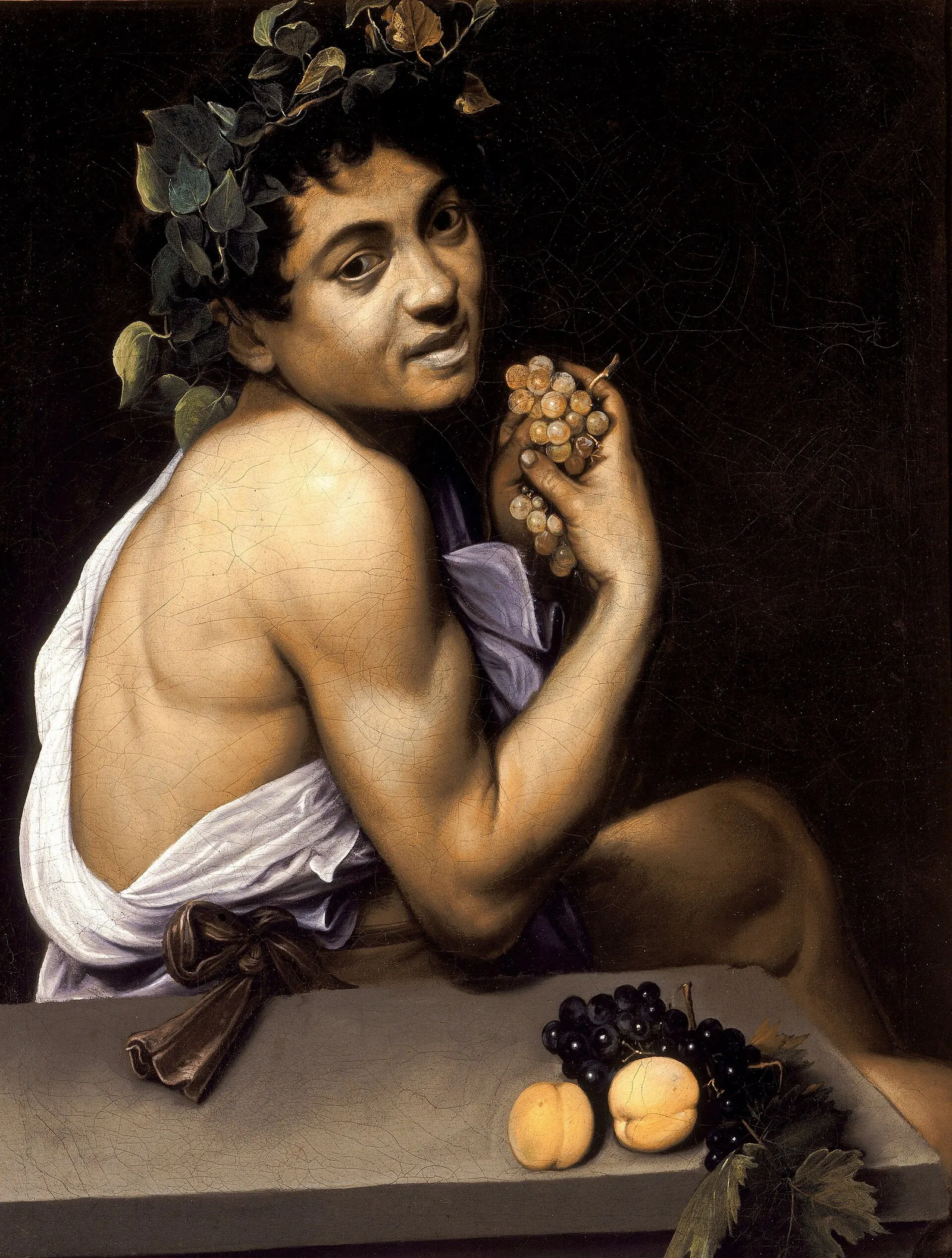
Caravaggio's Self-Portrait as Bacchus is held by the Galleria Borghese, where it is listed in Room 8, the room of Silen. Dated 1595 and measuring 67 by 53 cm, it is a small, close-up image of the wine god with a strikingly pale complexion, often called the 'Sick Bacchus'. In front of it, the rewards are in the details: the skin, the fruit, and the sideways glance.
Where to see it
The painting is in the collection of the Galleria Borghese, which lists it in Room 8 - room of Silen. Display arrangements can change, and works are sometimes moved or lent. Before you visit, check the Galleria Borghese's official website for the painting's current display status, opening hours, and any ticket or booking requirements.
What to look for in person
The pale, unhealthy-looking face
Start with the skin. Caravaggio gave Bacchus a sallow, yellow-green complexion and greyish lips, far from the rosy, robust wine god of earlier tradition. This is why the picture is widely known as the 'Sick Bacchus'. Notice how the eyes turn back over the shoulder toward you while the head stays half-turned away. The effect is direct and slightly unsettling, as if the figure has just noticed that he is being watched. Step close to see how softly the shadows model the cheek and jaw.
The fruit on the stone ledge
At the bottom of the canvas, a plain stone ledge holds a small still life: two peaches and a bunch of dark grapes. The figure also holds a cluster of pale grapes close to his chest. Caravaggio was already a careful painter of fruit early in his career, and here you can compare textures at close range: the velvety skin of the peaches, the glossy, slightly clouded grapes, and the hard, flat edge of the stone. The ledge also creates a barrier between the viewer and the figure.
Pose, costume and light
Look at how the body twists. The shoulder is bare and turned toward us, while the arms fold in to hold the grapes. A white cloth is wrapped around the figure and tied with a dark sash, and a wreath of ivy crowns the head, a traditional attribute of Bacchus. The background is plain and dark, so the light falling from the left picks out the shoulder, face and drapery. There is no landscape or setting, only the figure, the fruit and the light.
About the painting
Self-Portrait as Bacchus is an early work by Caravaggio, dated 1595 and measuring 67 by 53 cm. It belongs to the Galleria Borghese, where it is listed in Room 8, the room of Silen. Its modest size suits its subject: a single half-length figure, seen at close range, with no narrative scene around him.
The painting is generally understood as a self-portrait, with the young artist casting himself in the role of Bacchus, the classical god of wine. Rather than idealising the god, Caravaggio presents a real-looking young man in costume, holding grapes and wearing an ivy wreath. This approach, using a recognisable model in plain studio conditions to play a mythological part, is characteristic of his early paintings, which often feature single figures, carefully observed fruit and flowers, and strong directional light against a dark background.
The most discussed feature is the complexion. The pallid, greenish skin and colourless lips have given the painting its popular name, the 'Sick Bacchus', and the contrast between the god of abundance and this wan appearance is part of what keeps viewers looking.
For visitors, the painting rewards slow, close viewing. Compare the treatment of skin, cloth, leaves and fruit; notice how the ledge in the foreground pushes the figure slightly back; and watch how the glance over the shoulder engages you from different positions in the room. Seen alongside the museum's other works by Caravaggio, it offers a clear sense of his starting point before the larger dramatic compositions of his later career.
Key facts
| Artist | Caravaggio |
|---|---|
| Date | 1595 |
| Size | 67 × 53 cm |
| Medium | oil paint, canvas |
| Collection | Galleria Borghese |
How to visit: Galleria Borghese
Rome, Italy · Museum guide
| Opening hours | Tue–Sun 09:00–19:00 (entry at the start of each hourly slot, max 180 visitors per slot; visits last 2 hours, last slot shorter) |
|---|---|
| Closed | Mondays; 25 December and 1 January |
| Last entry | 17:45 (some official information gives 17:50 for the last same-day slot) |
| Admission | Adults EUR 16 (plus EUR 2 reservation fee; may rise during temporary exhibitions) Adults, last time slot EUR 11 (plus reservation fee) Ages 18–25 EUR 2 (plus reservation fee; valid until 25th birthday) Under 18 free (EUR 2 reservation fee still applies) Reservation fee (all tickets) EUR 2 (mandatory, including free tickets) |
| Free entry | Free for under-18s, ICOM members, MiC staff, certain students and faculty (humanities, architecture, fine arts), EU school groups and authorised guides/interpreters. Free for everyone on the first Sunday of the month and on 25 Apr, 2 Jun and 4 Nov (EUR 2 reservation fee applies; tickets released 10 days ahead; no last-minute tickets). |
| Booking | Reservation is required for timed entry. Tickets for free days (first Sunday etc.) are released 10 days in advance. |
Official ticket page
Official website
View on map
Hours and prices can change. Please check the official website before you go. (Checked on: 2026-11-09)
More by Caravaggio
 The Fortune Teller
 Bacchus — Uffizi Gallery
 Basket of Fruit
 Medusa — Uffizi Gallery
 Boy Peeling Fruit
 The Fortune Teller — Louvre Museum
 Boy with a Basket of Fruit — Galleria Borghese
 Saint Catherine of Alexandria — Thyssen-Bornemisza Museum
 David with the Head of Goliath — Galleria Borghese
 Penitent Magdalene
 Supper at Emmaus — National Gallery
 Amor Vincit Omnia — Gemäldegalerie Berlin