Art! Art! Art! › Works
Boy Peeling Fruit
 Caravaggio, 1590s
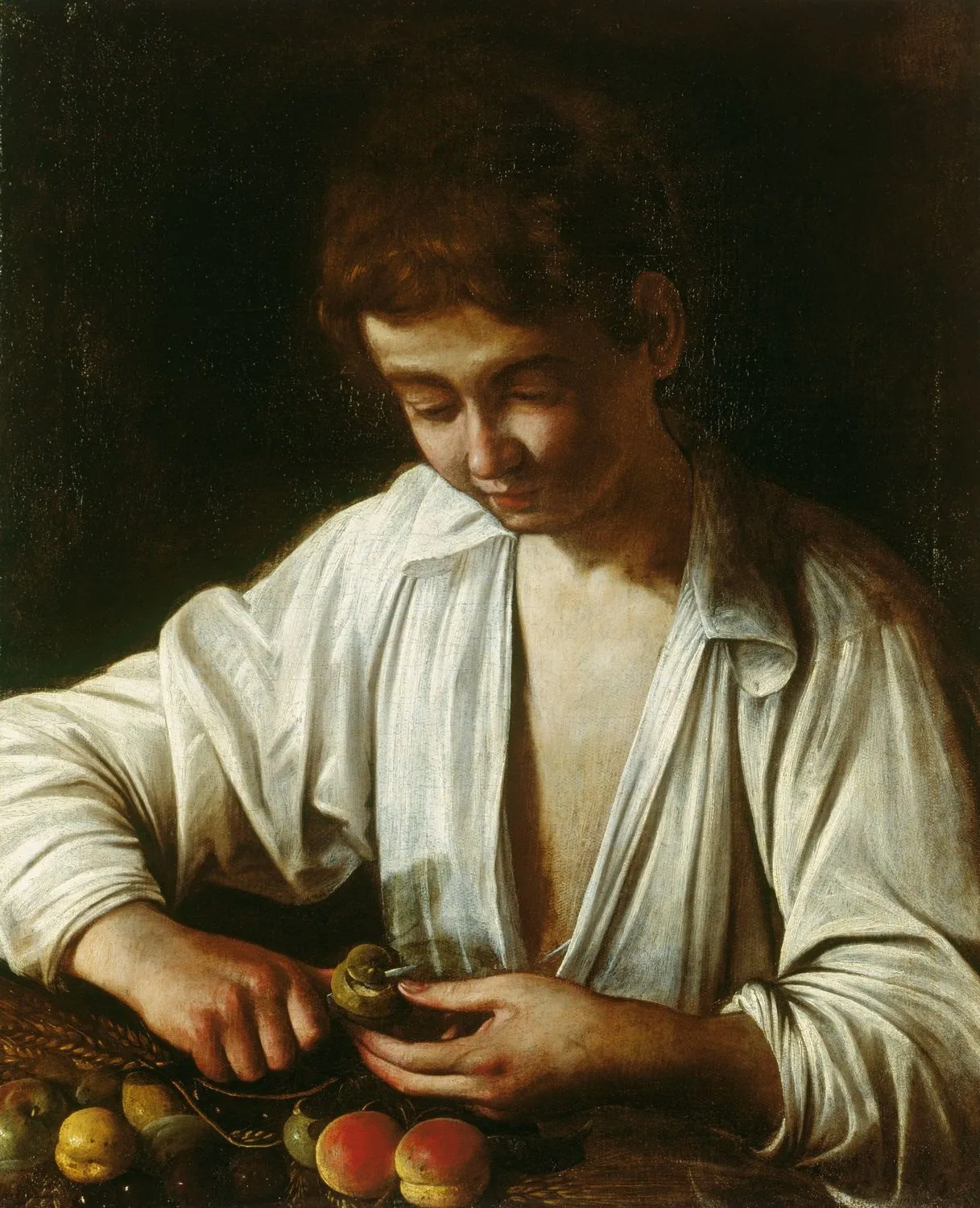
Boy Peeling Fruit is an early work by Caravaggio, dating from the 1590s, showing a young boy intent on peeling a piece of fruit. The canvas belongs to the Royal Collection and is located at Hampton Court Palace. It offers a close look at the direct observation and strong lighting that would define the artist's later work.
Where to see it
Boy Peeling Fruit is part of the Royal Collection, and its listed location is Hampton Court Palace. Display arrangements in historic palaces can change, and works may be moved, conserved or lent, so check the official websites of the Royal Collection and Hampton Court Palace for current display status, opening times and tickets before you plan your visit.
What to look for in person
A single figure, seen up close
The painting is modest in size, 63 by 53 centimetres, so it rewards standing close. A young boy fills most of the canvas, shown at half length and completely absorbed in his task. There is no narrative scene or detailed setting to distract you: the figure sits against a plain dark background, and the whole composition depends on his concentration. Notice how his lowered eyes and bent head steer your gaze down toward his hands, which is where the real subject of the picture lies.
Light, shadow and the hands
Look at how light falls across the figure from one side, picking out the face, the shirt and the hands while the background stays in shadow. This strong contrast of light and dark became central to Caravaggio's work, and here you can see it in an early, quieter form. Follow the movement of the knife against the fruit: a small, ordinary gesture is treated with the kind of seriousness usually reserved for grander subjects, and the hands become the focal point of the painting.
The still life on the table
Spend time with the fruit laid out in front of the boy. Caravaggio was interested in painting objects observed directly from life, and the still-life elements here are given genuine attention rather than treated as decoration. Compare the textures he sets side by side: the surfaces of the fruit, the soft fabric of the shirt and the skin of the face. Pairing a single youthful figure with carefully studied still life is characteristic of his early years, before he turned to large religious commissions.
About the painting
Boy Peeling Fruit belongs to the 1590s, the decade in which Caravaggio established himself as a painter. Works from this early phase are typically small canvases showing one or two young figures, often with fruit, flowers or musical instruments, and they appear to be painted from a live model rather than from imagination or classical sculpture. These pictures stand apart from the idealised figures common in Italian painting of the time: the boys look like real individuals, and everyday actions become the subject in their own right.
The composition is economical. A single figure, a dark ground, a table with fruit and one directed source of light are enough to hold the picture together. Visitors who know Caravaggio's later, more dramatic religious scenes may find it useful to treat this painting as a starting point. The habit of isolating figures against darkness and modelling them with sharp light is already present here, on a domestic scale.
The subject was evidently in demand, because several versions of Boy Peeling Fruit are known. Art historians have long discussed how these versions relate to one another and which, if any, comes from Caravaggio's own hand. When you stand in front of the Royal Collection canvas, it is worth keeping that discussion in mind and looking closely at the handling of paint, especially in the face, the hands and the fruit, the areas where differences between versions are usually compared.
The painting measures 63 by 53 centimetres. It is part of the Royal Collection and is located at Hampton Court Palace.
Key facts
| Artist | Caravaggio |
|---|---|
| Date | 1590s |
| Size | 63 × 53 cm |
| Medium | oil paint, canvas |
| Collection | Royal Collection |
How to visit: Royal Collection
, United Kingdom
Hours and prices can change. Please check the official website before you go.
More by Caravaggio
 The Fortune Teller
 Bacchus — Uffizi Gallery
 Basket of Fruit
 Medusa — Uffizi Gallery
 Self-Portrait as Bacchus — Galleria Borghese
 The Fortune Teller — Louvre Museum
 Boy with a Basket of Fruit — Galleria Borghese
 Saint Catherine of Alexandria — Thyssen-Bornemisza Museum
 David with the Head of Goliath — Galleria Borghese
 Penitent Magdalene
 Supper at Emmaus — National Gallery
 Amor Vincit Omnia — Gemäldegalerie Berlin