Art! Art! Art! › Works
Bacchus
 Caravaggio, 1598
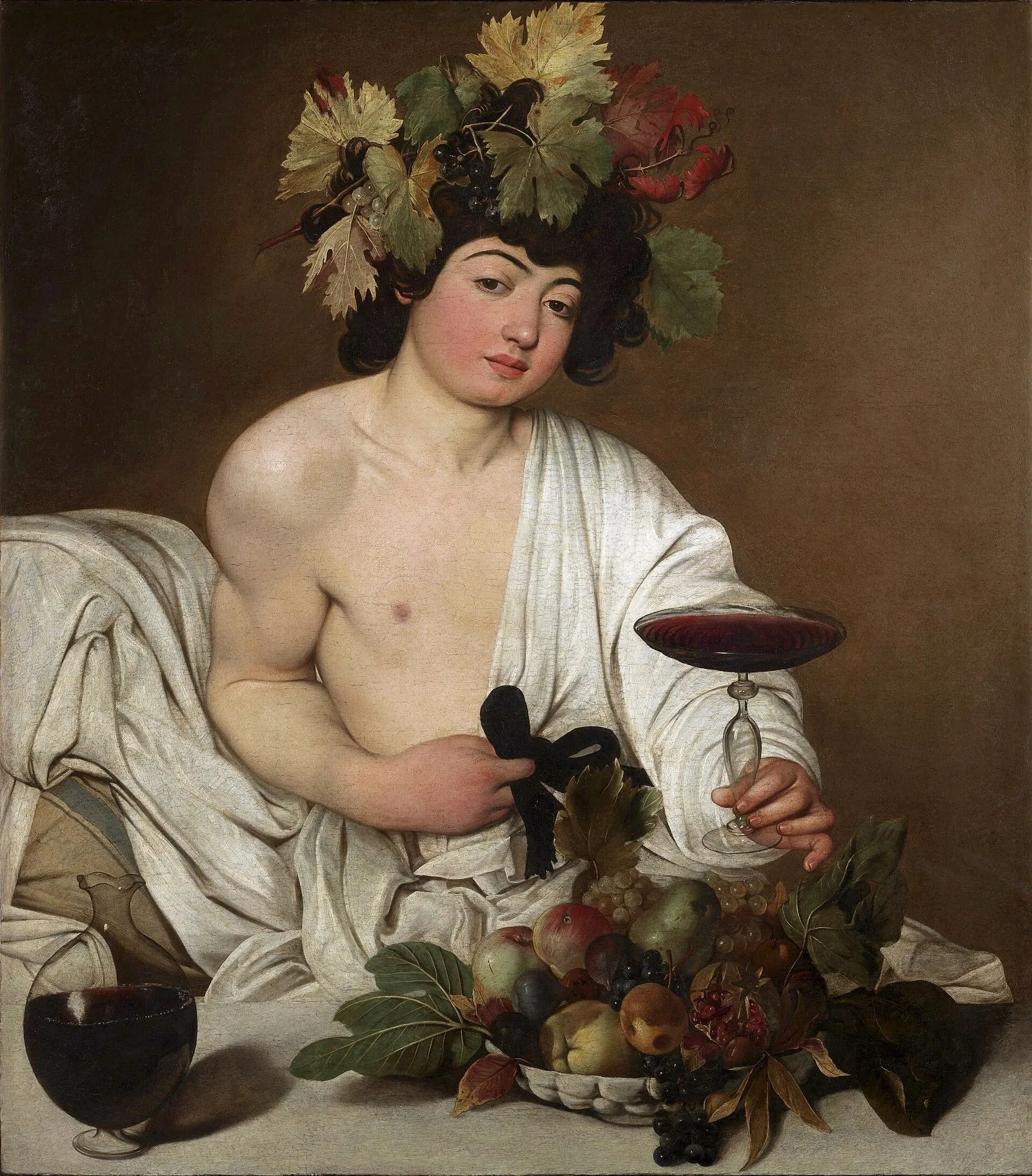
Caravaggio's Bacchus, dated 1598, belongs to the Uffizi Gallery. It shows the Roman god of wine as a very human young man who offers the viewer a glass of wine across a table laden with fruit. At 95 by 85 cm, it is a close-up, half-length picture best appreciated by standing near enough to read its surface details.
Where to see it
Bacchus is in the collection of the Uffizi Gallery, where the fact sheet lists its location as the room 'Caravaggio, hall 90'. Displays and room arrangements can change, and works are sometimes moved for conservation or lent elsewhere, so check the Uffizi Gallery's official website for current display status, opening hours and ticketing before you visit.
What to look for in person
The offered glass of wine
Start with the gesture at the centre of the picture. The young god holds out a shallow, fragile glass of red wine toward you, as if inviting you to drink. Notice how lightly his fingers grip the stem and how the wine's surface catches the light. The offer breaks the boundary between the painted world and the viewer's space, a device Caravaggio used often. Look also at his face: the flushed cheeks and steady, slightly languid gaze make him seem less like a distant deity than a real person sitting for the painter.
The fruit bowl and its imperfections
In the lower foreground, a bowl of fruit rests on the table. Take time to look closely rather than seeing it as simple decoration. Some of the fruit is bruised, split or spotted, and several leaves are beginning to wither. Caravaggio painted these flaws with the same care as the ripe fruit, a choice many viewers read as a reminder that pleasure and youth do not last. The bowl rewards a slow look, since each piece is treated almost as an independent still life within the larger composition.
The carafe, drapery and painted detail
To the left, a glass carafe of wine sits on the table. Look at its surface for the small ripples and reflections that suggest the liquid has just been disturbed. Then follow the white drapery wrapped around the figure like an improvised classical robe, and the dark sash tied at his chest. The vine leaves and grapes in his hair complete the costume. Together these details show Caravaggio's interest in painting textures directly from observation: glass, cloth, skin and foliage each handled distinctly in a carefully lit setting.
About the painting
Bacchus dates to 1598, a period when Caravaggio was establishing his reputation with paintings of young figures, still life and everyday objects observed with unusual directness. Rather than presenting the god of wine as an idealised classical statue, the painting shows a model in costume: a young man draped in white cloth, crowned with vine leaves and grapes, reclining beside a table. This sense of a staged scene, with a real person playing a mythological role, is one of the qualities that made Caravaggio's early work distinctive and influential.
The picture measures 95 by 85 cm, so it is a relatively intimate work. In the gallery, it helps to look at it in two ways. From a few steps back, take in the overall arrangement: the figure angled across the picture, the strong light falling from the left, and the plain dark background that pushes him forward. Then move closer to examine the still-life elements, the fruit bowl, the carafe and the glass, where much of the painting's interest lies.
Visitors often notice the tension between invitation and decay. The god offers wine with a relaxed, almost casual air, yet the fruit beside him is visibly past its best. Whether or not you read this as a moral message, the contrast shows how closely Caravaggio looked at the physical world.
The painting is held by the Uffizi Gallery. Because display arrangements may change, confirm its current status on the museum's official website before planning a visit around it.
Key facts
| Artist | Caravaggio |
|---|---|
| Date | 1598 |
| Size | 95 × 85 cm |
| Medium | oil paint, canvas |
| Collection | Uffizi Gallery |
How to visit: Uffizi Gallery
Florence, Italy · Museum guide
| Opening hours | Tue–Sun 08:15–18:30 (visitors leave by 18:30) |
|---|---|
| Closed | Mondays, 1 January and 25 December. |
| Last entry | Ticket office closes at 17:30. |
| Admission | Regular, bought on the day EUR 25 Regular, bought in advance EUR 29 Regular, entry from 16:00 (from 1 January 2026) EUR 16 Reduced (EU citizens aged 18–25; citizens of Switzerland, Norway, Liechtenstein, Uruguay etc.; ID required) EUR 2 Under 18 free (under 12s must be accompanied) Uffizi + Vasari Corridor EUR 43 on the day / EUR 47 in advance; named ticket, reservation required, non-refundable PassePartout 5 days (Uffizi, Pitti Palace, Boboli) EUR 40 (EUR 58 with Vasari Corridor) Audio guide EUR 6 |
| Free entry | Free for under-18s; disabled visitors plus one companion; tour guides and interpreters, ICOM members, certain journalists, and university teachers/students on the official list. Admission is free on the first Sunday of each month (national museums), when reservations are not possible. |
| Booking | Reservation is not required, except for the Uffizi + Vasari Corridor ticket, which must be reserved. |
Restoration and rearrangement works mean some rooms are temporarily closed and some artworks are not on display. A staff assembly on 11–12 November 2026 may change opening times.
Official ticket page
Official website
View on map
Hours and prices can change. Please check the official website before you go. (Checked on: 2026-11-12)
More by Caravaggio
 The Fortune Teller
 Basket of Fruit
 Medusa — Uffizi Gallery
 Self-Portrait as Bacchus — Galleria Borghese
 Boy Peeling Fruit
 The Fortune Teller — Louvre Museum
 Boy with a Basket of Fruit — Galleria Borghese
 Saint Catherine of Alexandria — Thyssen-Bornemisza Museum
 David with the Head of Goliath — Galleria Borghese
 Penitent Magdalene
 Supper at Emmaus — National Gallery
 Amor Vincit Omnia — Gemäldegalerie Berlin