Art! Art! Art! › Works
Amor Vincit Omnia
 Caravaggio, 1600s
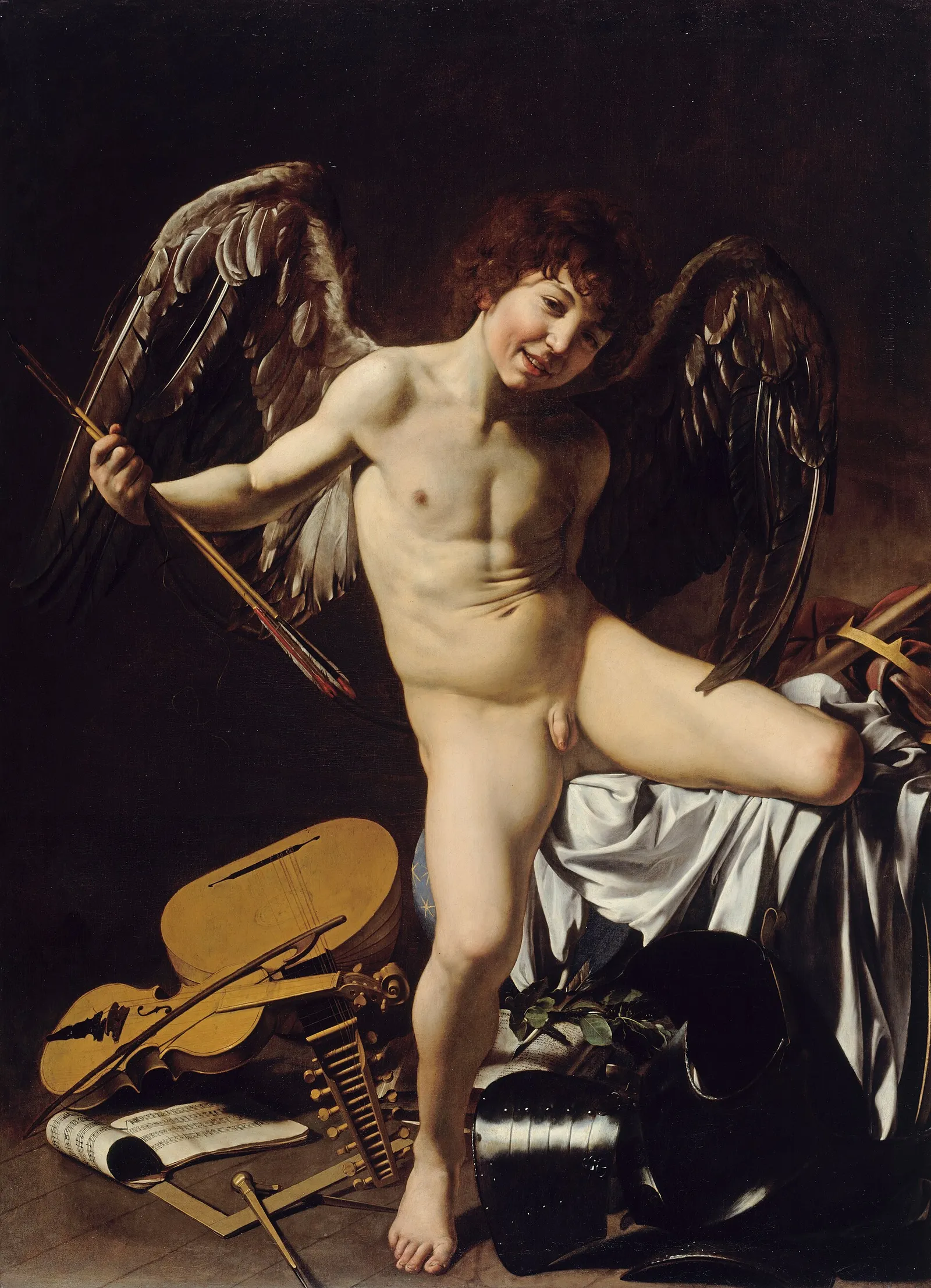
Caravaggio's Amor Vincit Omnia ("Love Conquers All") belongs to the Gemäldegalerie Berlin. It shows Cupid as a grinning, very real boy standing over a scatter of objects that represent human ambition. Seen in person, the painting's sharp light and direct gaze make it one of the most immediate encounters in the gallery's Italian collection.
Where to see it
Amor Vincit Omnia is in the collection of the Gemäldegalerie Berlin. The museum lists its location in the galleries of 17th and 18th century Italian, French and Spanish paintings, Room XIV. Displays can change, and works are sometimes moved or lent, so check the Gemäldegalerie's official website for current display status, opening hours and ticket information before you visit.
What to look for in person
A very human Cupid
Look first at the face. Caravaggio paints Cupid not as an idealised infant but as a real adolescent boy, smiling straight out at the viewer with tousled dark hair. His body is shown without flattering softening, and his awkward, half-climbing pose, with one leg resting on a draped surface, feels caught mid-movement. Step back and notice how strong light from the upper left strikes his skin while the background falls into near darkness, a contrast that pushes the figure forward into your space.
The objects under his feet
Bring your eyes down to the lower part of the canvas, where Cupid stands among a jumble of objects. Look for musical instruments and a sheet of music, pieces of armour, a crown and sceptre, a globe, and tools for measuring and drawing. Together they stand for human pursuits such as music, war, power, learning and the arts, all overturned by love. This matches the Latin title, taken from Virgil. Take time over the textures: metal, strings and paper are each painted with close attention.
Dark wings and dramatic light
Cupid's wings are not soft and white but dark and realistically feathered, painted as if from a real bird. Notice how their tips brush against his thigh and how they frame the figure against the shadowy background. This strong contrast of light and dark is characteristic of Caravaggio's work. The canvas measures 156.5 by 113.3 centimetres, large enough for the figure to read at near life scale, so stand at a normal viewing distance and see how directly the painting confronts you.
About the painting
Amor Vincit Omnia was painted by Caravaggio in the 1600s, during the years when he was working in Rome and building a reputation for painting religious and mythological subjects from live models. The title comes from a line in Virgil's Eclogues, "omnia vincit Amor", meaning "love conquers all". Rather than illustrating the phrase with a graceful classical god, Caravaggio presents a cheeky, earthy boy with bird's wings and arrows, triumphant over the symbols of everything else people strive for. The painting is closely associated with the Roman collector Marchese Vincenzo Giustiniani, a major patron of Caravaggio, in whose collection it was kept. Its frankness drew attention from contemporaries: the painter Giovanni Baglione, a rival of Caravaggio, painted a response showing Sacred Love overcoming Profane Love, a sign of how much the picture was discussed in Roman artistic circles. For visitors, part of the appeal is the tension between the lofty idea in the title and the very ordinary, almost mischievous figure who embodies it. Viewers have long debated how to read his expression and the deliberately unidealised body, and the painting continues to provoke different responses. When you stand in front of it, consider the arrangement as a whole: the bright figure rising diagonally from a dark corner, the still-life details at the bottom, and the steady gaze that seems to ask what you think of his victory. The work is now part of the Gemäldegalerie Berlin, where it hangs among Italian, French and Spanish paintings of the 17th and 18th centuries.
Key facts
| Artist | Caravaggio |
|---|---|
| Date | 1600s |
| Size | 156.5 × 113.3 cm |
| Medium | oil paint, canvas |
| Collection | Gemäldegalerie Berlin |
How to visit: Gemäldegalerie Berlin
Berlin, Germany · Museum guide
| Opening hours | Tue–Sun 10:00–18:00 |
|---|---|
| Closed | Closed Mondays. Closed 24 Dec 2026 and 31 Dec 2026. Open Sunday hours on 25–26 Dec 2026; 1 Jan 2027 12:00–18:00. Most other public holidays: Sunday hours. |
| Admission | Adult (Paintings from the 13th to 18th century) EUR 14 Reduced (schoolchildren, apprentices, students, severely disabled, etc.; ID required) EUR 7 Adult incl. special exhibition “Portraits!” (16 Oct 2026 – 14 Mar 2027) EUR 16 (reduced EUR 8) Kulturforum-Ticket (all Kulturforum museums, one day) EUR 22 (reduced EUR 11) Under 18 free (free ticket required, at the counter or online) |
| Free entry | Free with a free ticket and proof for children and young people up to 18, school groups, ICOM/German Museums Association members, friends' association members, press, recipients of Bürgergeld and similar benefits, required companions of severely disabled persons, and annual-pass holders. |
| Booking | Booking is recommended; there is no timed entry. Tickets can be bought up to four weeks in advance. |
Official ticket page
Official website
View on map
Hours and prices can change. Please check the official website before you go. (Checked on: 2026-11-09)
More by Caravaggio
 The Fortune Teller
 Bacchus — Uffizi Gallery
 Basket of Fruit
 Medusa — Uffizi Gallery
 Self-Portrait as Bacchus — Galleria Borghese
 Boy Peeling Fruit
 The Fortune Teller — Louvre Museum
 Boy with a Basket of Fruit — Galleria Borghese
 Saint Catherine of Alexandria — Thyssen-Bornemisza Museum
 David with the Head of Goliath — Galleria Borghese
 Penitent Magdalene
 Supper at Emmaus — National Gallery