Art! Art! Art! › Works
Medusa
 Caravaggio, 1590s
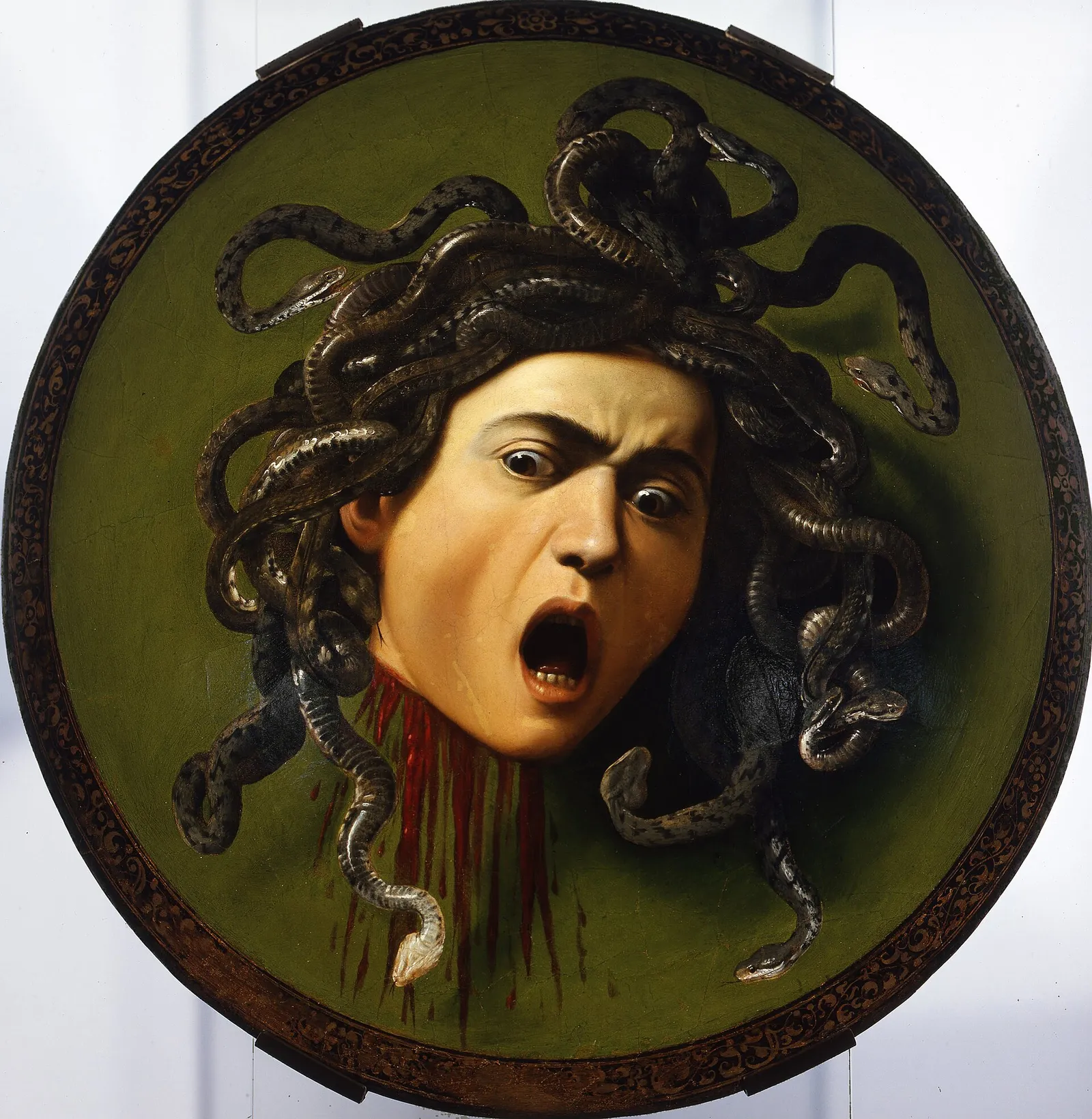
Caravaggio's Medusa shows the severed head of the mythical Gorgon, mouth open in a scream and hair alive with snakes. Painted in the 1590s on a round, convex shield, it is held by the Uffizi Gallery. At 60 by 55 cm it is a compact work that rewards close, careful looking.
Where to see it
Medusa is in the collection of the Uffizi Gallery, which is also its listed location. Display arrangements, temporary closures and loans can change, so check the Uffizi Gallery's official website for the painting's current display status before you plan your visit. Booking information and opening hours are also best confirmed there.
What to look for in person
A face on a curved surface
This image is painted on a round, convex shield rather than a flat panel or canvas on a stretcher. Look at it first from slightly to one side, then step to the front. The head seems to push forward, while the plain background reads as almost flat. Caravaggio worked against the real curve of the support, using light and shading so that the surface can appear less rounded than it is. Notice how the light falls from one side, modelling the brow, cheeks and open mouth.
The moment after the blow
Look at the base of the neck, where streams of blood fall as though still moving. The face has not yet gone slack: the brows are raised, the eyes are wide and the mouth is open in a cry. Caravaggio chose an instant when Medusa still seems aware of what has happened, rather than showing a calm, decorative mask. Let your eye travel from the staring eyes down to the blood, and the shield reads like a single second of a story caught in paint.
Snakes instead of hair
The snakes that replace Medusa's hair are painted one by one, twisting in different directions, some with open mouths. Small highlights pick out their bodies, and several curl over others, building depth across a small surface. Together they form a dark, restless crown around the pale face. Compare the agitation of the snakes with the clean, circular edge of the shield. Because the work measures 60 by 55 cm, it is worth standing reasonably close, within the museum's rules, to follow these details.
About the painting
In Greek myth, Medusa was a Gorgon whose gaze turned anyone who looked at her to stone. The hero Perseus approached her by watching her reflection in a polished shield, cut off her head, and later gave it to the goddess Athena, who set it on her own shield or aegis as a protective emblem. A Medusa painted on a shield therefore echoes the story itself: the image becomes the kind of object that, in myth, carried her terrifying face. Caravaggio painted this work in the 1590s, during the early part of his career in Rome. It is widely accepted that the shield was commissioned by his patron Cardinal Francesco Maria del Monte as a gift for Ferdinando I de' Medici, Grand Duke of Tuscany, which explains how it came into the Medici collections now associated with the Uffizi Gallery. It was a ceremonial object made for display, not for use in battle. What sets the work apart from many earlier treatments of the subject is its directness. Instead of a stylised emblem, Caravaggio presents a living face at the instant of death, with strong light, sharp contrasts and a close attention to physical detail that would become central to his later religious paintings. Another version of the subject by Caravaggio is known, held outside the Uffizi. For visitors, the key is to take time with the object as an object: its round format, its curve, and the way the painted head seems to project out from the shield. Viewed in person, the tension between the real surface and the painted illusion is much easier to appreciate than in reproductions.
Key facts
| Artist | Caravaggio |
|---|---|
| Date | 1590s |
| Size | 60 × 55 cm |
| Medium | oil paint, canvas |
| Collection | Uffizi Gallery |
How to visit: Uffizi Gallery
Florence, Italy · Museum guide
| Opening hours | Tue–Sun 08:15–18:30 (visitors leave by 18:30) |
|---|---|
| Closed | Mondays, 1 January and 25 December. |
| Last entry | Ticket office closes at 17:30. |
| Admission | Regular, bought on the day EUR 25 Regular, bought in advance EUR 29 Regular, entry from 16:00 (from 1 January 2026) EUR 16 Reduced (EU citizens aged 18–25; citizens of Switzerland, Norway, Liechtenstein, Uruguay etc.; ID required) EUR 2 Under 18 free (under 12s must be accompanied) Uffizi + Vasari Corridor EUR 43 on the day / EUR 47 in advance; named ticket, reservation required, non-refundable PassePartout 5 days (Uffizi, Pitti Palace, Boboli) EUR 40 (EUR 58 with Vasari Corridor) Audio guide EUR 6 |
| Free entry | Free for under-18s; disabled visitors plus one companion; tour guides and interpreters, ICOM members, certain journalists, and university teachers/students on the official list. Admission is free on the first Sunday of each month (national museums), when reservations are not possible. |
| Booking | Reservation is not required, except for the Uffizi + Vasari Corridor ticket, which must be reserved. |
Restoration and rearrangement works mean some rooms are temporarily closed and some artworks are not on display. A staff assembly on 11–12 November 2026 may change opening times.
Official ticket page
Official website
View on map
Hours and prices can change. Please check the official website before you go. (Checked on: 2026-11-12)
More by Caravaggio
 The Fortune Teller
 Bacchus — Uffizi Gallery
 Basket of Fruit
 Self-Portrait as Bacchus — Galleria Borghese
 Boy Peeling Fruit
 The Fortune Teller — Louvre Museum
 Boy with a Basket of Fruit — Galleria Borghese
 Saint Catherine of Alexandria — Thyssen-Bornemisza Museum
 David with the Head of Goliath — Galleria Borghese
 Penitent Magdalene
 Supper at Emmaus — National Gallery
 Amor Vincit Omnia — Gemäldegalerie Berlin