Art! Art! Art! › Works
The Fortune Teller
 Caravaggio, 1594
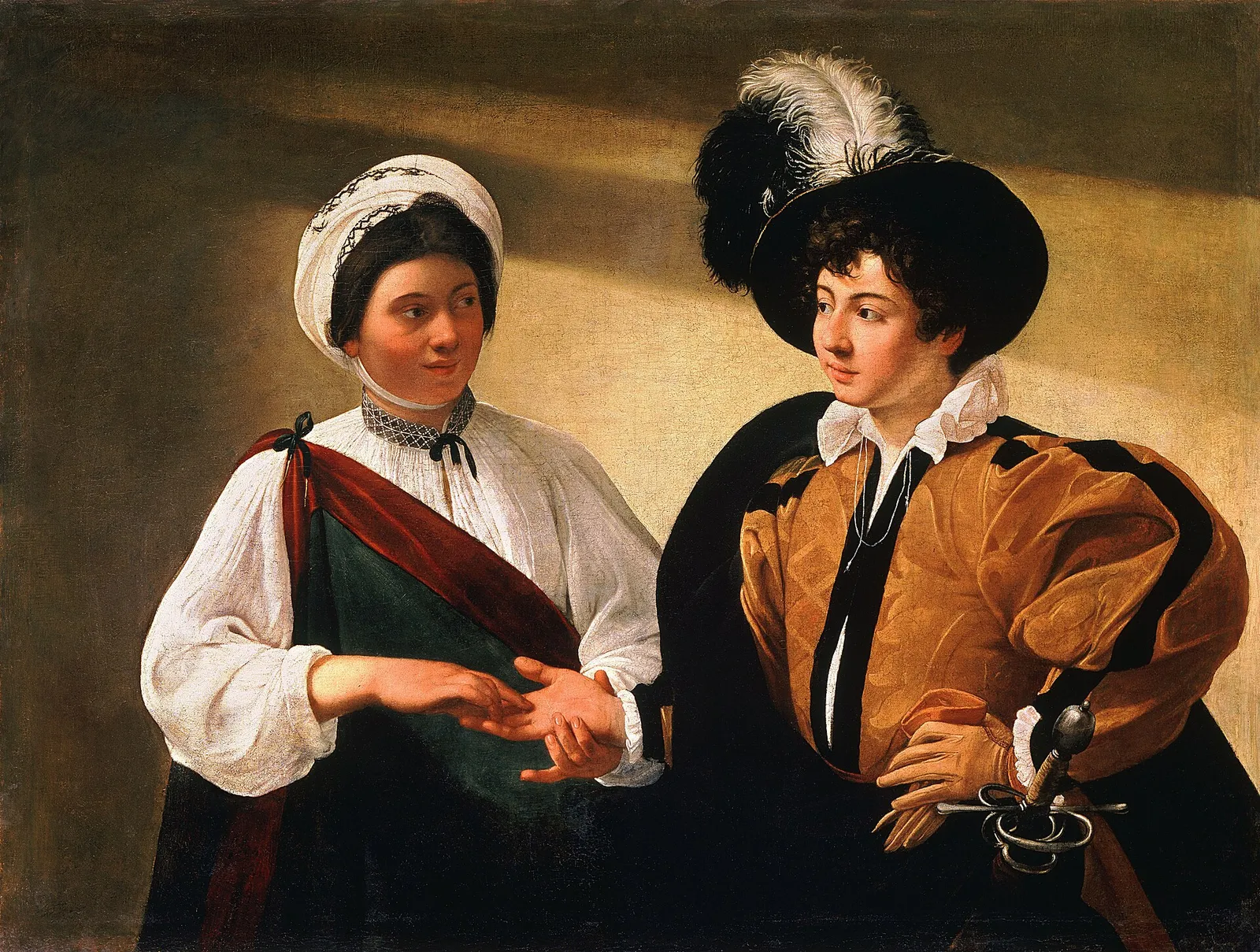
Caravaggio's The Fortune Teller is in the collection of the Department of Paintings of the Louvre, at the Louvre Museum. Dated 1594 in the fact sheet, this canvas shows a young fortune teller reading a well-dressed youth's palm. It is an early work and an example of the everyday street scenes Caravaggio painted in Rome.
Where to see it
The Fortune Teller belongs to the Department of Paintings of the Louvre and is held at the Louvre Museum. The recorded location is Room 712. Works can move between rooms, go into storage or travel on loan, so check the Louvre Museum's official website for the painting's current display status and room before you visit. The canvas measures 99 cm high by 131 cm wide. That is a moderate size, so stand fairly close to see the small gestures that carry the story.
What to look for in person
Watch the hands
The story is told through hands. The young woman holds the youth's palm as if reading his future. Look closely at her fingers: while she gazes up at him, she is generally understood to be easing a ring from his finger. Spend a moment following her hand and then his face. He seems absorbed in her attention and unaware of what she is doing. The painting works on the gap between what the youth sees and what the viewer is allowed to notice.
Two faces, one exchange of glances
Only two half-length figures fill the canvas, set close to the picture's front edge, so the encounter feels near and immediate. Compare their expressions. The fortune teller meets the young man's eyes with a calm, engaging look. He returns her gaze with a mix of curiosity and self-assurance. There are no other characters, no landscape and no props beyond clothing. All the meaning rests on this exchange of looks, which invites you to read the scene as closely as she pretends to read his palm.
Light, costume and a plain wall
Notice how simple the background is: a mostly bare wall crossed by light. That plainness pushes the figures forward and keeps your attention on them. Then look at the surfaces. The youth wears a plumed hat, a sword and fine clothes. The woman has a wrapped headcloth and a shawl knotted at her shoulder. Caravaggio paints these fabrics with care, and the light picks out faces, hands and cloth. This careful observation of ordinary people is characteristic of his early Roman work.
About the painting
The Fortune Teller belongs to the early part of Caravaggio's career, when he was working in Rome and painting half-length scenes of everyday life. Here a fashionably dressed young man has his palm read by a young woman, usually identified as a Romani fortune teller. While she seems to tell his fortune, she quietly removes his ring. The subject of a naive youth being tricked was a familiar moral theme. Caravaggio presents it without exaggeration, using real-looking people and a tightly cropped composition rather than an elaborate setting.
The fact sheet dates the work to 1594 and gives its size as 99 by 131 centimetres. It is part of the Department of Paintings of the Louvre at the Louvre Museum, with Room 712 recorded as its location.
For visitors, the painting rewards slow looking. At first glance it can read as a simple, friendly encounter between two young people. The real subject only becomes clear when you notice the action of the woman's fingers. This delayed discovery shapes the experience of standing in front of the canvas: you become a witness who sees more than the young man does.
Caravaggio returned to scenes of deception among young people in this period, and this subject was copied and imitated by other painters. Seeing the work in person is a good way to understand why his early genre scenes attracted attention. Look at the believable faces, the textures of clothing and the steady light against a bare wall. With these modest elements he builds a small drama that depends entirely on gesture and glance.
Key facts
| Artist | Caravaggio |
|---|---|
| Date | 1594 |
| Size | 99 × 131 cm |
| Medium | oil paint, canvas |
| Collection | Department of Paintings of the Louvre |
| Gallery | Room 712, Denon wing, level 1 Checked in the museum's open data on 2026-11-12 (galleries can change) Source |
How to visit: Louvre Museum
Paris, France · Museum guide
| Opening hours | Mon, Thu, Sat, Sun 09:00–18:00 Wed, Fri 09:00–21:00 (evening opening) Rooms are cleared 30 minutes before closing |
|---|---|
| Closed | Every Tuesday; 1 January, 1 May and 25 December. Other public holidays are open unless they fall on a Tuesday. |
| Last entry | 1 hour before closing |
| Admission | Adult (non-EEA visitors) EUR 32 Adult (EEA citizens and residents) EUR 22 Under 18 free (ID required) EEA citizens/residents under 26 free (photo ID; residents also need a residence permit of over 90 days) Audio guide rental EUR 6 (can be booked in advance online) Rates apply from 14 January 2026 |
| Free entry | Free for under-18s, EEA citizens/residents under 26, all visitors on the first Friday of the month after 18:00 (except July and August) and on 14 July, and disabled visitors plus one carer. Also free with proof for EEA art and art-history teachers, ICOM members, journalists, EEA job seekers and EEA residents on income support. |
| Booking | Entry is by timed slot, and booking in advance is recommended. |
The Cour Carrée entrance is currently closed. On Thursday 12 November 2026 the museum may open later and some exhibition rooms may remain closed.
Official ticket page
Official website
View on map
Hours and prices can change. Please check the official website before you go. (Checked on: 2026-11-11)
More by Caravaggio
 The Fortune Teller
 Bacchus — Uffizi Gallery
 Basket of Fruit
 Medusa — Uffizi Gallery
 Self-Portrait as Bacchus — Galleria Borghese
 Boy Peeling Fruit
 Boy with a Basket of Fruit — Galleria Borghese
 Saint Catherine of Alexandria — Thyssen-Bornemisza Museum
 David with the Head of Goliath — Galleria Borghese
 Penitent Magdalene
 Supper at Emmaus — National Gallery
 Amor Vincit Omnia — Gemäldegalerie Berlin