Art! Art! Art! › Works
Penitent Magdalene
 Caravaggio, 1593
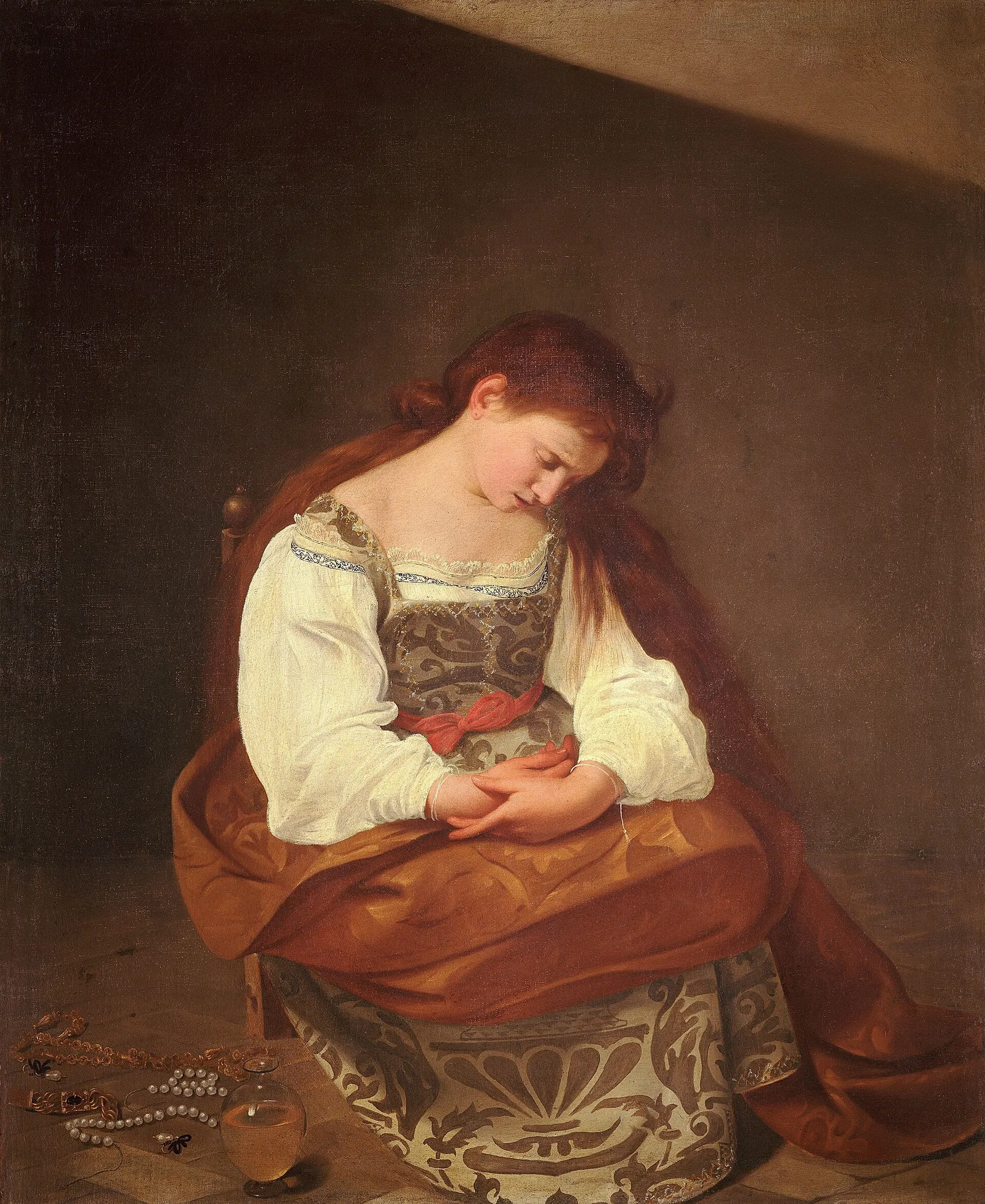
Caravaggio's Penitent Magdalene belongs to the Galleria Doria Pamphilj, where it is part of the gallery's collection. Dated to 1593 in our fact sheet, it shows Mary Magdalene as a young woman seated alone in a bare room, head bowed, with her jewels discarded on the floor beside her.
Where to see it
The Penitent Magdalene is held by the Galleria Doria Pamphilj and is located there. Display arrangements can change because of conservation work, rehanging or loans, so check the Galleria Doria Pamphilj's official website for current display status, opening hours and ticket information before you visit.
What to look for in person
The objects on the floor
Beside her on the floor lie a glass vessel of oil, a broken strand of pearls and scattered jewellery. These details turn a quiet domestic scene into a religious one: the discarded ornaments signal her renunciation of a worldly life, while the jar is the traditional attribute of Mary Magdalene, who anoints Christ in the Gospels. Look closely at how Caravaggio paints the glass and pearls with careful, still-life precision. Their small highlights are among the brightest touches in the picture and reward a close look.
A saint without a halo
Caravaggio presents the Magdalene as a young woman of his own time, in contemporary dress, seated on a low chair in an almost empty room. There is no halo, no heavenly light and no theatrical gesture. Her head is bowed, her hands rest in her lap, and a single tear runs down her cheek. Standing in front of the painting, notice how much of the meaning is carried by posture alone: the lowered head and folded hands convey remorse quietly, without the upturned eyes found in many earlier images of the saint.
Light on a plain wall
The setting is deliberately sparse. A band of light falls diagonally across the upper wall, and the figure is lit from one side against a largely neutral background. This is an early work, painted before the deep shadows of his later altarpieces, but his interest in a single, directed light source is already visible. Notice how the light picks out the patterned fabric of her dress, her hair and the objects on the floor, leading your eye down from her face to the possessions she has set aside.
About the painting
Penitent Magdalene is an early work by Caravaggio, dated 1593 in our fact sheet, and it is held by the Galleria Doria Pamphilj. The canvas is 122.5 cm high. It belongs to the period when the young painter was producing smaller pictures of single figures, often modelled from life, before he received the large public church commissions that later made his name.
The subject is Mary Magdalene, a follower of Christ whom Western tradition long described as a repentant sinner. Artists usually identified her through attributes such as a jar of ointment and long loose hair, and often showed her in a wilderness or in ecstatic prayer. Caravaggio takes a different approach. He sets the scene in an ordinary interior and paints the saint as a recognisable young woman of his day, without supernatural signs. The religious meaning is carried by a few quiet details: the jar, the abandoned jewellery and pearls, the tear on her cheek and her bowed, inward-turned pose.
This directness, grounding a sacred subject in everyday appearance, became central to Caravaggio's reputation and to his influence on later painters. For a visitor, the painting rewards slow looking rather than a quick glance. Take time with the contrast between the richly patterned dress and the plain surroundings, and with the way the light moves from her face down to the floor. It is a modest-sized, intimate picture, and viewing it in person makes it easier to appreciate how its emotional effect depends on restraint rather than drama.
Key facts
| Artist | Caravaggio |
|---|---|
| Date | 1593 |
| Size | 122.5 × 30 cm |
| Medium | oil paint, canvas |
| Collection | Galleria Doria Pamphilj |
How to visit: Galleria Doria Pamphilj
Rome, Italy
Hours and prices can change. Please check the official website before you go.
More by Caravaggio
 The Fortune Teller
 Bacchus — Uffizi Gallery
 Basket of Fruit
 Medusa — Uffizi Gallery
 Self-Portrait as Bacchus — Galleria Borghese
 Boy Peeling Fruit
 The Fortune Teller — Louvre Museum
 Boy with a Basket of Fruit — Galleria Borghese
 Saint Catherine of Alexandria — Thyssen-Bornemisza Museum
 David with the Head of Goliath — Galleria Borghese
 Supper at Emmaus — National Gallery
 Amor Vincit Omnia — Gemäldegalerie Berlin