Art! Art! Art! › Works
Saint Catherine of Alexandria
 Caravaggio, 1598
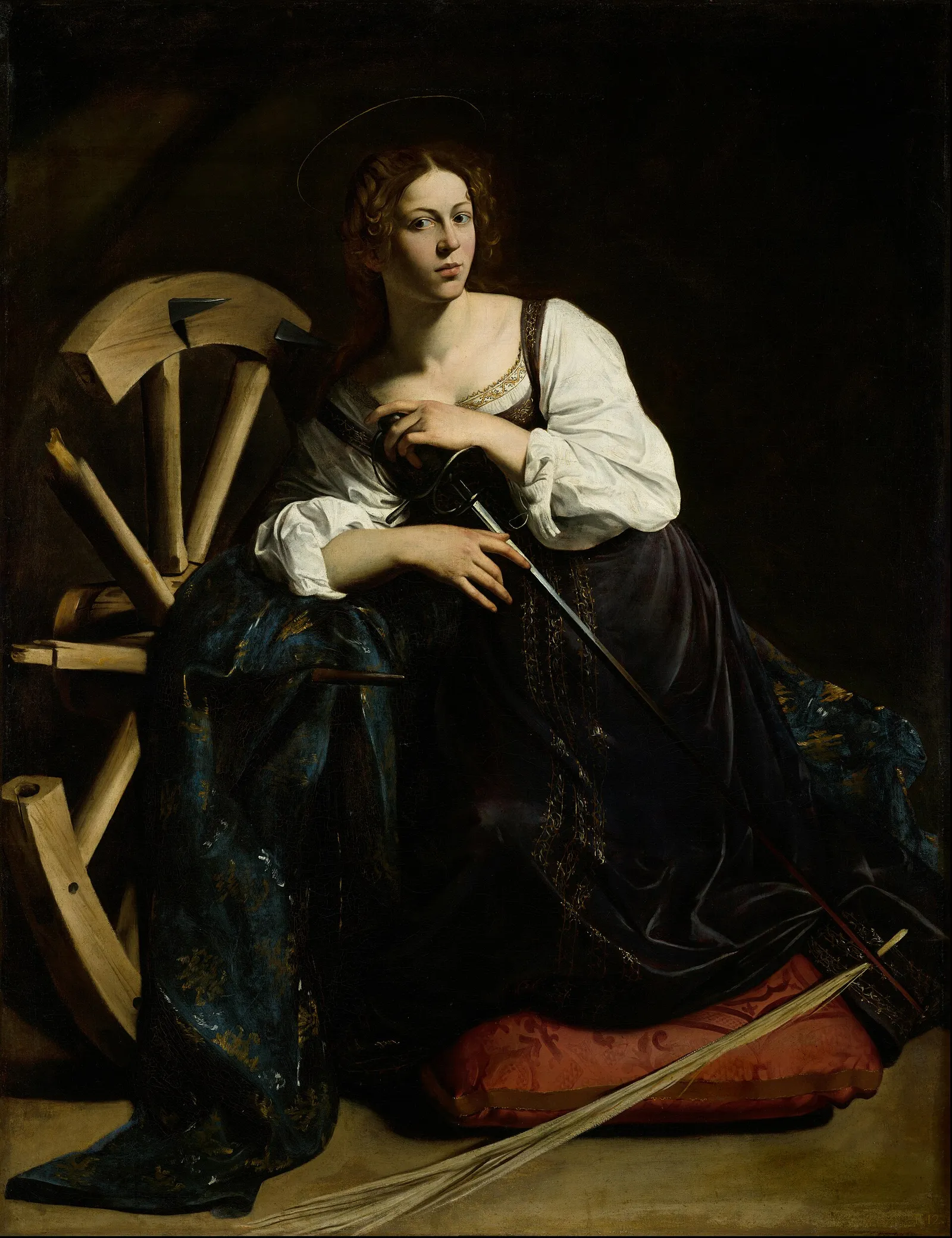
Caravaggio's Saint Catherine of Alexandria, dated 1598, is part of the collection of the Thyssen-Bornemisza Museum. At 173 by 133 cm, it presents a near life-size saint, lit sharply against darkness and surrounded by the objects of her martyrdom.
Where to see it
The painting is held by the Thyssen-Bornemisza Museum. Display arrangements can change because of rehangings, conservation work or loans, so check the museum's official website for current display status, opening hours and ticket information before you visit.
What to look for in person
The attributes of a martyr
Start by reading the objects around the saint. They identify her according to her legend. The large wooden wheel with spikes refers to the torture device that, according to tradition, broke before it could harm her. The blade she holds recalls her eventual execution by the sword. The palm frond lying near her is the conventional sign of martyrdom. Caravaggio places these symbols in the foreground as solid, tangible things. Notice how close they sit to the picture's edge, as if they were within the viewer's reach.
Light against darkness
Look at how the light falls. A strong beam from one side picks out the saint's face, hands and the folds of her clothing, and the background drops into deep shadow. This sharp contrast between light and dark is characteristic of Caravaggio's work around this period. Step back to see how it organises the composition, then move closer. You can see how the light models the wheel, the blade and the fabric, and how much of the canvas remains in darkness.
A saint painted from life
Caravaggio was known for painting directly from living models instead of idealised types. Look at the saint's face and the way she turns toward the viewer. Look at how her hands hold the blade, and at the weight of her heavy, rich garments and the cushion beneath her. The textures of cloth, wood and metal are painted with close attention. The figure is near life-size within a canvas of 173 by 133 cm, so standing at a normal viewing distance gives a sense of physical presence.
About the painting
Saint Catherine of Alexandria was painted by Caravaggio and is dated 1598. It belongs to the collection of the Thyssen-Bornemisza Museum. The canvas measures 173 cm high by 133 cm wide, a scale that allows the saint to appear close to life-size.
Catherine was one of the most frequently depicted virgin martyrs in European art. According to her legend, she was a learned young woman of Alexandria who refused to renounce her Christian faith. She was condemned to be broken on a spiked wheel, which shattered, and she was then beheaded. Painters traditionally identified her through the wheel, the sword and the palm of martyrdom, and Caravaggio includes all three.
What distinguishes this picture is how directly those conventions are handled. Instead of placing the saint in a heavenly or decorative setting, Caravaggio sets her against a dark, undefined space. The light falls strongly on the figure and her attributes. The objects are described with careful attention to their material, and the saint herself has the look of a real person observed in the studio, an approach for which the artist became well known.
The work dates from the years when Caravaggio was establishing his reputation in Rome. In this period his painting moved toward the dramatic lighting and naturalism that shaped much of his later religious work. For visitors, the painting offers a clear introduction to these qualities in a single, carefully balanced composition.
When you visit, allow time to view the painting both from a distance, to take in the overall pattern of light and shadow, and from closer up, to study the surfaces of fabric, wood and metal.
Key facts
| Artist | Caravaggio |
|---|---|
| Date | 1598 |
| Size | 173 × 133 cm |
| Medium | oil paint, canvas |
| Collection | Thyssen-Bornemisza Museum |
How to visit: Thyssen-Bornemisza Museum
Madrid, Spain · Museum guide
| Opening hours | Mon 12:00–16:00 (1 Sep–30 Jun, collection only, free) Tue, Wed, Thu, Fri, Sun 10:00–19:00 (1 Sep–30 Jun) Sat 10:00–23:00 (all year; 21:00–23:00 free for temporary exhibitions on level -1 and ground floor) Mon 12:00–16:00 (1 Jul–31 Aug, collection only, free) Tue–Fri 10:00–21:00 (1 Jul–31 Aug) Sun 10:00–19:00 (1 Jul–31 Aug) 24 and 31 December 10:00–15:00 (special hours) |
|---|---|
| Closed | Closed 1 January, 1 May and 25 December. Temporary exhibition hours vary (e.g. “The Freudian Universe of Dalí” is closed on Mondays). |
| Last entry | 30 minutes before closing |
| Admission | General EUR 14 (Permanent Collection, Carmen Thyssen Collection and current temporary exhibitions) Over 65s and pensioners EUR 10 (proof required) Students EUR 10 Groups (7 or more) EUR 12 per person Under 18s, unemployed, disability of 33% or more, Friends of the Museum: free Audio guide: ticket price + EUR 5.5 Paseo del Arte Pass (Thyssen + Prado + Reina Sofía) EUR 32.8 (one visit to each within 1 year) |
| Free entry | Free entry to the collection on Mondays 12:00–16:00, and to the temporary exhibitions on level -1 and the ground floor on Saturdays 21:00–23:00; no ticket required for either. “Soy de la Mutua” card holders can get up to two free same-day tickets at the ticket office. |
| Booking | No reservation is required and there is no timed entry. |
Official ticket page
Official website
View on map
Hours and prices can change. Please check the official website before you go. (Checked on: 2026-11-09)
More by Caravaggio
 The Fortune Teller
 Bacchus — Uffizi Gallery
 Basket of Fruit
 Medusa — Uffizi Gallery
 Self-Portrait as Bacchus — Galleria Borghese
 Boy Peeling Fruit
 The Fortune Teller — Louvre Museum
 Boy with a Basket of Fruit — Galleria Borghese
 David with the Head of Goliath — Galleria Borghese
 Penitent Magdalene
 Supper at Emmaus — National Gallery
 Amor Vincit Omnia — Gemäldegalerie Berlin