Art! Art! Art! › Works
Supper at Emmaus
 Caravaggio, 1601
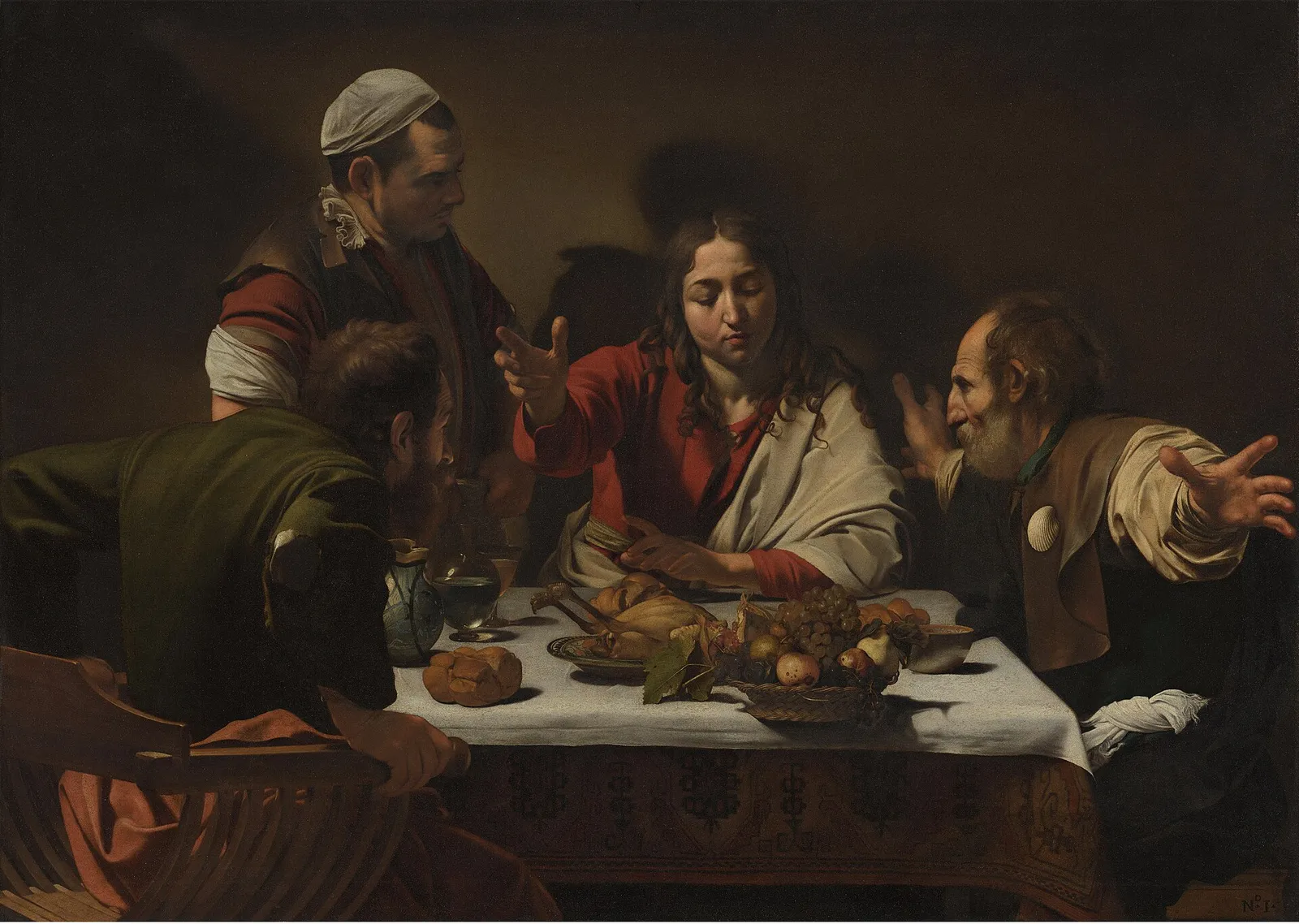
Caravaggio's Supper at Emmaus, dated 1601, is in the collection of the National Gallery. It shows the moment two disciples realise that the stranger sharing their meal is the risen Christ, and it is staged so that their surprise seems to spill out toward the viewer.
Where to see it
Supper at Emmaus belongs to the National Gallery, where the fact sheet lists it in Room 32, Baroque Splendour: Italian Painting 1600–1700. Displays change, and works can be moved, taken off view for conservation or lent elsewhere, so check the National Gallery's official website for the painting's current display status and the gallery's opening hours before you visit.
What to look for in person
Gestures that break the picture plane
Stand in front of the painting and follow the two disciples. The one on the right throws his arms wide in a sharply foreshortened gesture, so that one hand seems to come toward you and the other recedes into the shadow. The one on the left grips the arms of his chair as if about to spring up, and the torn elbow of his sleeve is painted with plain realism. Caravaggio uses these movements to pull you into the scene, as though you are sitting at the near edge of the table.
A beardless Christ and an unaware innkeeper
Look at the central figure. Caravaggio shows Christ as a young, beardless man, an unusual choice that departs from the familiar bearded type and helps explain why his companions did not recognise him at first. His hand is raised over the bread in blessing, which is the moment of recognition in the Gospel account. Compare this with the standing innkeeper, who looks on calmly. He has not understood what is happening, and his stillness sets off the disciples' astonishment.
The still life on the table
Lower your eyes to the table. The basket of fruit sits at the very edge, appearing to overhang it, and its shadow falls across the cloth, inviting you to reach out and steady it. Nearby you can find bread, a roast bird, a glass carafe and a jug, each catching the light differently. Caravaggio was admired for still-life painting, and these objects show how closely he observed texture, reflection and shadow. Notice too how the strong light from the upper left models faces and objects against a dark background.
About the painting
Supper at Emmaus illustrates an episode from the Gospel of Luke. After the Crucifixion, two disciples walking to the village of Emmaus meet a stranger and invite him to eat with them. When he blesses and breaks the bread, they recognise him as the risen Christ, and he then vanishes from their sight. Caravaggio chose the instant of recognition, the split second before understanding turns into action.
The painting, dated 1601, belongs to the period when Caravaggio was working in Rome and developing the style that made his reputation. Several features typical of that style are on show here. The figures are ordinary-looking people in everyday clothes, set close to the front of the picture. The background is dark and almost empty, and a strong, directed light picks out faces, hands and objects, creating sharp contrasts between light and shadow. This dramatic lighting, often called chiaroscuro, became highly influential among painters across Europe in the decades that followed.
The disciple on the right wears a scallop shell, an emblem associated with pilgrims, a detail that fits the story of travellers on the road. The arrangement around the table is designed to involve the viewer, with the open space at the front edge acting almost as a seat left for us.
When you visit, give yourself time to step back to take in the whole composition and then move closer to study the still life and the handling of the fabrics and faces. It is worth comparing it with other Italian paintings of the 1600s in the same part of the gallery to see how Caravaggio's approach to light and realism was taken up by other artists.
Key facts
| Artist | Caravaggio |
|---|---|
| Date | 1601 |
| Size | 196.2 × 141 cm |
| Medium | oil paint, canvas |
| Collection | National Gallery |
How to visit: National Gallery
London, United Kingdom · Museum guide
| Opening hours | Mon–Thu, Sat, Sun 10:00–18:00 Fri 10:00–21:00 (Friday late) |
|---|---|
| Closed | 24–26 December and 1 January. |
| Admission | General admission (collection) free; donations invited Some exhibitions are charged (e.g. Renoir and Love, until 31 Jan 2027) |
| Free entry | General admission is always free. |
| Booking | No reservation or timed entry is required. Free timed booking gives fast-track entry. |
Building work and improvements are under way: some rooms are closed and some paintings have moved, so check the floorplans or collection search before visiting. A new Research Centre is due to open in 2028. On 17 November only, some east wing rooms and the Espresso Bar close from 16:00.
Official ticket page
Official website
View on map
Hours and prices can change. Please check the official website before you go. (Checked on: 2026-11-11)
More by Caravaggio
 The Fortune Teller
 Bacchus — Uffizi Gallery
 Basket of Fruit
 Medusa — Uffizi Gallery
 Self-Portrait as Bacchus — Galleria Borghese
 Boy Peeling Fruit
 The Fortune Teller — Louvre Museum
 Boy with a Basket of Fruit — Galleria Borghese
 Saint Catherine of Alexandria — Thyssen-Bornemisza Museum
 David with the Head of Goliath — Galleria Borghese
 Penitent Magdalene
 Amor Vincit Omnia — Gemäldegalerie Berlin