Art! Art! Art! › Works
The Cardsharps
 Caravaggio, 1590s
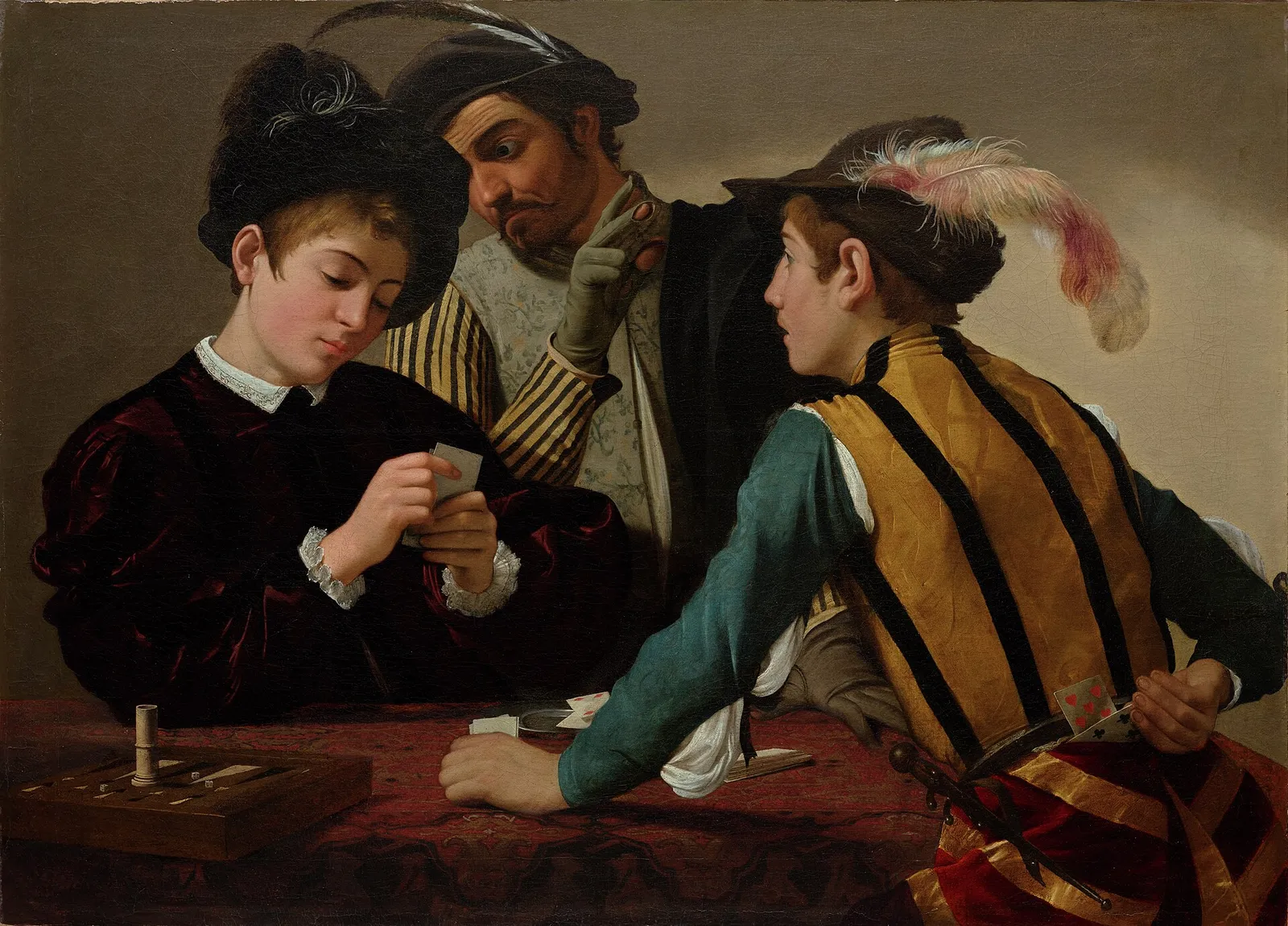
Caravaggio's The Cardsharps, painted in the 1590s, is in the collection of the Kimbell Art Museum. The canvas shows a card game in which a naive young player is being cheated by two accomplices, and the trick unfolds in plain view for the viewer to discover.
Where to see it
The Cardsharps belongs to the Kimbell Art Museum, which is also listed as its location. Works in museum collections can be moved for conservation, rotation or loans, so check the Kimbell Art Museum's official website for current display status, opening hours and ticketing before you visit.
What to look for in person
Follow the hands
Start with the hands, because they tell the story. The older man standing behind the young victim raises his fingers in a signal to his partner across the table, telling him what cards the victim holds. Look closely at his glove: the fingertips are worn through, a detail often read as a sign of a practised cheat who needs a sensitive touch. Then look at the seated cheat, whose hand reaches behind his back. The whole deception can be read gesture by gesture.
The hidden cards
Look at the back of the young cheat on the right. Tucked into his belt, out of sight of his opponent but visible to us, are extra playing cards ready to be swapped into the game. Caravaggio places the viewer in a privileged position: we can see what the victim cannot. Notice also the dagger at the cheat's hip, a quiet reminder that this is not an innocent pastime. Standing in front of the canvas, take time to find each of these small clues yourself.
Faces, costume and light
Compare the three faces. The victim, absorbed in his cards, has a smooth, unsuspecting expression. The older accomplice leans in with a sharp, intent look, while the young cheat glances toward his partner. Caravaggio paints the striped and slashed costumes, feathered hats and the table carpet with careful attention to texture. Light falls from the left across the figures against a plain background, so the group stands out clearly. At 94.2 by 130.9 cm, the figures are shown close to the picture plane, as if we were standing at the table.
About the painting
The Cardsharps is an early work by Caravaggio, dated to the 1590s. It belongs to a type of picture that he helped make popular: a scene of everyday life, showing ordinary or slightly disreputable characters at close range, rather than a religious or mythological subject. Here the subject is a card game rigged against a well-dressed, inexperienced young man. Two tricksters work together, one signalling from behind the victim and the other preparing to slip in a hidden card. The painting asks the viewer to notice the deceit, turning looking itself into part of the experience.
The composition is compact. Three half-length figures are grouped around a table covered with a patterned carpet, with a gaming board at its edge. The plain background keeps attention on the figures, their gestures and the exchange of glances. Caravaggio's interest in close observation shows in the fabrics, feathers and worn glove, and in the way light models the faces.
The painting is widely associated with Cardinal Francesco Maria del Monte, an important early patron of Caravaggio, who is generally said to have acquired it. The theme of cheats and their victims was taken up by many later painters, and this canvas is often cited as an influential example of the subject.
When you visit, give yourself time to read the painting slowly: begin with the victim's cards, move to the signalling hand above him, and finish with the hidden cards behind the cheat's back. The canvas measures 94.2 by 130.9 cm, so it rewards viewing both from a few steps back and close up.
Key facts
| Artist | Caravaggio |
|---|---|
| Date | 1590s |
| Size | 94.2 × 130.9 cm |
| Medium | oil paint, canvas |
| Collection | Kimbell Art Museum |
How to visit: Kimbell Art Museum
Fort Worth, United States
Hours and prices can change. Please check the official website before you go.
More by Caravaggio
 The Fortune Teller
 Bacchus — Uffizi Gallery
 Basket of Fruit
 Medusa — Uffizi Gallery
 Self-Portrait as Bacchus — Galleria Borghese
 Boy Peeling Fruit
 The Fortune Teller — Louvre Museum
 Boy with a Basket of Fruit — Galleria Borghese
 Saint Catherine of Alexandria — Thyssen-Bornemisza Museum
 David with the Head of Goliath — Galleria Borghese
 Penitent Magdalene
 Supper at Emmaus — National Gallery