Art! Art! Art! › Works
Death of the Virgin
 Caravaggio, 1600s
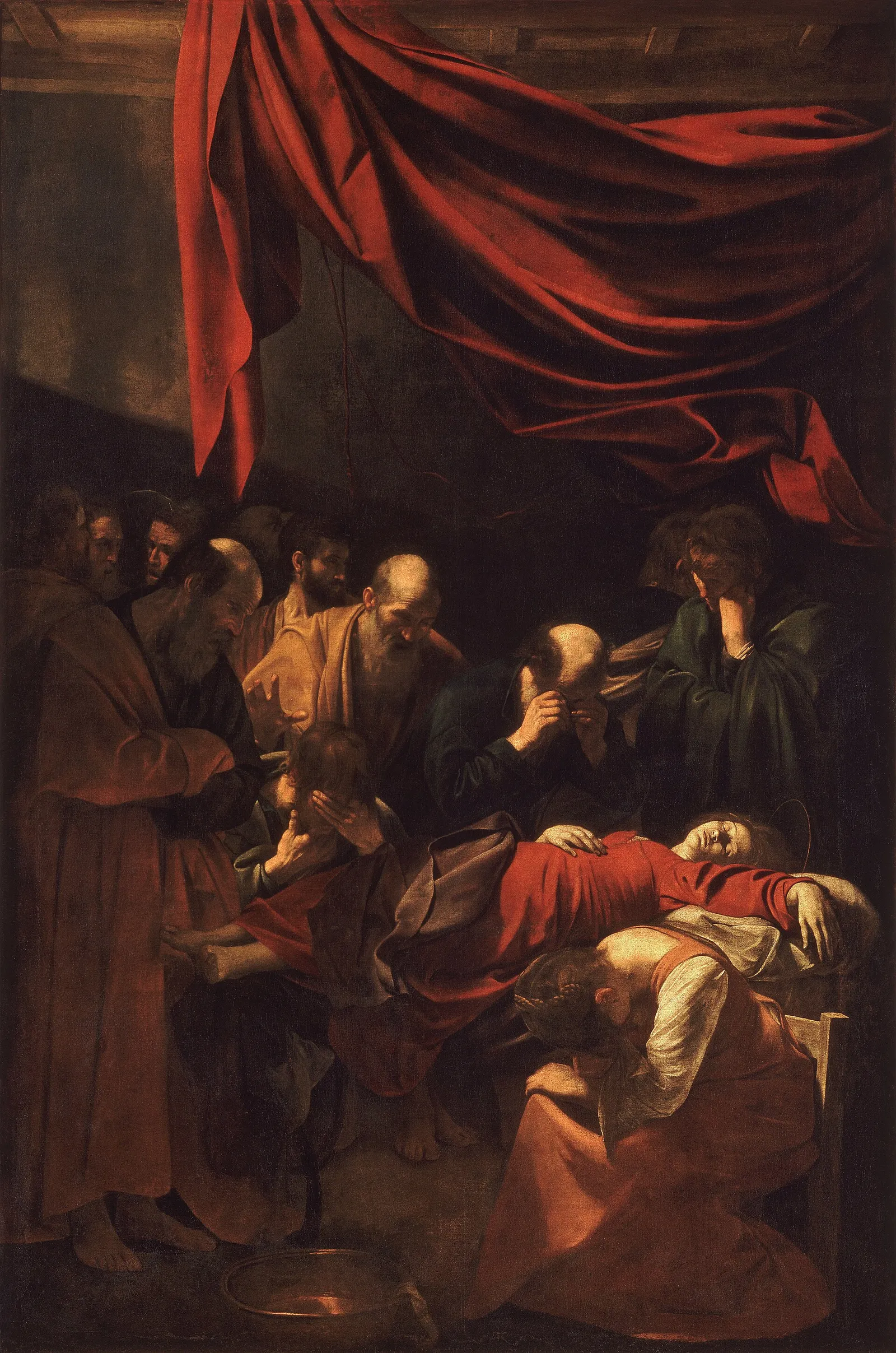
Caravaggio's Death of the Virgin belongs to the Department of Paintings of the Louvre and is held at the Louvre Museum. Painted in the 1600s and measuring 369 by 245 centimetres, it treats the death of Mary not as a heavenly triumph but as a quiet, human scene of grief in a darkened room.
Where to see it
Death of the Virgin is in the collection of the Department of Paintings of the Louvre, at the Louvre Museum. Display arrangements at large museums can change because of rehangings, conservation work or loans, so check the Louvre Museum's official website for the painting's current display status, opening hours and ticketing before you visit. At 369 cm high and 245 cm wide, it is a large work: give yourself time to view it first from a distance to take in the whole composition, then move closer to study the faces, hands and fabrics.
What to look for in person
The red drapery overhead
Before looking at any figure, look up. A great swag of deep red cloth hangs across the top of the picture, filling much of the upper space. It works like a theatre curtain, framing the scene below and drawing your eye downward toward Mary. Notice how the light catches its folds while the room around it stays dark. The red is echoed in Mary's own dress, tying the upper and lower halves of the composition together. Stand back to see how this single shape organises the whole vertical format of the painting.
Mary as an ordinary woman
Mary lies stretched out on a simple support, her body slack, one arm falling across her. Her face is pale and her bare feet extend toward the edge of the bed, a detail that viewers often notice. There are no angels, no opening heavens and no grand display of glory; only a thin, barely visible halo marks her identity. Look closely at how plainly she is presented, in an unadorned dress. This directness is central to why the painting has drawn both admiration and controversy since it was made.
Grief shown through gesture
Caravaggio lets bodies and hands express mourning. In the foreground, Mary Magdalene sits hunched on a low chair, head buried in her hands, beside a basin of water. Behind and around Mary, the apostles gather, some bowing their heads, some covering their faces, others staring. Follow the strong light falling from the upper left: it picks out bald heads, foreheads and hands against deep shadow. Move along the row of mourners and notice how each reacts differently, so the scene reads as a group of individuals rather than a single uniform pose.
About the painting
Death of the Virgin is a large religious painting by Caravaggio, dated to the 1600s and now part of the Department of Paintings of the Louvre at the Louvre Museum. It measures 369 centimetres high by 245 centimetres wide, a scale suited to an altarpiece, and that is what it was made to be. The painting was commissioned for a chapel in the church of Santa Maria della Scala in Trastevere, Rome, and it is widely recorded that the church rejected it. The reasons usually given relate to its unidealised treatment of the subject: Mary appears as a dead woman laid out in a bare room, rather than as a figure being taken up into heaven. For visitors, this context helps explain what is distinctive in front of the canvas. Caravaggio uses a dark setting and a sharply directed light to concentrate attention on a few elements: the hanging red cloth, Mary's pale body, and the faces and hands of the mourners. The emotional tone is restrained and heavy, carried by posture rather than by dramatic action. After its rejection, the painting passed into other hands; it is generally recorded that Peter Paul Rubens recommended its purchase to the Duke of Mantua, and it later entered royal collections before reaching the Louvre. Seen today, it is a useful work for understanding Caravaggio's approach to religious subjects: sacred stories set among recognisable people, with light and shadow doing much of the storytelling. Allow time to look slowly; the painting rewards close attention to small details as well as its overall design.
Key facts
| Artist | Caravaggio |
|---|---|
| Date | 1600s |
| Size | 369 × 245 cm |
| Medium | oil paint, canvas |
| Collection | Department of Paintings of the Louvre |
| Gallery | Room 712, Denon wing, level 1 Checked in the museum's open data on 2026-11-12 (galleries can change) Source |
How to visit: Louvre Museum
Paris, France · Museum guide
| Opening hours | Mon, Thu, Sat, Sun 09:00–18:00 Wed, Fri 09:00–21:00 (evening opening) Rooms are cleared 30 minutes before closing |
|---|---|
| Closed | Every Tuesday; 1 January, 1 May and 25 December. Other public holidays are open unless they fall on a Tuesday. |
| Last entry | 1 hour before closing |
| Admission | Adult (non-EEA visitors) EUR 32 Adult (EEA citizens and residents) EUR 22 Under 18 free (ID required) EEA citizens/residents under 26 free (photo ID; residents also need a residence permit of over 90 days) Audio guide rental EUR 6 (can be booked in advance online) Rates apply from 14 January 2026 |
| Free entry | Free for under-18s, EEA citizens/residents under 26, all visitors on the first Friday of the month after 18:00 (except July and August) and on 14 July, and disabled visitors plus one carer. Also free with proof for EEA art and art-history teachers, ICOM members, journalists, EEA job seekers and EEA residents on income support. |
| Booking | Entry is by timed slot, and booking in advance is recommended. |
The Cour Carrée entrance is currently closed. On Thursday 12 November 2026 the museum may open later and some exhibition rooms may remain closed.
Official ticket page
Official website
View on map
Hours and prices can change. Please check the official website before you go. (Checked on: 2026-11-11)
More by Caravaggio
 The Fortune Teller
 Bacchus — Uffizi Gallery
 Basket of Fruit
 Medusa — Uffizi Gallery
 Self-Portrait as Bacchus — Galleria Borghese
 Boy Peeling Fruit
 The Fortune Teller — Louvre Museum
 Boy with a Basket of Fruit — Galleria Borghese
 Saint Catherine of Alexandria — Thyssen-Bornemisza Museum
 David with the Head of Goliath — Galleria Borghese
 Penitent Magdalene
 Supper at Emmaus — National Gallery