Art! Art! Art! › Works
Crucifixion of Saint Peter
 Caravaggio, 1600
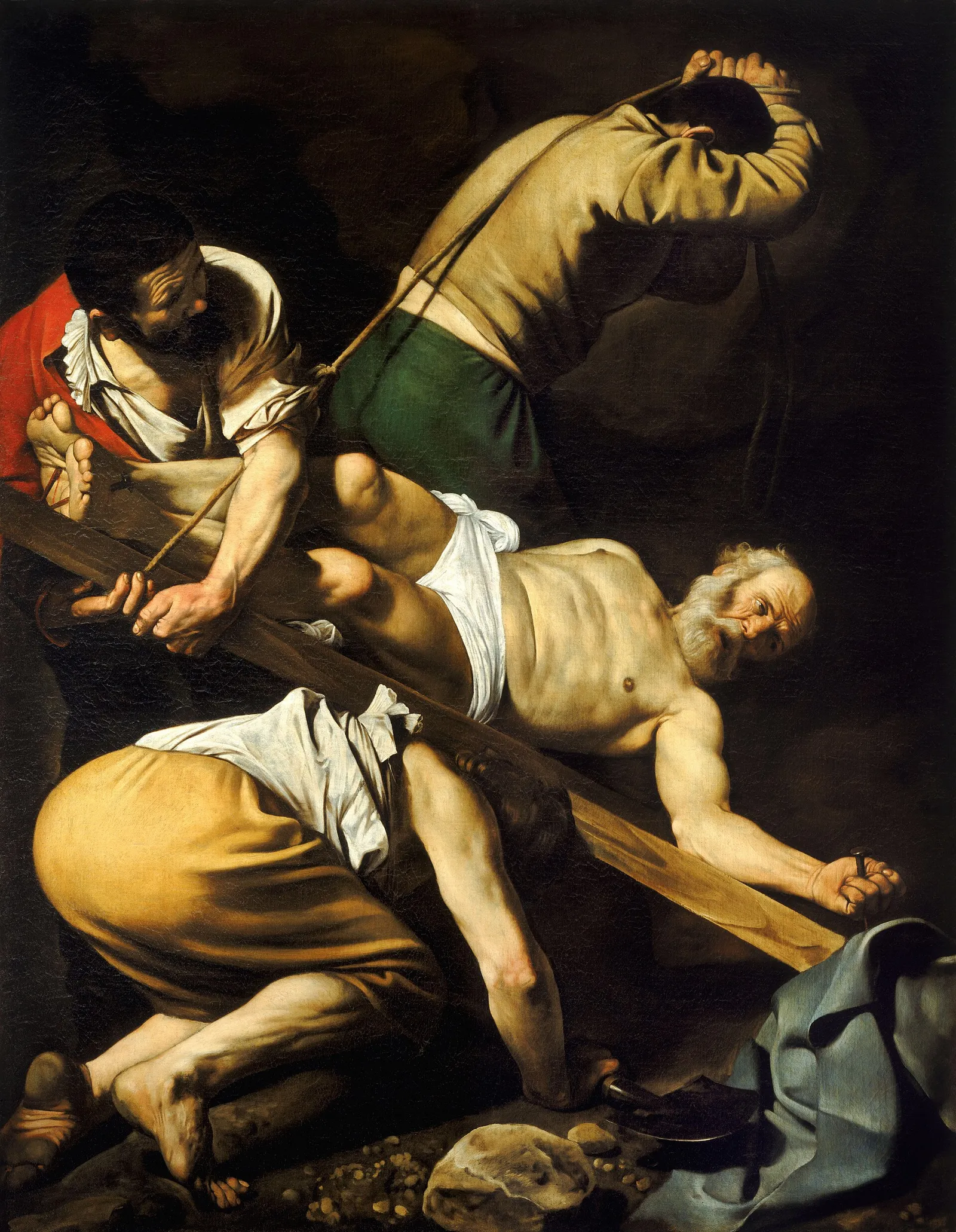
Caravaggio's Crucifixion of Saint Peter, dated 1600, belongs to the church of Santa Maria del Popolo, where it is in the Cerasi Chapel. The canvas captures the moment the elderly apostle's cross is hauled upright, and it rewards slow looking at close range.
Where to see it
The painting is held by Santa Maria del Popolo and is located in the Cerasi Chapel. Because this is a working church rather than a conventional museum, opening hours can change around services, ceremonies and conservation work. Check the church's official website or official visitor information for current access and display status before you go, and be respectful of worshippers while viewing.
What to look for in person
Peter's gaze
Start with the saint himself. Peter is already nailed to the cross, which is being turned upside down, a detail drawn from the tradition that he asked not to die in the same way as Christ. Rather than lying passive, he raises his head and shoulders against the pull of the wood. Notice his lined forehead, his grey beard and the tension in his neck. Caravaggio presents him as an old, physically vulnerable man, which makes his alertness all the more striking.
The hidden executioners
Three men do the work of raising the cross, and none of them shows a clear face. One pulls on a rope, one pushes with his back and shoulders, and one crouches underneath, bracing the beam. Look at how their bodies are turned away or shadowed: Caravaggio makes them into straining labourers rather than individual villains. In the foreground, the crouching figure's bare, soiled feet face the viewer, a plain, everyday detail typical of the artist's approach to sacred subjects.
Diagonals and darkness
Step back and follow the lines of the composition. The cross cuts across the canvas on a strong diagonal, and the figures press in around it, filling the frame with little space to spare. The background is almost entirely dark, so light falls selectively on Peter's pale body, the executioners' limbs and the rough wood. This sharp contrast between light and shadow, often called tenebrism, is central to Caravaggio's style. Notice also the rock and spade at the lower right, grounding the scene in a bare, earthly setting.
About the painting
Crucifixion of Saint Peter was painted by Caravaggio for the Cerasi Chapel in Santa Maria del Popolo, and the fact sheet gives its date as 1600. It measures 230 by 175 centimetres, a size that brings the life-sized figures close to the viewer's own scale in the confined space of a chapel. The commission came from Tiberio Cerasi, a papal official who acquired the chapel, and Caravaggio produced two paintings for it. Crucifixion of Saint Peter hangs on a side wall, paired with his Conversion of Saint Paul opposite, while the altarpiece, an Assumption of the Virgin, is by Annibale Carracci. Seeing these works together lets visitors compare two very different approaches to religious painting in the same small room. The subject pairs the two founding apostles of the church in Rome, Peter and Paul, at decisive moments in their lives. Caravaggio avoids the angels, crowds and heavenly light that often accompany martyrdom scenes. Instead he concentrates on physical effort and the weight of bodies: the mechanics of lifting a cross with a man fastened to it. The narrow, dark setting and the plain clothing of the executioners reflect his habit of placing sacred events among ordinary-looking people. When you stand in the chapel, take time to view the painting from different positions, as the angle of view changes how the diagonal of the cross reads, and compare it directly with the Saint Paul canvas facing it.
Key facts
| Artist | Caravaggio |
|---|---|
| Date | 1600 |
| Size | 230 × 175 cm |
| Medium | oil paint, canvas |
| Collection | Santa Maria del Popolo |
How to visit: Santa Maria del Popolo
Rome, Italy
Hours and prices can change. Please check the official website before you go.
More by Caravaggio
 The Fortune Teller
 Bacchus — Uffizi Gallery
 Basket of Fruit
 Medusa — Uffizi Gallery
 Self-Portrait as Bacchus — Galleria Borghese
 Boy Peeling Fruit
 The Fortune Teller — Louvre Museum
 Boy with a Basket of Fruit — Galleria Borghese
 Saint Catherine of Alexandria — Thyssen-Bornemisza Museum
 David with the Head of Goliath — Galleria Borghese
 Penitent Magdalene
 Supper at Emmaus — National Gallery