Art! Art! Art! › Works
Boy Bitten by a Lizard
 Caravaggio, 1590s
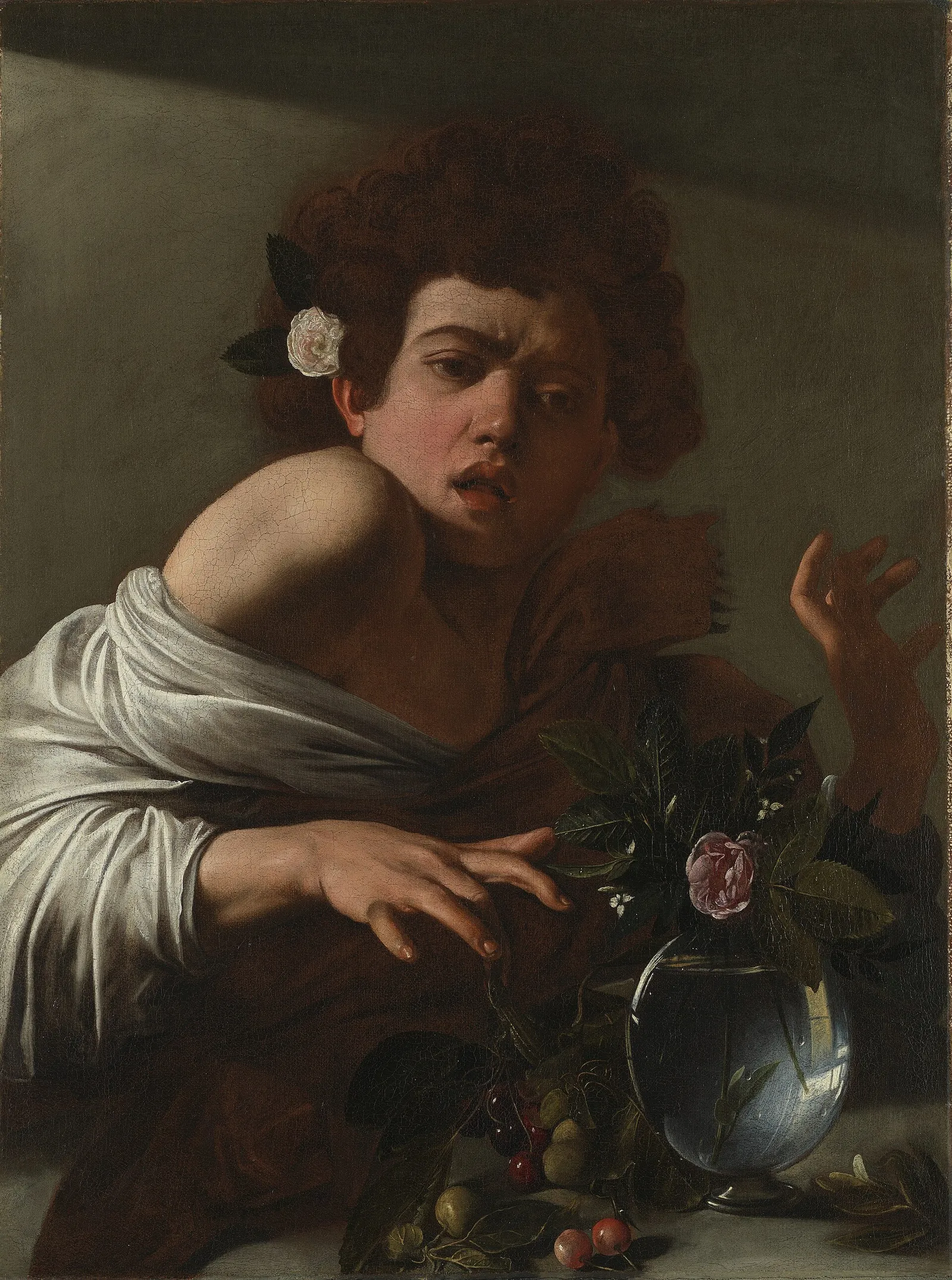
Caravaggio's Boy Bitten by a Lizard captures a split second of shock: a young man pulls back as a small lizard, hidden among fruit, bites his finger. Dating from the 1590s, the painting is in the collection of the National Gallery. At 66 by 49.5 cm, it is an intimate, close-up picture that rewards a slow look.
Where to see it
Boy Bitten by a Lizard is held by the National Gallery, which is listed as both its collection and its location. Paintings can be moved between rooms, lent to other institutions or taken off view for conservation, so check the National Gallery's official website for the current display status of this work before you visit. The picture is relatively small (66 x 49.5 cm), so plan to stand close to it to take in the details of the glass, the fruit and the boy's expression.
What to look for in person
The moment of recoil
Start with the boy's face and body. His brow tightens, his mouth opens, and his shoulder rises as he jerks away from the pain. Caravaggio does not show the scene before or after the bite, only the instant itself, as if the viewer has walked in at exactly the wrong moment. Notice how his hands are caught mid-movement rather than posed. Look for the lizard itself: it is easy to miss at first, half-hidden among the fruit, which mirrors the surprise the boy has just experienced.
The glass vase and its reflections
On the ledge in front of the boy stands a glass vase holding water and a flower. Take time with it, because it is one of the most closely observed passages in the picture. The glass is transparent yet clearly solid, and bright highlights sit on its curved surface. Art historians often point out that a window appears reflected in the glass, a detail that suggests the artist was studying real light in a real room. The water, the stems and the edge of the ledge seen through the glass are all carefully described.
Strong light against darkness
Step back slightly and notice how a strong light falls across the boy's bare shoulder, face and the white drapery, while the background stays dark and plain. This contrast pushes the figure forward and makes the gesture feel sudden and close. The same light picks out the fruit on the ledge and the flower tucked into his hair, giving each surface its own texture. This sharp, focused lighting became a hallmark of Caravaggio's work and is already clearly visible in this early painting.
About the painting
Boy Bitten by a Lizard dates from the 1590s, an early phase of Caravaggio's career when he was establishing himself in Rome. In these years he painted a number of half-length pictures of young men, often combined with carefully observed flowers, fruit and objects. Rather than presenting a religious or historical subject, this painting shows an everyday incident: a boy reaching towards fruit is unexpectedly bitten by a lizard hidden among it.
What makes the picture notable is its focus on a fleeting reaction. Earlier painters had depicted emotion, but Caravaggio here concentrates on an instant of physical surprise and pain, captured with close attention to the face, the gesture and the way the body flinches. The still-life elements are given the same careful scrutiny as the figure, from the transparency of the glass vase to the surfaces of the fruit.
The painting also shows Caravaggio's interest in working from a live model and in strong, directed light set against a dark background. These qualities, developed further in his later religious works, influenced many artists across Europe in the following decades.
Caravaggio is generally thought to have painted more than one version of this composition. The version described here is the one in the National Gallery's collection, measuring 66 by 49.5 cm. For visitors, the picture offers a compact introduction to the artist's early style: a single figure, a dramatic moment and a still life that repays close looking. Allow a few minutes in front of it to move between the boy's expression, the lizard and the reflections in the glass.
Key facts
| Artist | Caravaggio |
|---|---|
| Date | 1590s |
| Size | 66 × 49.5 cm |
| Medium | oil paint, canvas |
| Collection | National Gallery |
How to visit: National Gallery
London, United Kingdom · Museum guide
| Opening hours | Mon–Thu, Sat, Sun 10:00–18:00 Fri 10:00–21:00 (Friday late) |
|---|---|
| Closed | 24–26 December and 1 January. |
| Admission | General admission (collection) free; donations invited Some exhibitions are charged (e.g. Renoir and Love, until 31 Jan 2027) |
| Free entry | General admission is always free. |
| Booking | No reservation or timed entry is required. Free timed booking gives fast-track entry. |
Building work and improvements are under way: some rooms are closed and some paintings have moved, so check the floorplans or collection search before visiting. A new Research Centre is due to open in 2028. On 17 November only, some east wing rooms and the Espresso Bar close from 16:00.
Official ticket page
Official website
View on map
Hours and prices can change. Please check the official website before you go. (Checked on: 2026-11-11)
More by Caravaggio
 The Fortune Teller
 Bacchus — Uffizi Gallery
 Basket of Fruit
 Medusa — Uffizi Gallery
 Self-Portrait as Bacchus — Galleria Borghese
 Boy Peeling Fruit
 The Fortune Teller — Louvre Museum
 Boy with a Basket of Fruit — Galleria Borghese
 Saint Catherine of Alexandria — Thyssen-Bornemisza Museum
 David with the Head of Goliath — Galleria Borghese
 Penitent Magdalene
 Supper at Emmaus — National Gallery