Art! Art! Art! › Works
Venus and Mars
 Sandro Botticelli, 1485
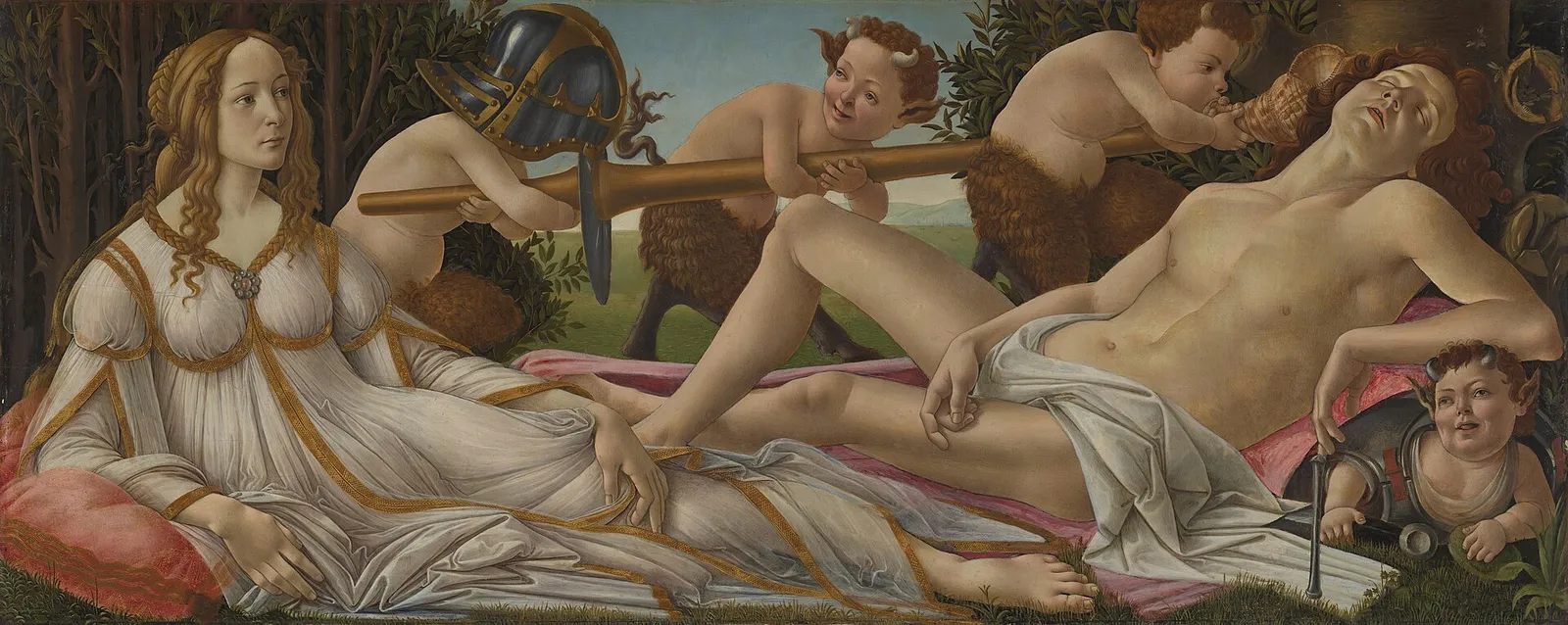
Sandro Botticelli's Venus and Mars, dated 1485, is in the collection of the National Gallery. The long, low panel shows the goddess of love awake and composed while the god of war lies in deep sleep, as small satyrs make off with his armour.
Where to see it
Venus and Mars belongs to the National Gallery. Its listed location is Room 62, The Family Palace: Painting in Florence 1400‒1500. Displays change, and works can be moved, rehung or lent, so check the National Gallery's official website for the painting's current display status before you plan your visit.
What to look for in person
The sleeping god and the watchful goddess
Stand back first and compare the two figures. Venus, on the left, reclines fully clothed in a pale gown, upright and alert, her gaze directed toward Mars. Mars, on the right, is sprawled almost naked, head tipped back, mouth slightly open, completely unconscious. The contrast is the heart of the picture: the god of war has been disarmed not by battle but by sleep, while love stays awake. Notice how Botticelli balances the composition, with the two bodies stretched along the length of the panel like mirror images in mood.
Satyrs at play
Move closer to find the small goat-legged satyrs, the painting's comic element. They have taken over Mars's gear: one wears his oversized helmet, others carry off his heavy lance, and one blows a conch shell close to his ear, yet he does not stir. Their mischief makes the theme easy to read without any text: war's weapons have become toys. Look at how lightly the satyrs are painted against the dark armour and how their busy movement contrasts with the stillness of the two gods.
A painting shaped for its setting
The format is unusual: the panel measures 69.2 by 173.4 cm, far wider than it is tall. Let your eye travel from left to right as you would along a frieze. The figures lie in a shallow space before a screen of trees, with only glimpses of sky and landscape behind, keeping attention on the foreground. Near Mars's head, look for the wasps buzzing around a hollow in a tree trunk, a small detail easily missed. Botticelli's clear outlines and flowing drapery are easiest to appreciate from close range.
About the painting
Venus and Mars was painted by Sandro Botticelli, one of the leading painters of fifteenth-century Florence, and is dated to 1485. It belongs to the same period of his career as his other celebrated mythological pictures, when classical gods and stories were increasingly chosen as subjects for private patrons in Florence alongside religious themes. The painting shows the Roman goddess of love, Venus, and the god of war, Mars, a pairing drawn from ancient literature in which the two were lovers. Rather than illustrating a single dramatic episode, Botticelli presents a calm, almost emblematic scene: love is awake and in control, while war lies helpless in sleep. The playful satyrs who steal and misuse Mars's weapons reinforce the idea that love can overcome strife. This reading, that love conquers war, is the most widely accepted interpretation of the picture. The painting's long horizontal shape is notable. At 69.2 by 173.4 cm, it is much wider than a typical altarpiece or portrait, and its format suggests it was made to be set into furniture or wall panelling in a domestic interior rather than hung as a free-standing picture. Its display in a room devoted to painting for Florentine family palaces reflects that domestic context. For visitors, the work rewards slow looking. The figures are defined by Botticelli's characteristic crisp, rhythmic outlines, and the contrast between Venus's composed pose and Mars's slack body is both elegant and gently humorous. Allow time to examine the satyrs, the armour and the small natural details in the background before stepping back to take in the whole composition.
Key facts
| Artist | Sandro Botticelli |
|---|---|
| Date | 1485 |
| Size | 69.2 × 173.4 cm |
| Medium | oil paint, poplar panel, egg tempera |
| Collection | National Gallery |
How to visit: National Gallery
London, United Kingdom · Museum guide
| Opening hours | Mon–Thu, Sat, Sun 10:00–18:00 Fri 10:00–21:00 (Friday late) |
|---|---|
| Closed | 24–26 December and 1 January. |
| Admission | General admission (collection) free; donations invited Some exhibitions are charged (e.g. Renoir and Love, until 31 Jan 2027) |
| Free entry | General admission is always free. |
| Booking | No reservation or timed entry is required. Free timed booking gives fast-track entry. |
Building work and improvements are under way: some rooms are closed and some paintings have moved, so check the floorplans or collection search before visiting. A new Research Centre is due to open in 2028. On 17 November only, some east wing rooms and the Espresso Bar close from 16:00.
Official ticket page
Official website
View on map
Hours and prices can change. Please check the official website before you go. (Checked on: 2026-11-11)
More by Sandro Botticelli
 Saint Augustine
 The Story of Nastagio Degli Onesti, part one — Museo del Prado
 Coronation of the Virgin — Uffizi Gallery
 The Birth of Venus — Uffizi Gallery
 Madonna and Child with Five Angels — Louvre Museum
 Punishment of the Rebels
 Madonna of the Pomegranate — Uffizi Gallery
 Madonna of the Magnificat — Uffizi Gallery
 Adoration of the Magi — Uffizi Gallery
 Primavera — Uffizi Gallery
 The Mystical Nativity — National Gallery