Art! Art! Art! › Works
Adoration of the Magi
 Sandro Botticelli, 1470s
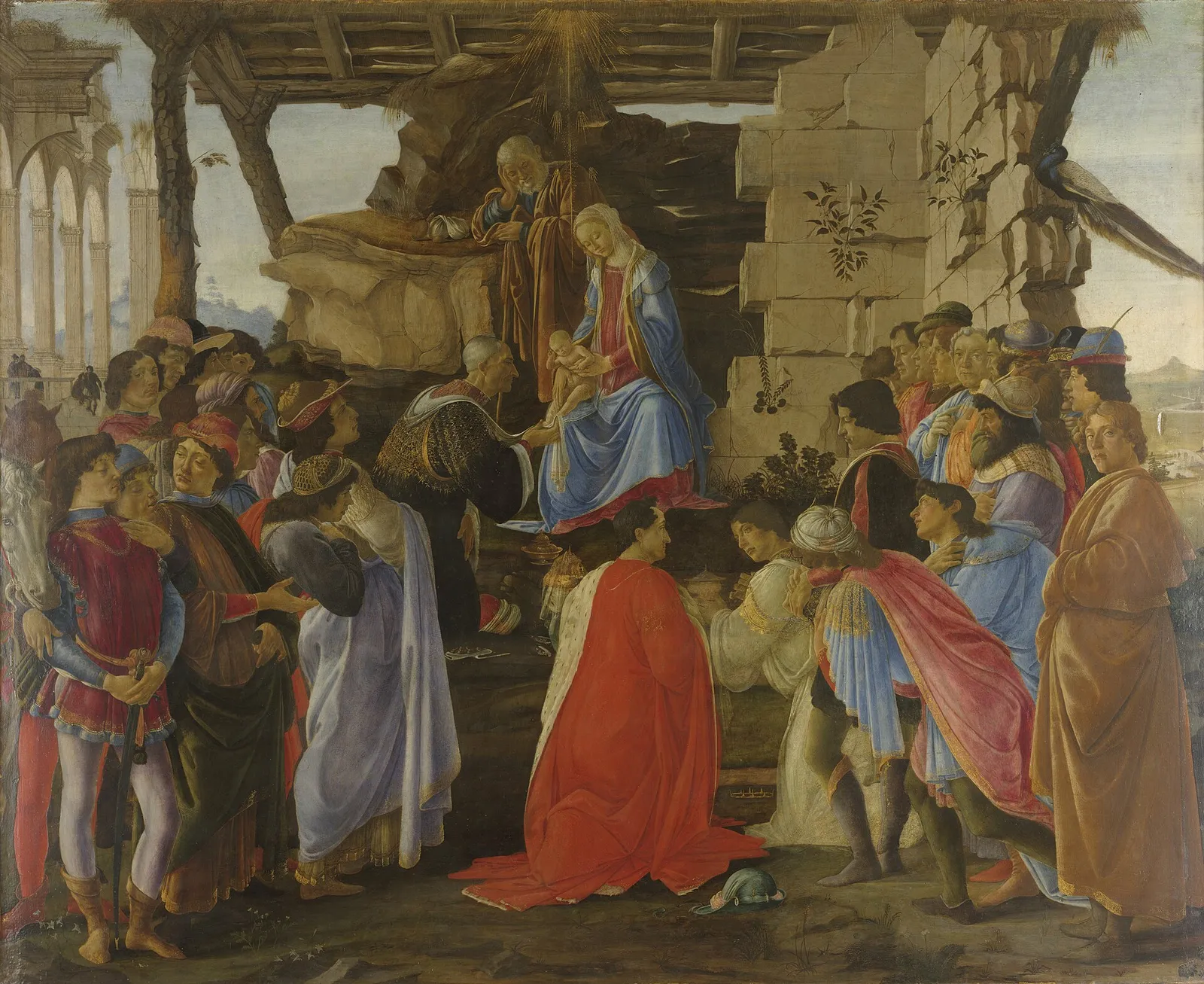
Sandro Botticelli's Adoration of the Magi, painted in the 1470s, belongs to the Uffizi Gallery. At 111 by 134 centimetres, this panel lets you study it up close, and it rewards slow looking. It turns a familiar Gospel scene into a crowded gathering in which members of the Medici circle appear among the worshippers.
Where to see it
Adoration of the Magi is in the collection of the Uffizi Gallery, and the Uffizi Gallery is listed as its location. Display arrangements can change because of rehanging, conservation work or temporary closures. Check the Uffizi Gallery's official website for current display status, opening hours and ticketing before you visit. Because the painting measures 111 x 134 cm, step close to read the faces in the crowd, then step back to see how the whole composition fits together.
What to look for in person
Find the Medici among the worshippers
Look at the kneeling kings near the Virgin and Child. Art historians widely accept that Botticelli gave them the features of members of the Medici family, the powerful Florentine banking dynasty. The oldest king, kneeling closest to the Child, is generally identified as Cosimo de' Medici, who had died before the painting was made. Rather than show the Magi as distant, exotic strangers, Botticelli fills the scene with recognisable contemporary faces. The result works both as a devotional image and as a statement of loyalty to the family that dominated the city.
The man who looks back at you
On the far right edge of the picture stands a figure wrapped in a golden-yellow cloak. Almost everyone else is turned toward the Holy Family, but he turns his head and looks straight out of the painting at the viewer. This figure is widely regarded as a self-portrait of Botticelli. Spend a moment with his direct gaze. It sets him apart from the crowd and makes him a kind of witness between the sacred event and the people standing in front of the panel. Many visitors miss him at first glance, so look for him deliberately.
Ruins, a stable and a crowd in arcs
Notice how the composition is built. The Virgin and Child sit raised at the centre, a little back from the picture's front edge. The crowd spreads out in two curving groups on the left and right, which draws your eye inward toward them. Behind the Holy Family, Botticelli sets a rough timber shelter against weathered classical masonry. Painters of the period often used this pairing of humble roof and crumbling ancient stone to suggest a new faith arising from the old world. Also look at the varied poses, gestures and rich costumes in each group.
About the painting
Botticelli painted Adoration of the Magi in the 1470s, early in his independent career. The panel measures 111 x 134 cm and is now held by the Uffizi Gallery. It is generally accepted that the work was commissioned by Guasparre del Lama, a Florentine banker and broker. He had it made for his funerary chapel in the church of Santa Maria Novella. The subject fit a private chapel well, and it also fit the city. The Magi were popular in Florence, where a confraternity devoted to them staged processions, and the Medici family was closely associated with that devotion.
Placing Medici portraits among the kings and their followers gave the patron a way to show his connections to Florence's leading family. For visitors today, this blending of sacred story and social portrait is one of the main reasons to look closely. The painting is both a religious image and a group portrait of a particular moment in Florentine life.
The picture also shows Botticelli's skill as a portraitist and as an organiser of complex scenes. Each head is individually characterised, yet the composition stays clear and balanced around the raised Holy Family. The work belongs to his production before his best-known mythological paintings. It is a useful point of comparison if you go on to see other works by him. Botticelli returned to the Adoration theme more than once, so it helps to note that this is the version measuring 111 x 134 cm in the Uffizi Gallery.
Key facts
| Artist | Sandro Botticelli |
|---|---|
| Date | 1470s |
| Size | 111 × 134 cm |
| Medium | tempera, panel |
| Collection | Uffizi Gallery |
How to visit: Uffizi Gallery
Florence, Italy · Museum guide
| Opening hours | Tue–Sun 08:15–18:30 (visitors leave by 18:30) |
|---|---|
| Closed | Mondays, 1 January and 25 December. |
| Last entry | Ticket office closes at 17:30. |
| Admission | Regular, bought on the day EUR 25 Regular, bought in advance EUR 29 Regular, entry from 16:00 (from 1 January 2026) EUR 16 Reduced (EU citizens aged 18–25; citizens of Switzerland, Norway, Liechtenstein, Uruguay etc.; ID required) EUR 2 Under 18 free (under 12s must be accompanied) Uffizi + Vasari Corridor EUR 43 on the day / EUR 47 in advance; named ticket, reservation required, non-refundable PassePartout 5 days (Uffizi, Pitti Palace, Boboli) EUR 40 (EUR 58 with Vasari Corridor) Audio guide EUR 6 |
| Free entry | Free for under-18s; disabled visitors plus one companion; tour guides and interpreters, ICOM members, certain journalists, and university teachers/students on the official list. Admission is free on the first Sunday of each month (national museums), when reservations are not possible. |
| Booking | Reservation is not required, except for the Uffizi + Vasari Corridor ticket, which must be reserved. |
Restoration and rearrangement works mean some rooms are temporarily closed and some artworks are not on display. A staff assembly on 11–12 November 2026 may change opening times.
Official ticket page
Official website
View on map
Hours and prices can change. Please check the official website before you go. (Checked on: 2026-11-12)
More by Sandro Botticelli
 Saint Augustine
 The Story of Nastagio Degli Onesti, part one — Museo del Prado
 Coronation of the Virgin — Uffizi Gallery
 The Birth of Venus — Uffizi Gallery
 Madonna and Child with Five Angels — Louvre Museum
 Punishment of the Rebels
 Madonna of the Pomegranate — Uffizi Gallery
 Venus and Mars — National Gallery
 Madonna of the Magnificat — Uffizi Gallery
 Primavera — Uffizi Gallery
 The Mystical Nativity — National Gallery