Art! Art! Art! › Works
Coronation of the Virgin
 Sandro Botticelli, 1488
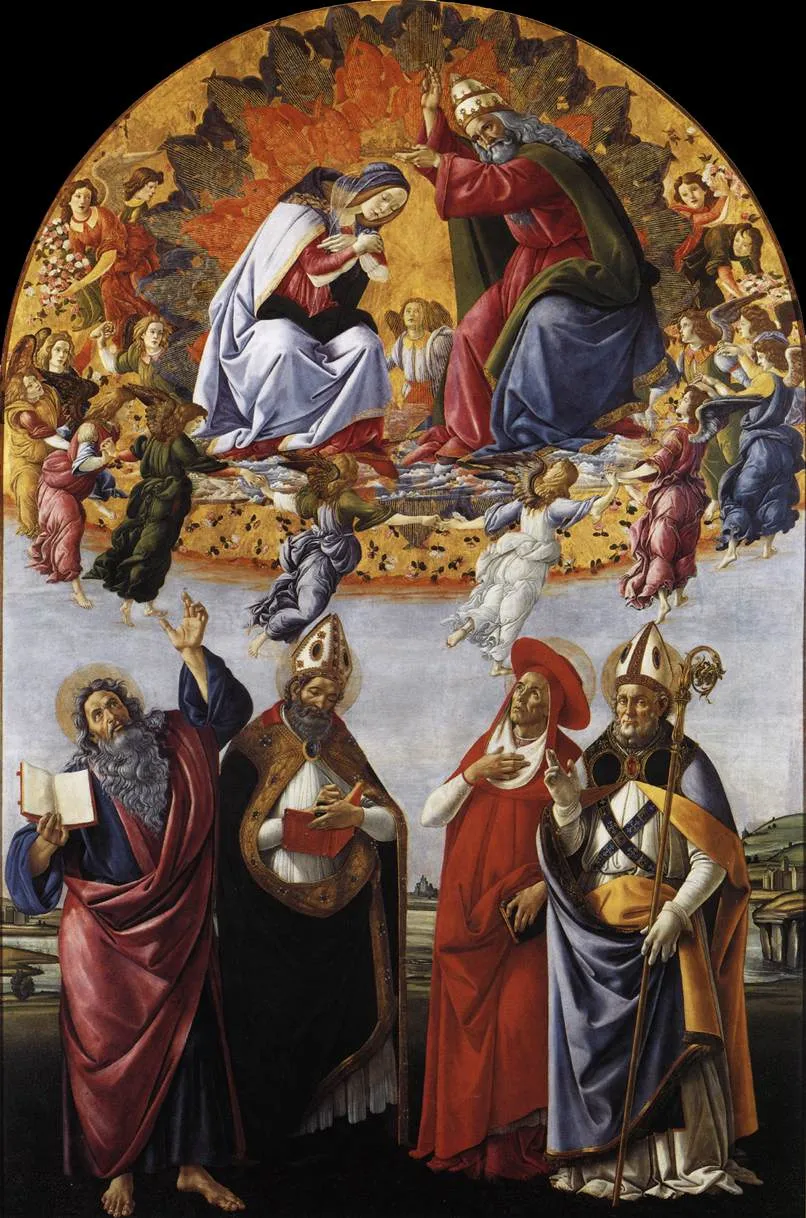
Sandro Botticelli's Coronation of the Virgin is a towering altarpiece in the collection of the Uffizi Gallery in Florence. Dated 1488 and standing 378 cm high, it divides into a heavenly scene of the Virgin crowned among angels and an earthly row of four saints below.
Where to see it
The Coronation of the Virgin is held by the Uffizi Gallery in Florence, Italy. Display arrangements at large museums can change because of rehanging, conservation or exhibitions, so check the Uffizi's official website for current display status before you visit.
What to look for in person
The ring of dancing angels
Start at the top. God the Father places the crown on the Virgin as both sit on clouds, and around them Botticelli sets a circle of angels who dance hand in hand. Look at how their robes swing and overlap, giving the circle a sense of turning movement. Other angels scatter roses over the scene, and the outer edges of heaven are filled with cherubim and seraphim. Step back to take in the whole circle, then come closer to follow individual figures and the falling flowers.
Four saints on solid ground
Below the clouds, the mood changes. Four saints stand on earth: John the Evangelist, Augustine, Jerome and Eligius. Notice how some look upward toward the vision while others are absorbed in thought, which links the two halves of the panel. Saint Eligius, a goldsmith in life, was the patron of the goldsmiths' guild that paid for the altarpiece, so his presence here is a direct reference to the commissioners. Compare the weighty, grounded saints with the light, airborne angels above them.
Traces of a long conservation history
This panel has been restored several times, and that history is part of what you are looking at. Among the angels on the left, find the third figure: the green robe was lost and was repainted by the restorer Fabrizio Lucarini by 1921. Earlier, Francesco Acciai had restored the work in 1830, and a later campaign by the Opificio delle Pietre Dure was completed in 1990. Looking at the surface with this in mind helps explain differences in condition across the picture.
About the painting
The Coronation of the Virgin is an altarpiece painted in tempera on panel, measuring 378 x 258 cm. The fact sheet gives its date as 1488, and it belongs to Botticelli's mature years in Florence. It was commissioned by the Arte degli Orafi, the goldsmiths' guild, for its chapel dedicated to Saint Eligius (Sant'Alò), located to the left of the entrance in the church of San Marco in Florence. Botticelli was paid 100 gold florins for the work.
The picture follows a two-level arrangement common in large Florentine altarpieces: a celestial vision above, with God the Father crowning the Virgin amid dancing and rose-scattering angels, and a group of saints below. Two preparatory drawings of angels are known, one of a flying angel in a private collection in Bologna and one of a standing angel in the Uffizi's prints and drawings department, which give a glimpse of how Botticelli worked out individual figures.
The altarpiece originally had a predella in five parts, together 21 x 268 cm, showing Saint John on Patmos, Saint Augustine in his study, the Annunciation, Saint Jerome penitent in the desert, and a miracle of Saint Eligius. These scenes echo the saints in the main panel.
The work did not stay long in its chapel. In 1596 it was replaced there by a Transfiguration by Giovanni Battista Paggi and moved to the convent's chapter house. After the suppressions of 1808 it went to the Galleria dell'Accademia, and it underwent restorations in 1830, by 1921, and in a long campaign that ended in 1990, after which it was exhibited at the Uffizi.
Key facts
| Artist | Sandro Botticelli |
|---|---|
| Date | 1488 |
| Size | 378 × 258 cm |
| Medium | tempera, plaster |
| Collection | Uffizi Gallery |
How to visit: Uffizi Gallery
Florence, Italy · Museum guide
| Opening hours | Tue–Sun 08:15–18:30 (visitors leave by 18:30) |
|---|---|
| Closed | Mondays, 1 January and 25 December. |
| Last entry | Ticket office closes at 17:30. |
| Admission | Regular, bought on the day EUR 25 Regular, bought in advance EUR 29 Regular, entry from 16:00 (from 1 January 2026) EUR 16 Reduced (EU citizens aged 18–25; citizens of Switzerland, Norway, Liechtenstein, Uruguay etc.; ID required) EUR 2 Under 18 free (under 12s must be accompanied) Uffizi + Vasari Corridor EUR 43 on the day / EUR 47 in advance; named ticket, reservation required, non-refundable PassePartout 5 days (Uffizi, Pitti Palace, Boboli) EUR 40 (EUR 58 with Vasari Corridor) Audio guide EUR 6 |
| Free entry | Free for under-18s; disabled visitors plus one companion; tour guides and interpreters, ICOM members, certain journalists, and university teachers/students on the official list. Admission is free on the first Sunday of each month (national museums), when reservations are not possible. |
| Booking | Reservation is not required, except for the Uffizi + Vasari Corridor ticket, which must be reserved. |
Restoration and rearrangement works mean some rooms are temporarily closed and some artworks are not on display. A staff assembly on 11–12 November 2026 may change opening times.
Official ticket page
Official website
View on map
Hours and prices can change. Please check the official website before you go. (Checked on: 2026-11-12)
More by Sandro Botticelli
 Saint Augustine
 The Story of Nastagio Degli Onesti, part one — Museo del Prado
 The Birth of Venus — Uffizi Gallery
 Madonna and Child with Five Angels — Louvre Museum
 Punishment of the Rebels
 Madonna of the Pomegranate — Uffizi Gallery
 Venus and Mars — National Gallery
 Madonna of the Magnificat — Uffizi Gallery
 Adoration of the Magi — Uffizi Gallery
 Primavera — Uffizi Gallery
 The Mystical Nativity — National Gallery
Sources
- Wikidata Q1131263
- Wikipedia (ja) (CC BY-SA 4.0)
- Wikipedia (it) (CC BY-SA 4.0)
- Wikipedia (fr) (CC BY-SA 4.0)
- Wikipedia (de) (CC BY-SA 4.0)
- www.uffizi.it