Art! Art! Art! › Works
Primavera
 Sandro Botticelli, 1480s
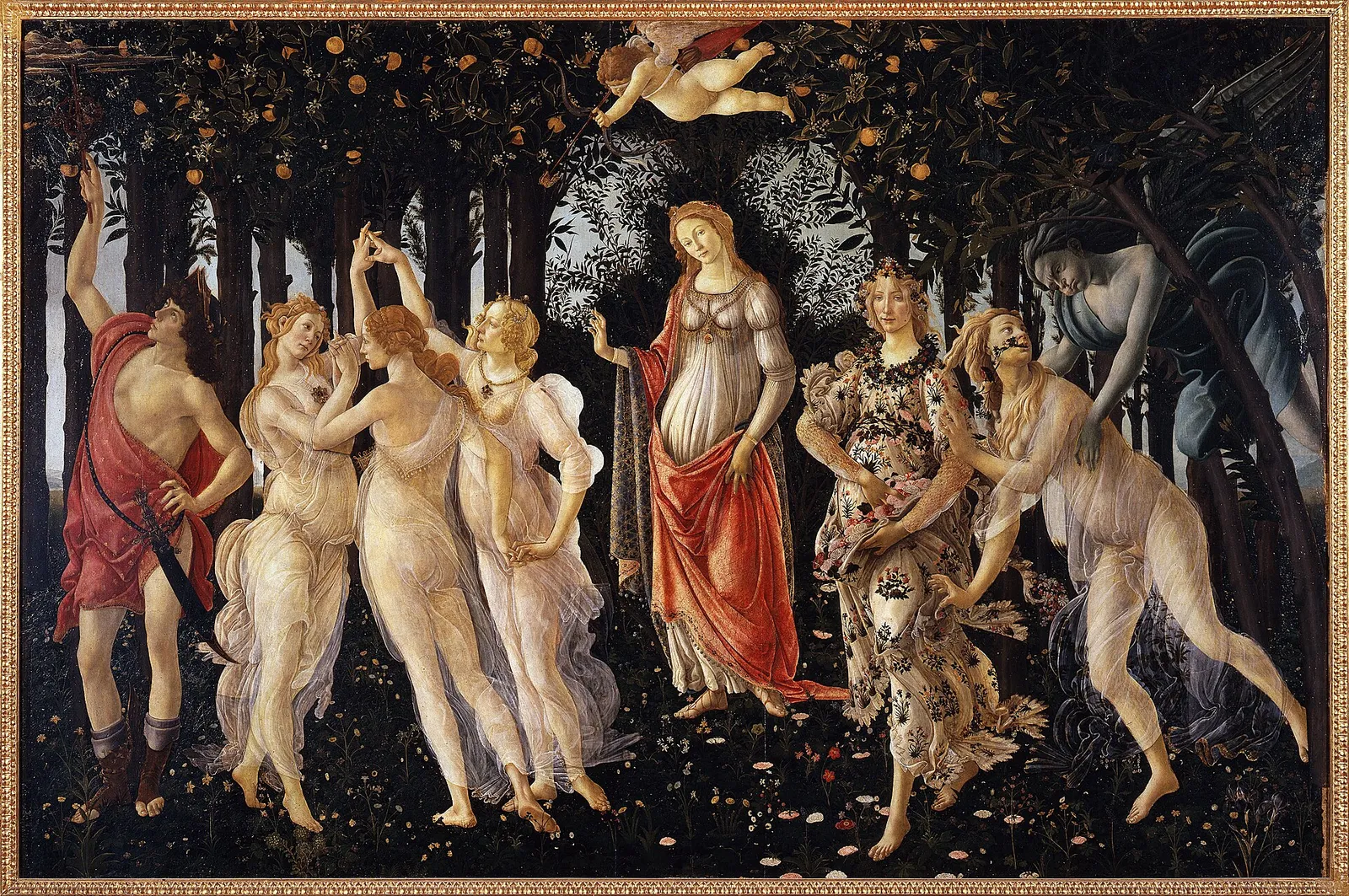
Sandro Botticelli's Primavera is in the collection of the Uffizi Gallery. Painted in the 1480s and measuring 203 by 314 cm, it fills the viewer's field of vision with a garden of figures from classical myth. Standing in front of it, you can read the scene from right to left and pick out each figure in turn.
Where to see it
Primavera belongs to the Uffizi Gallery. Its location history also lists the Palazzo Medici, including a bedroom associated with Lorenzo il Magnifico, and the Palazzo Medici Riccardi, which reflects where the painting was kept before it entered the Uffizi. Galleries are rehung, and works are sometimes moved for conservation or exhibitions. Check the Uffizi Gallery's official website for current display status, opening hours and ticketing before you visit.
What to look for in person
Read the story from right to left
Start at the far right. A blue-tinged figure, usually identified as Zephyr, the west wind, leans out of the trees and reaches for the nymph Chloris. Look at her mouth: flowers spill from it. Beside her stands Flora in a dress covered with flowers, scattering blossoms from her lap. Many scholars read these two women as one figure shown before and after her transformation. Compare the hurried poses on the right with the calm figures further left, and the change in mood across the panel becomes clear.
Venus, Cupid and the Three Graces
At the centre, slightly set back, stands Venus, framed by an opening in the foliage behind her. Above her head, a blindfolded Cupid aims a flaming arrow. Follow its line to the left, where the Three Graces dance in a ring, their hands joined and raised. Notice the thin, transparent drapery Botticelli gives them and the way their hair and veils seem to move. The rhythm of their linked arms is one of the most closely studied passages in the painting.
Mercury and the garden itself
At the far left, Mercury, recognisable by his winged sandals and staff, reaches up toward the clouds and turns away from the group. He closes the composition just as Zephyr opens it. Then step back and look at the setting: a dark grove of trees hung with fruit and a meadow scattered with many different flowers. At 203 by 314 cm, the panel invites close looking, and the plants reward it, because many are painted carefully enough that botanists have tried to identify them.
About the painting
Primavera is one of Sandro Botticelli's best-known works and a central example of how Renaissance painters took up subjects from classical mythology. It dates from the 1480s and is large: 203 cm high and 314 cm wide. The figures are close to life size, which affects the experience of standing before it. The title, meaning "Spring", was given to it later and was not necessarily Botticelli's own. It reflects the springtime setting of flowering meadow and fruit-laden trees. The painting is linked to the Medici family. Its recorded locations include the Palazzo Medici and the Palazzo Medici Riccardi before it reached the Uffizi Gallery, which holds it today. Scholars have long debated exactly who commissioned it and for what occasion. The figures are generally identified as Venus, Cupid, the Three Graces, Mercury, Flora, Chloris and Zephyr. Their combined meaning is not settled. Interpretations draw on ancient poetry, especially Ovid's account of Chloris becoming Flora. Others draw on the poetry and philosophy that circulated in Medici circles, including ideas about love and beauty associated with Neoplatonism. Some readings treat the painting as an allegory of love or marriage. Others see it as a meditation on the season. For visitors, it helps to know that the painting does not have to be decoded to be enjoyed. Botticelli's flowing line, the patterned surface of the flowers and the measured spacing of the figures across the dark grove reward slow looking. Give yourself time to move from one end of the panel to the other, then step back to take in the whole composition.
Key facts
| Artist | Sandro Botticelli |
|---|---|
| Date | 1480s |
| Size | 203 × 314 cm |
| Medium | plaster, tempera, panel |
| Collection | Uffizi Gallery |
How to visit: Uffizi Gallery
Florence, Italy · Museum guide
| Opening hours | Tue–Sun 08:15–18:30 (visitors leave by 18:30) |
|---|---|
| Closed | Mondays, 1 January and 25 December. |
| Last entry | Ticket office closes at 17:30. |
| Admission | Regular, bought on the day EUR 25 Regular, bought in advance EUR 29 Regular, entry from 16:00 (from 1 January 2026) EUR 16 Reduced (EU citizens aged 18–25; citizens of Switzerland, Norway, Liechtenstein, Uruguay etc.; ID required) EUR 2 Under 18 free (under 12s must be accompanied) Uffizi + Vasari Corridor EUR 43 on the day / EUR 47 in advance; named ticket, reservation required, non-refundable PassePartout 5 days (Uffizi, Pitti Palace, Boboli) EUR 40 (EUR 58 with Vasari Corridor) Audio guide EUR 6 |
| Free entry | Free for under-18s; disabled visitors plus one companion; tour guides and interpreters, ICOM members, certain journalists, and university teachers/students on the official list. Admission is free on the first Sunday of each month (national museums), when reservations are not possible. |
| Booking | Reservation is not required, except for the Uffizi + Vasari Corridor ticket, which must be reserved. |
Restoration and rearrangement works mean some rooms are temporarily closed and some artworks are not on display. A staff assembly on 11–12 November 2026 may change opening times.
Official ticket page
Official website
View on map
Hours and prices can change. Please check the official website before you go. (Checked on: 2026-11-12)
More by Sandro Botticelli
 Saint Augustine
 The Story of Nastagio Degli Onesti, part one — Museo del Prado
 Coronation of the Virgin — Uffizi Gallery
 The Birth of Venus — Uffizi Gallery
 Madonna and Child with Five Angels — Louvre Museum
 Punishment of the Rebels
 Madonna of the Pomegranate — Uffizi Gallery
 Venus and Mars — National Gallery
 Madonna of the Magnificat — Uffizi Gallery
 Adoration of the Magi — Uffizi Gallery
 The Mystical Nativity — National Gallery