Art! Art! Art! › Works
Madonna of the Magnificat
 Sandro Botticelli, 1483
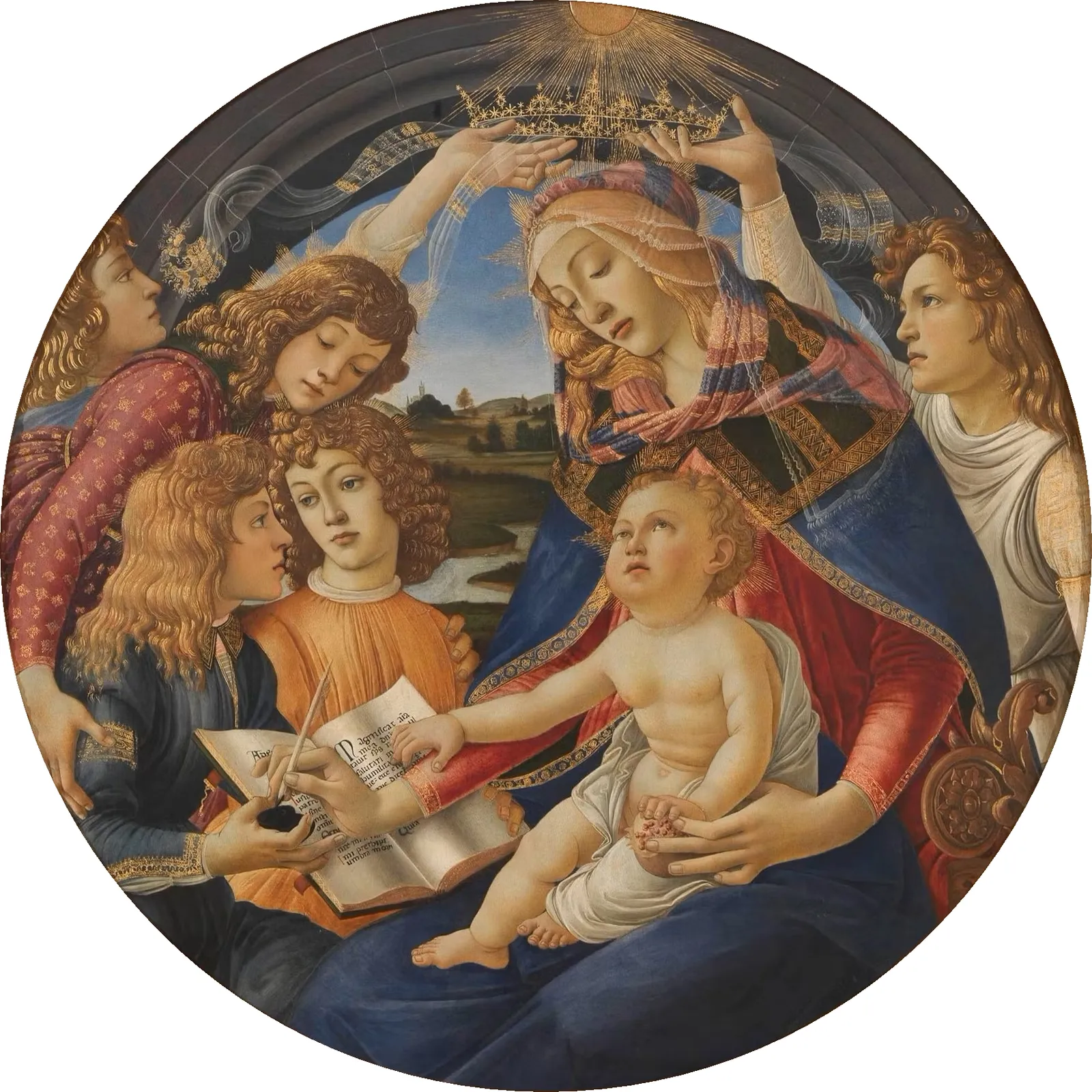
Sandro Botticelli's Madonna of the Magnificat, dated to 1483, is a round devotional painting in the collection of the Uffizi Gallery in Florence, Italy. It shows the Virgin Mary writing a hymn of praise while the Christ Child sits on her lap and angels gather around her. Its curved composition and fine gold detail reward a slow, close look.
Where to see it
The Madonna of the Magnificat belongs to the Uffizi Gallery in Florence, Italy. The fact sheet lists its location as Room 11-12, the Botticelli rooms of the Uffizi, where several of the artist's works are gathered. Displays can change because of conservation, rehanging or temporary closures, so check the Uffizi Gallery's official website for current display status, opening hours and ticketing before you visit.
What to look for in person
Mary writing the Magnificat
At the centre, Mary holds a pen and writes in an open book supported by kneeling angels. The painting takes its name from this text, the Magnificat, the hymn of praise Mary speaks in the Gospel of Luke. Look at the Christ Child on her lap: his hand rests close to hers, as if taking part in the writing, while his eyes turn upward. An angel nearby holds an inkpot. If the gallery allows you to stand close, look for the tiny lettering Botticelli painted on the pages.
A composition shaped by the circle
This is a tondo, a circular painting, a format favoured in fifteenth-century Florence for devotional images. Notice how Botticelli fits the figures to the round frame: the angels' heads form an arc around the upper edge, bodies lean along the curve, and the whole group seems to bulge gently toward the viewer, an effect often compared to a reflection in a convex mirror. Step back a few paces to see how the rim of the panel and the arrangement of figures echo one another.
Gold, the crown and the pomegranate
Above Mary's head, two angels hold a delicate crown, and golden rays fall from the top of the picture. Botticelli used gold generously, in hair, halos, the crown and the borders of garments, so the surface catches the light differently as you shift position. In the Child's hand is a pomegranate, a traditional symbol associated with Christ's Passion and Resurrection. Behind the figures, a calm landscape with a river opens into the distance, giving breathing space to the crowded foreground.
About the painting
Sandro Botticelli was a leading painter in Renaissance Florence, and the Uffizi Gallery holds one of the most important groups of his works. The Madonna of the Magnificat, dated to 1483, belongs to the period when he was producing large religious and mythological paintings for Florentine patrons. Round paintings of the Virgin and Child were popular in the city at the time, and this tondo is among the best known examples of the type. The subject combines several familiar themes. Mary appears as the Mother of God and as Queen of Heaven, signalled by the crown held above her. She is also shown as the author of the Magnificat, the song of praise recorded in the Gospel of Luke, which links the image to prayer and to the Christian liturgy. The Christ Child, holding a pomegranate, points toward his future sacrifice, a reminder that gives a quieter tone to an otherwise joyful scene. For visitors, the painting works on two scales. From a distance, it reads as a balanced ring of figures around a central mother and child. Up close, the details come forward: the written page, the patterned fabrics, the transparent veil over Mary's hair, the shining gold and the gentle, slightly melancholy faces that are characteristic of Botticelli's style. Seeing it alongside other Botticelli works in the Uffizi helps show how he handled line, grace and decoration across different subjects.
Key facts
| Artist | Sandro Botticelli |
|---|---|
| Date | 1483 |
| Medium | tempera, panel |
| Collection | Uffizi Gallery |
How to visit: Uffizi Gallery
Florence, Italy · Museum guide
| Opening hours | Tue–Sun 08:15–18:30 (visitors leave by 18:30) |
|---|---|
| Closed | Mondays, 1 January and 25 December. |
| Last entry | Ticket office closes at 17:30. |
| Admission | Regular, bought on the day EUR 25 Regular, bought in advance EUR 29 Regular, entry from 16:00 (from 1 January 2026) EUR 16 Reduced (EU citizens aged 18–25; citizens of Switzerland, Norway, Liechtenstein, Uruguay etc.; ID required) EUR 2 Under 18 free (under 12s must be accompanied) Uffizi + Vasari Corridor EUR 43 on the day / EUR 47 in advance; named ticket, reservation required, non-refundable PassePartout 5 days (Uffizi, Pitti Palace, Boboli) EUR 40 (EUR 58 with Vasari Corridor) Audio guide EUR 6 |
| Free entry | Free for under-18s; disabled visitors plus one companion; tour guides and interpreters, ICOM members, certain journalists, and university teachers/students on the official list. Admission is free on the first Sunday of each month (national museums), when reservations are not possible. |
| Booking | Reservation is not required, except for the Uffizi + Vasari Corridor ticket, which must be reserved. |
Restoration and rearrangement works mean some rooms are temporarily closed and some artworks are not on display. A staff assembly on 11–12 November 2026 may change opening times.
Official ticket page
Official website
View on map
Hours and prices can change. Please check the official website before you go. (Checked on: 2026-11-12)
More by Sandro Botticelli
 Saint Augustine
 The Story of Nastagio Degli Onesti, part one — Museo del Prado
 Coronation of the Virgin — Uffizi Gallery
 The Birth of Venus — Uffizi Gallery
 Madonna and Child with Five Angels — Louvre Museum
 Punishment of the Rebels
 Madonna of the Pomegranate — Uffizi Gallery
 Venus and Mars — National Gallery
 Adoration of the Magi — Uffizi Gallery
 Primavera — Uffizi Gallery
 The Mystical Nativity — National Gallery