Art! Art! Art! › Works
Madonna of the Pomegranate
 Sandro Botticelli, 1487
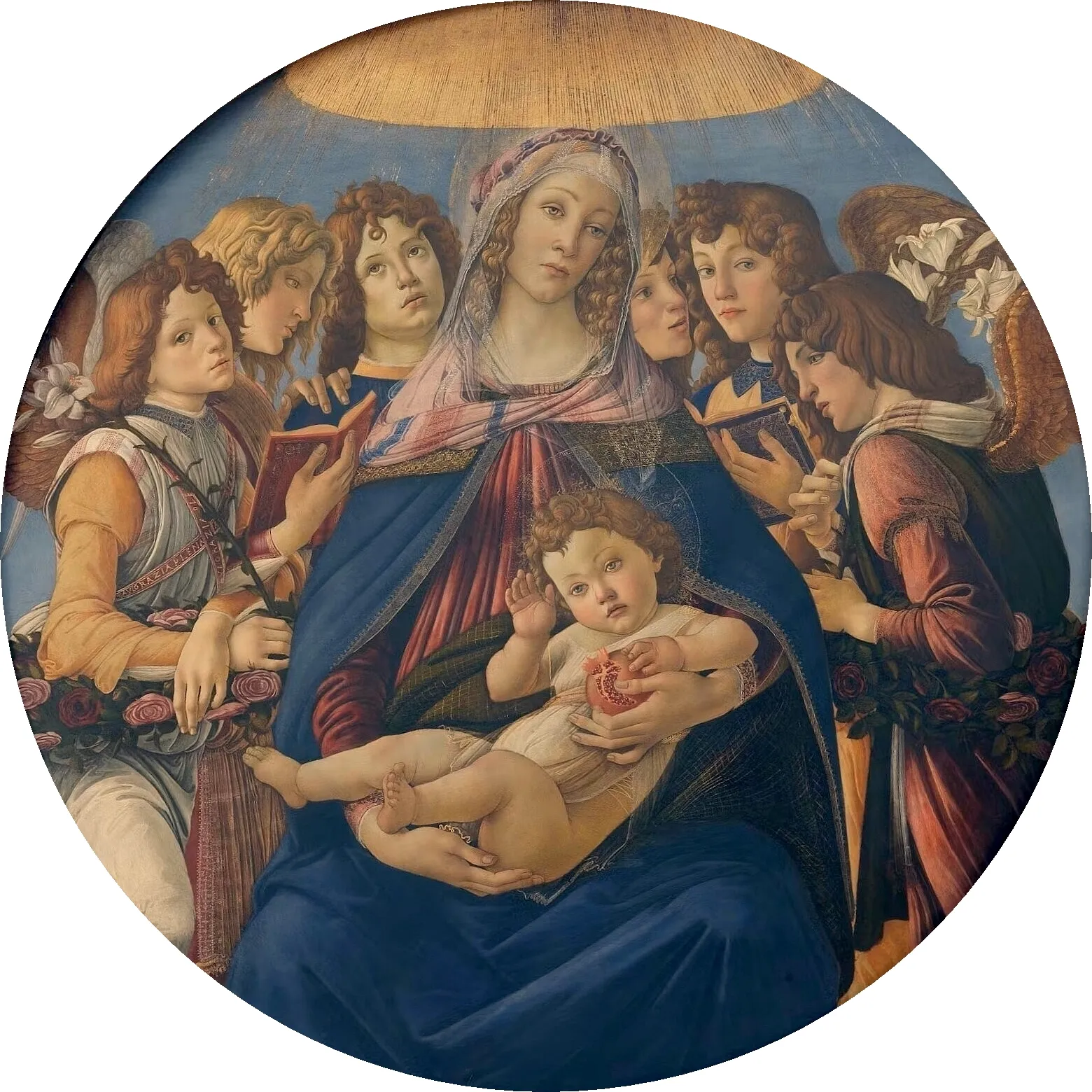
Sandro Botticelli's Madonna of the Pomegranate, dated 1487, belongs to the Uffizi Gallery. The circular painting measures 143.5 cm across. It shows the Virgin and Child surrounded by angels, with a split pomegranate at the centre of the scene.
Where to see it
Madonna of the Pomegranate is in the collection of the Uffizi Gallery, which is also its listed location. Works in large museums can be moved between rooms, taken off view for conservation, or lent to other institutions. Before you visit, check the Uffizi Gallery's official website for the painting's current display status and for up-to-date information on tickets, opening hours and booking.
What to look for in person
The pomegranate at the centre
Look first at the hands of the Virgin and Child, which meet over a split pomegranate with its red seeds showing. In Christian art the pomegranate is commonly read as a symbol of Christ's Passion and of resurrection, because of its blood-red seeds and its many seeds held within one fruit. Botticelli places it close to the middle of the circle, so the eye returns to it again and again. Notice the Child's other hand raised in a gesture of blessing toward the viewer.
A composition built for the circle
The painting is a tondo, a round format popular for devotional pictures in fifteenth-century Florence. Step back and see how Botticelli arranges the figures to follow the curve of the frame: the angels stand on either side of the Virgin, their heads and bodies bending inward so that the group forms a ring. The Virgin's head tilts to the side, echoing the curved edge. Standing at a distance shows how carefully the figures fill the circular space without crowding it.
Line, faces and quiet mood
Move closer to study Botticelli's drawing. He was known for clear, flowing contour lines, and you can follow them in the curls of the angels' hair, the folds of drapery and the long fingers. Compare the faces: the Virgin looks downward with a gentle, thoughtful, somewhat melancholy expression rather than looking out at us. Look also at the top of the picture, where fine golden rays descend toward the Mother and Child, a delicate detail that is easy to miss from far away.
About the painting
Sandro Botticelli was one of the leading painters of Renaissance Florence, and religious subjects such as the Virgin and Child formed a large part of his work alongside his better-known mythological pictures. Madonna of the Pomegranate is dated 1487, placing it in the mature phase of his career. It is a tondo, a circular painting, measuring 143.5 cm in height and width. Round devotional images of this kind were especially fashionable in fifteenth-century Florence, and Botticelli produced several of them; this one belongs to the Uffizi Gallery. The subject is simple: the Virgin holds the infant Christ, and they are flanked by angels. What gives the picture its meaning is the pomegranate. Its split rind and red seeds were widely understood as pointing to Christ's future suffering and to the promise of resurrection, so a tender family image also carries a sense of what is to come. This mix of gentleness and seriousness is typical of Botticelli's Madonnas, in which the Virgin often appears absorbed and slightly sorrowful. For visitors, the painting rewards two kinds of looking. From a distance, notice how the figures follow the curve of the circle and lead the eye toward the centre. Up close, pay attention to the drawing: crisp outlines, carefully described hair, hands and fabrics, and the thin golden rays at the top. Taking time with these details helps explain why Botticelli's line is so often singled out when people discuss his art. Because display arrangements change, confirm on the Uffizi Gallery's official website that the painting is on view before planning your visit around it.
Key facts
| Artist | Sandro Botticelli |
|---|---|
| Date | 1487 |
| Size | 143.5 × 143.5 cm |
| Medium | tempera, panel |
| Collection | Uffizi Gallery |
How to visit: Uffizi Gallery
Florence, Italy · Museum guide
| Opening hours | Tue–Sun 08:15–18:30 (visitors leave by 18:30) |
|---|---|
| Closed | Mondays, 1 January and 25 December. |
| Last entry | Ticket office closes at 17:30. |
| Admission | Regular, bought on the day EUR 25 Regular, bought in advance EUR 29 Regular, entry from 16:00 (from 1 January 2026) EUR 16 Reduced (EU citizens aged 18–25; citizens of Switzerland, Norway, Liechtenstein, Uruguay etc.; ID required) EUR 2 Under 18 free (under 12s must be accompanied) Uffizi + Vasari Corridor EUR 43 on the day / EUR 47 in advance; named ticket, reservation required, non-refundable PassePartout 5 days (Uffizi, Pitti Palace, Boboli) EUR 40 (EUR 58 with Vasari Corridor) Audio guide EUR 6 |
| Free entry | Free for under-18s; disabled visitors plus one companion; tour guides and interpreters, ICOM members, certain journalists, and university teachers/students on the official list. Admission is free on the first Sunday of each month (national museums), when reservations are not possible. |
| Booking | Reservation is not required, except for the Uffizi + Vasari Corridor ticket, which must be reserved. |
Restoration and rearrangement works mean some rooms are temporarily closed and some artworks are not on display. A staff assembly on 11–12 November 2026 may change opening times.
Official ticket page
Official website
View on map
Hours and prices can change. Please check the official website before you go. (Checked on: 2026-11-12)
More by Sandro Botticelli
 Saint Augustine
 The Story of Nastagio Degli Onesti, part one — Museo del Prado
 Coronation of the Virgin — Uffizi Gallery
 The Birth of Venus — Uffizi Gallery
 Madonna and Child with Five Angels — Louvre Museum
 Punishment of the Rebels
 Venus and Mars — National Gallery
 Madonna of the Magnificat — Uffizi Gallery
 Adoration of the Magi — Uffizi Gallery
 Primavera — Uffizi Gallery
 The Mystical Nativity — National Gallery