Art! Art! Art! › Works
The Story of Nastagio Degli Onesti, part one
 Sandro Botticelli, 1483
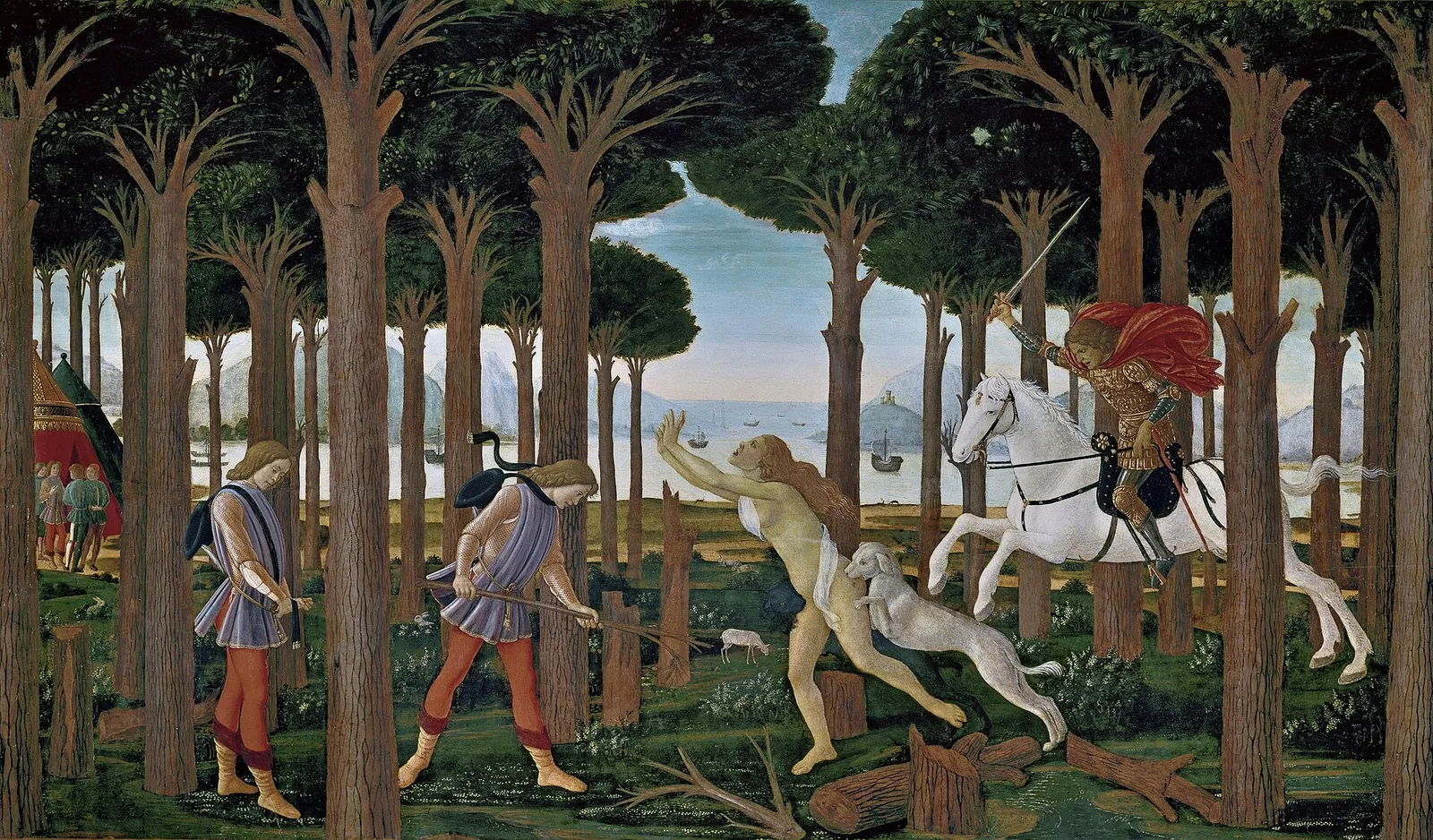
The Story of Nastagio Degli Onesti, part one is a tempera panel of 1483 designed by Sandro Botticelli and held by the Museo del Prado in Madrid. It opens a four-part painted tale from Boccaccio's Decameron, made for a Florentine wedding, and reads like a storyboard: one figure moves through a single landscape in several moments.
Where to see it
The painting is in the collection of the Museo del Prado in Madrid, which holds three of the four panels in the series. Display arrangements can change, so check the Museo del Prado's official website for current display status before you visit. The fourth panel of the series is in the Palazzo Pucci in Florence.
What to look for in person
One hero, three moments
Start by finding Nastagio, because he is in the picture more than once. Botticelli uses continuous narrative, letting the eye follow him from left to right. On the left he stands with companions near a group of tents. Next he appears alone, wandering among the trees, lost in his thoughts after being rejected in love. Finally he is caught up in the action, raising a stick against the dogs. Tracing these three appearances is the simplest way to read the panel as a story rather than a single scene.
The pursuit in the forest
The dramatic centre of the panel is the chase Nastagio stumbles upon. A woman runs from a knight on horseback and his hunting dogs. Look for the knight's golden armour and the sword he carries; the metallic tone sets him apart from the softer greens and browns around him. Nastagio is easy to spot by his red hose, a bright accent that helps you keep track of him across the composition. His attempt to beat back the dogs with a stick is the moment that ties the episodes together.
A wide panel for a wedding
Notice the long horizontal format, 83 by 138 centimetres, which suits a story unfolding across space. The setting is a pine forest near Ravenna, and the tall, regularly spaced trunks act almost like stage columns, dividing the episodes. The panel was the first of four made to celebrate a marriage in 1483, so it was intended as part of a sequence seen together. Botticelli designed the series, while much of the painting of the first three panels is attributed to his assistant Bartolomeo di Giovanni, a reminder of how Florentine workshops operated.
About the painting
The subject comes from Giovanni Boccaccio's Decameron: the eighth story of the fifth day, which tells of Nastagio degli Onesti, a nobleman of Ravenna. Unhappy after his love is rejected, Nastagio goes into a pine forest outside the city, where he witnesses a woman being hunted by a knight and his dogs. This first panel sets up the tale, introducing the hero and the startling scene that will shape the rest of the story across the following panels.
The work is painted in tempera on wood and dates from 1483. It belongs to a series of four panels made for the marriage that year of Giannozzo Pucci and Lucrezia di Piero Bini. Paintings like these were commissioned to decorate a household, and a story of love, rejection and its consequences carried a message for a newly married couple. Botticelli was responsible for the design, and much of the execution of the first three panels is credited to his workshop assistant Bartolomeo di Giovanni.
The panels stayed together in the Palazzo Pucci in Florence until they were sold in 1868. In 1929 the Catalan politician and collector Francesc Cambó acquired three of them from the heirs of Joseph Spiridon, and in 1941 he gave those three to the Museo del Prado. The fourth panel took a different route: after a period in the Watney Collection at Charlbury, Oxfordshire, it is now in the Palazzo Pucci in Florence. Visitors to Madrid can therefore see most of the cycle together, while its final episode is in Florence.
Key facts
| Artist | Sandro Botticelli |
|---|---|
| Date | 1483 |
| Size | 83 × 138 cm |
| Medium | tempera, panel |
| Collection | Museo del Prado |
How to visit: Museo del Prado
Madrid, Spain · Museum guide
| Opening hours | Mon–Sat 10:00–20:00 Sun and public holidays 10:00–19:00 6 Jan, 24 Dec, 31 Dec 10:00–14:00 (limited opening) |
|---|---|
| Closed | Closed on 1 January, 1 May and 25 December. |
| Last entry | Last entry 30 minutes before closing; visitors are asked to leave the galleries 10 minutes before closing. |
| Admission | General EUR 15 (includes the Collection and temporary exhibitions) Reduced (over 65, youth card holders, members of large families) EUR 7.5 Under 18, students aged 18–25, people with a disability of 33% or more, and other listed groups: free (official proof required at the ticket office on the day) Audio guide EUR 5 (added to the ticket; over 250 works in 15 languages) |
| Free entry | The Collection is free during the last two hours before closing (tickets at the ticket office, subject to capacity; 50% off temporary exhibitions). Always free for under-18s, students aged 18–25 and other listed groups with official proof at the ticket office. |
| Booking | Entry is by timed ticket. |
Official ticket page
Official website
View on map
Hours and prices can change. Please check the official website before you go. (Checked on: 2026-11-11)
More by Sandro Botticelli
 Saint Augustine
 Coronation of the Virgin — Uffizi Gallery
 The Birth of Venus — Uffizi Gallery
 Madonna and Child with Five Angels — Louvre Museum
 Punishment of the Rebels
 Madonna of the Pomegranate — Uffizi Gallery
 Venus and Mars — National Gallery
 Madonna of the Magnificat — Uffizi Gallery
 Adoration of the Magi — Uffizi Gallery
 Primavera — Uffizi Gallery
 The Mystical Nativity — National Gallery
Sources
- Wikidata Q1131019
- Wikipedia (en) (CC BY-SA 4.0)
- Wikipedia (ja) (CC BY-SA 4.0)
- Wikipedia (fr) (CC BY-SA 4.0)
- content3.cdnprado.net
- museodelprado.es
- www.museodelprado.es