Art! Art! Art! › Works
The Mystical Nativity
 Sandro Botticelli, 1500
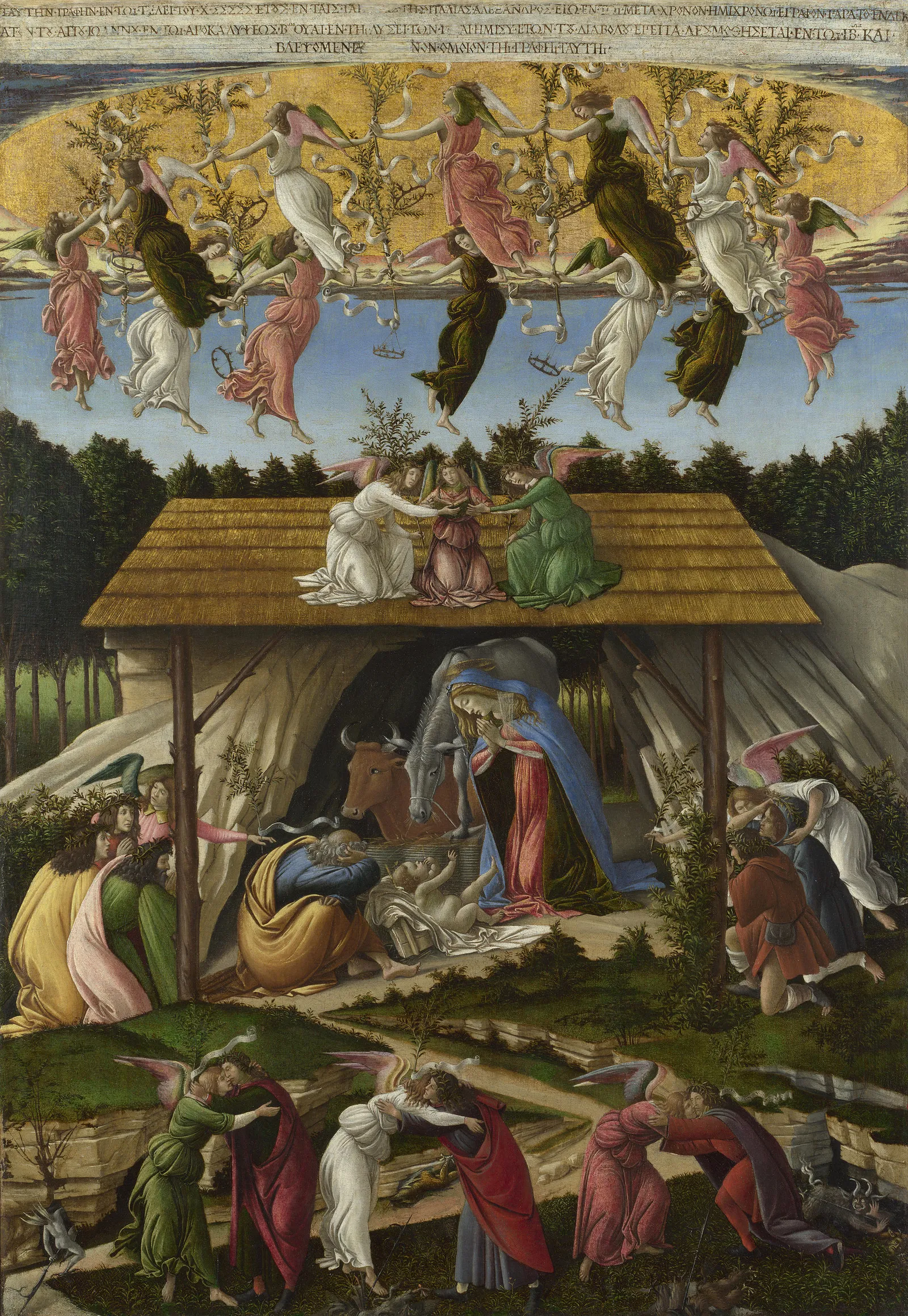
Sandro Botticelli's The Mystical Nativity, dated 1500, belongs to the collection of the National Gallery. At 109 by 75 cm, it is a fairly compact picture, but it is packed with angels, worshippers and symbolic detail that reward a slow, close look.
Where to see it
The Mystical Nativity is held by the National Gallery. Works can be moved, lent or taken off view for conservation, so check the National Gallery's official website for the painting's current display status before you visit.
What to look for in person
The ring of dancing angels
Start at the top of the panel. Above the stable roof, a circle of angels holds hands and dances against a golden sky that seems to open into heaven. They carry olive branches, and small crowns hang from ribbons between them. Follow the ring around and notice how Botticelli varies the colours of their robes and the angle of each figure, so the circle seems to turn. This celestial dance sets a joyful, otherworldly tone for the whole scene below.
The Holy Family in the stable
In the centre, under a simple thatched shelter set before a rocky cave, the Virgin Mary kneels in prayer before the infant Christ. Notice that she is painted noticeably larger than the figures around her, a deliberate choice that marks her importance rather than an attempt at realistic scale. Joseph sits hunched nearby, and the ox and ass look on from behind. Angels kneel on the stable roof, and groups of worshippers, guided by angels, approach from either side.
Embraces and fleeing devils
Now look along the bottom edge. Here angels embrace human figures, a gesture usually read as heaven reconciled with humanity. Look carefully among the rocks and you will find small dark devils scrambling away and disappearing into cracks in the ground, as if driven out by the event above. These tiny figures are easy to miss from a distance, so step closer. The contrast between the embracing pairs and the escaping demons gives the painting its sense of a world being set right.
About the painting
Botticelli painted The Mystical Nativity in 1500, late in his career, and the work looks very different from the graceful mythologies for which he is often remembered. Instead of a straightforward Christmas scene, it presents the birth of Christ as a vision, arranged in three clear bands: angels dancing in heaven at the top, the Holy Family and worshippers in the middle, and figures of reconciliation and fleeing devils at the bottom. The painting measures 109 by 75 cm, so its effect depends less on size than on the density of its detail. A Greek inscription runs across the top of the picture. It refers to troubled times in Italy and to imagery drawn from the Book of Revelation, linking the Nativity to ideas about the end of the world and the eventual defeat of evil. This apocalyptic framing is why the painting has come to be called 'mystical'. Visually, Botticelli abandons consistent perspective and natural scale. Figures are sized by importance, the space is shallow and stage-like, and the composition is built from rhythmic, repeated shapes: the circle of angels, the curving lines of kneeling figures, the symmetry of groups on either side of the stable. The result feels deliberately archaic and devotional rather than realistic. When you visit, give yourself time to read the painting from top to bottom, as its message unfolds in sequence. Look for the olive branches carried by many of the angels, the crowns suspended in the sky, and the small devils at the base. Viewing from a short distance first, then moving closer, helps you take in both the overall design and the fine detail.
Key facts
| Artist | Sandro Botticelli |
|---|---|
| Date | 1500 |
| Size | 109 × 75 cm |
| Medium | oil paint, canvas |
| Collection | National Gallery |
How to visit: National Gallery
London, United Kingdom · Museum guide
| Opening hours | Mon–Thu, Sat, Sun 10:00–18:00 Fri 10:00–21:00 (Friday late) |
|---|---|
| Closed | 24–26 December and 1 January. |
| Admission | General admission (collection) free; donations invited Some exhibitions are charged (e.g. Renoir and Love, until 31 Jan 2027) |
| Free entry | General admission is always free. |
| Booking | No reservation or timed entry is required. Free timed booking gives fast-track entry. |
Building work and improvements are under way: some rooms are closed and some paintings have moved, so check the floorplans or collection search before visiting. A new Research Centre is due to open in 2028. On 17 November only, some east wing rooms and the Espresso Bar close from 16:00.
Official ticket page
Official website
View on map
Hours and prices can change. Please check the official website before you go. (Checked on: 2026-11-11)
More by Sandro Botticelli
 Saint Augustine
 The Story of Nastagio Degli Onesti, part one — Museo del Prado
 Coronation of the Virgin — Uffizi Gallery
 The Birth of Venus — Uffizi Gallery
 Madonna and Child with Five Angels — Louvre Museum
 Punishment of the Rebels
 Madonna of the Pomegranate — Uffizi Gallery
 Venus and Mars — National Gallery
 Madonna of the Magnificat — Uffizi Gallery
 Adoration of the Magi — Uffizi Gallery
 Primavera — Uffizi Gallery