Art! Art! Art! › Works
The Birth of Venus
 Sandro Botticelli, 1485
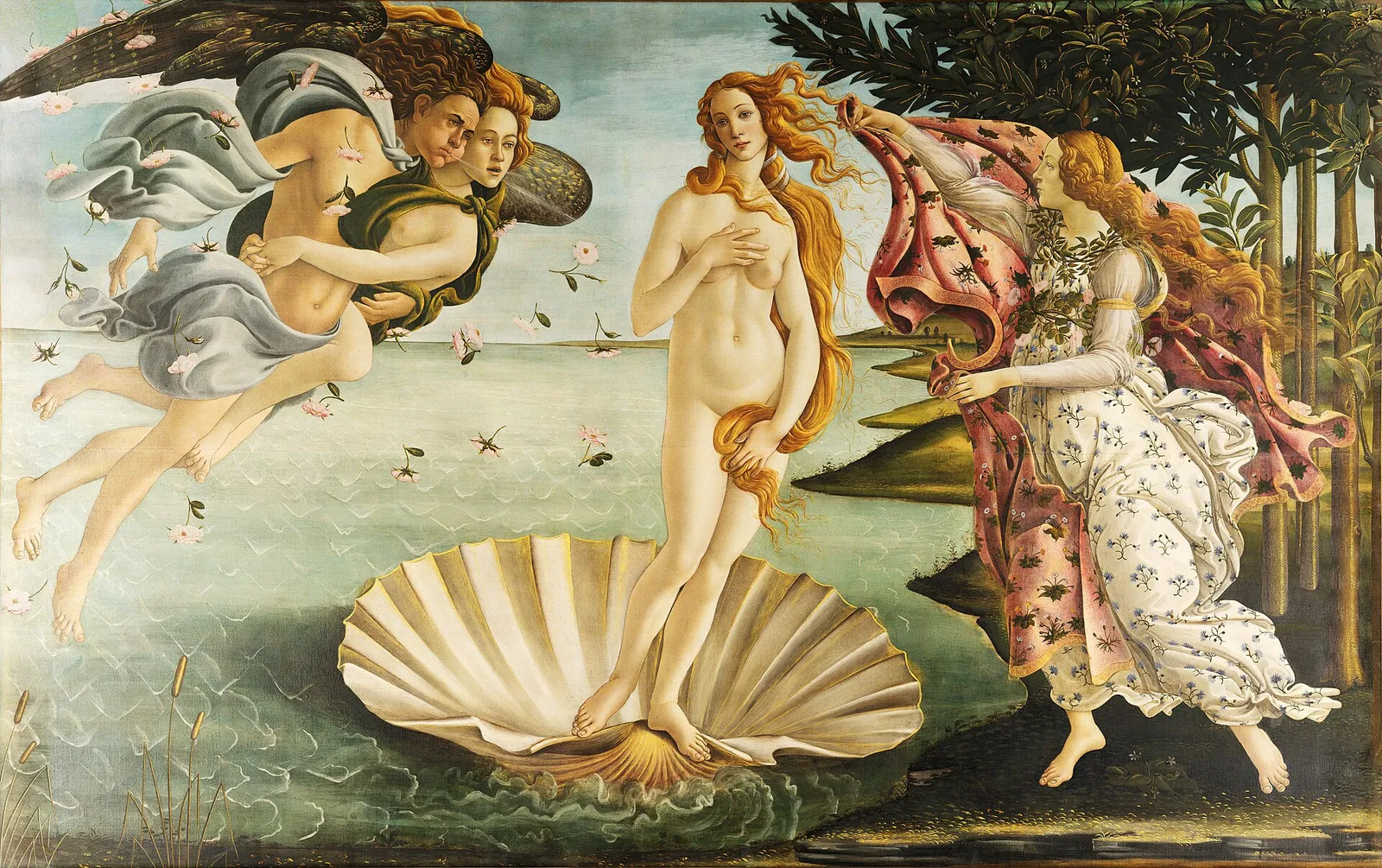
Sandro Botticelli's The Birth of Venus, dated 1485, belongs to the Uffizi Gallery in Florence, Italy. The canvas is large, at 172.5 cm high and 278.5 cm wide, so its figures appear close to life-size when you stand in front of it. This page covers where to find the painting and what to look for when you get there.
Where to see it
The Birth of Venus is in the collection of the Uffizi Gallery in Florence, Italy. Our fact sheet lists its location as Room 11-12, the rooms dedicated to Botticelli. Museum hangings can change, and works are sometimes moved for conservation or other reasons. Check the Uffizi Gallery's official website for current display status, opening hours and ticket information before you visit. Allow time to step back as well as move close: the painting measures 172.5 by 278.5 cm, and both the overall composition and the small details reward attention.
What to look for in person
Venus on the Scallop Shell
At the centre, Venus stands on a large scallop shell as it reaches the shore. Her pose, with one hand at her breast and the other gathering her long hair, echoes a classical statue type known as the modest Venus (Venus Pudica). Her weight rests on one leg, yet the figure seems to float rather than stand. Botticelli lengthens her neck and slopes her shoulders, favouring graceful line over strict anatomy. Her pale skin stands out against the cool green-blue sea, which keeps your eye on her.
The Winds on the Left
On the left, the wind god Zephyr, cheeks puffed, blows Venus toward land while entwined with a female companion. Roses drift through the air around them. Follow the direction of their breath and their fluttering drapery: the whole left side pushes movement toward the centre. Scholars differ on who the companion is, but together the pair clearly reads as a gust of wind carrying the goddess ashore. Below them, notice the small V-shaped waves, which Botticelli paints more as a decorative pattern than as a realistic sea.
The Figure on the Shore
On the right, a woman on the shore hurries forward and holds out a billowing cloak decorated with flowers, ready to cover Venus. She is usually identified as one of the Horae, the goddesses of the seasons. Her own dress is patterned with flowers, and a garland of leaves wraps around her. Look closely here, and in Venus's hair, for touches of gold that catch the light. The dark trees behind her form a vertical band that closes the right side of the composition and frames the central figure.
About the painting
Sandro Botticelli was a leading painter in Florence in the late fifteenth century, and The Birth of Venus, dated 1485, is one of his best-known works. The subject comes from classical mythology: the goddess of love, born from the sea, arrives at the shore. Large paintings of pagan, non-religious subjects were still uncommon in Renaissance Italy, which is one reason the work draws so much attention. Botticelli tells the story by arranging figures across a wide horizontal format, here 172.5 cm high and 278.5 cm wide. The winds blow in from the left, Venus stands in the middle, and an attendant waits on the right. Botticelli's style relies on clear, flowing outlines rather than deep shadow or strong three-dimensional modelling. The sea, sky and shoreline are simplified, and the figures seem to move in a shallow space close to the picture surface. Look for the rhythm of lines in the hair, drapery and waves. These repeating curves give the scene its sense of movement. Venus's pose draws on ancient sculpture, which reflects the strong interest in classical art and literature among educated Florentines of the period. The painting now belongs to the Uffizi Gallery in Florence, where it hangs among other works by Botticelli. Many visitors find it useful to view the whole composition from a distance first. Then move closer to see the finer passages, such as the individual strands of hair, the flowers on the cloak and the small roses in the air. Who commissioned the work, and exactly what it was meant to mean, are still debated by scholars.
Key facts
| Artist | Sandro Botticelli |
|---|---|
| Date | 1485 |
| Size | 172.5 × 278.5 cm |
| Medium | tempera, canvas |
| Collection | Uffizi Gallery |
How to visit: Uffizi Gallery
Florence, Italy · Museum guide
| Opening hours | Tue–Sun 08:15–18:30 (visitors leave by 18:30) |
|---|---|
| Closed | Mondays, 1 January and 25 December. |
| Last entry | Ticket office closes at 17:30. |
| Admission | Regular, bought on the day EUR 25 Regular, bought in advance EUR 29 Regular, entry from 16:00 (from 1 January 2026) EUR 16 Reduced (EU citizens aged 18–25; citizens of Switzerland, Norway, Liechtenstein, Uruguay etc.; ID required) EUR 2 Under 18 free (under 12s must be accompanied) Uffizi + Vasari Corridor EUR 43 on the day / EUR 47 in advance; named ticket, reservation required, non-refundable PassePartout 5 days (Uffizi, Pitti Palace, Boboli) EUR 40 (EUR 58 with Vasari Corridor) Audio guide EUR 6 |
| Free entry | Free for under-18s; disabled visitors plus one companion; tour guides and interpreters, ICOM members, certain journalists, and university teachers/students on the official list. Admission is free on the first Sunday of each month (national museums), when reservations are not possible. |
| Booking | Reservation is not required, except for the Uffizi + Vasari Corridor ticket, which must be reserved. |
Restoration and rearrangement works mean some rooms are temporarily closed and some artworks are not on display. A staff assembly on 11–12 November 2026 may change opening times.
Official ticket page
Official website
View on map
Hours and prices can change. Please check the official website before you go. (Checked on: 2026-11-12)
More by Sandro Botticelli
 Saint Augustine
 The Story of Nastagio Degli Onesti, part one — Museo del Prado
 Coronation of the Virgin — Uffizi Gallery
 Madonna and Child with Five Angels — Louvre Museum
 Punishment of the Rebels
 Madonna of the Pomegranate — Uffizi Gallery
 Venus and Mars — National Gallery
 Madonna of the Magnificat — Uffizi Gallery
 Adoration of the Magi — Uffizi Gallery
 Primavera — Uffizi Gallery
 The Mystical Nativity — National Gallery