Art! Art! Art! › Works
Punishment of the Rebels
 Sandro Botticelli, 1481
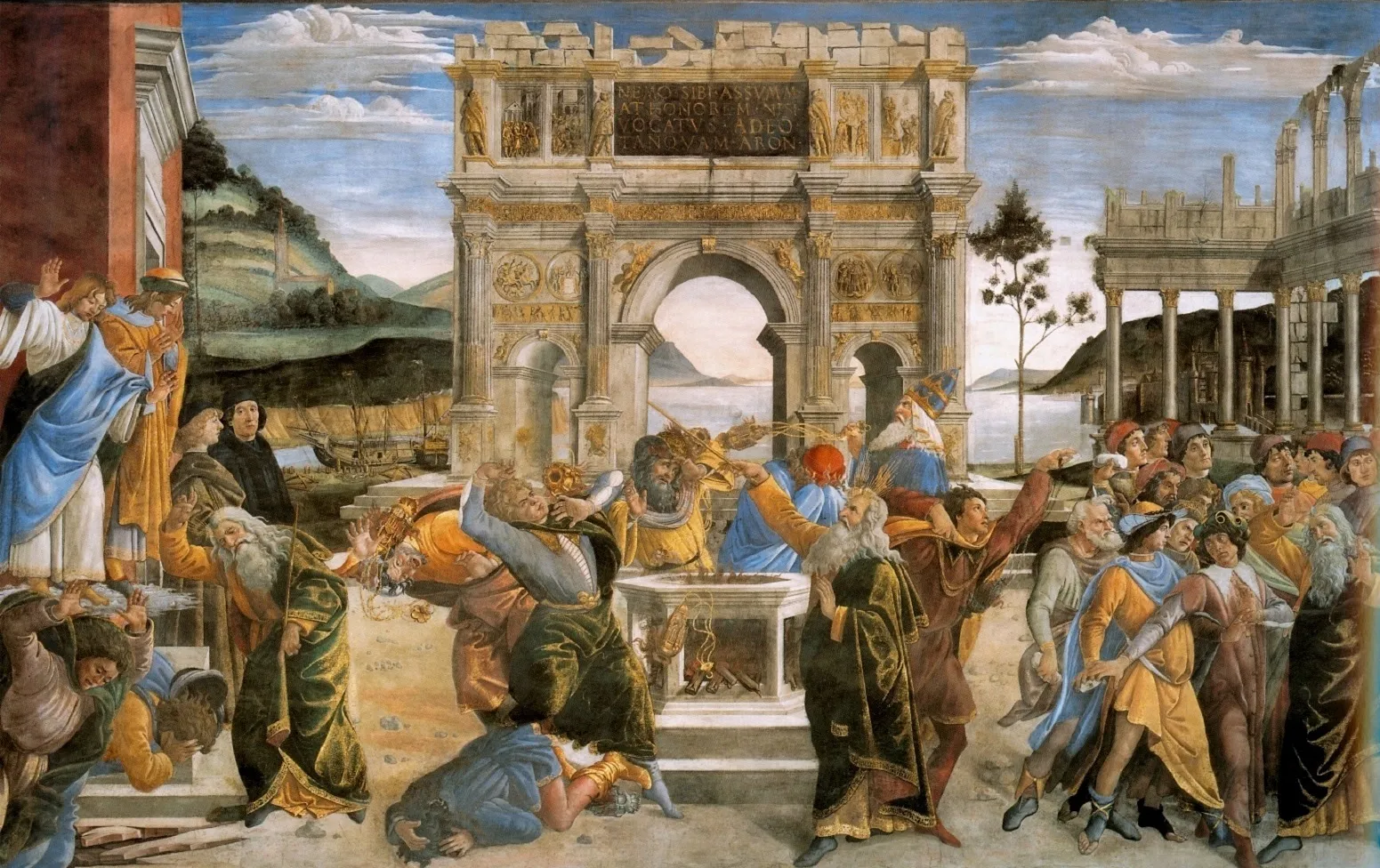
Sandro Botticelli's Punishment of the Rebels, dated 1481, is one of the large wall paintings in the Sistine Chapel. It tells the Old Testament story of a revolt against the authority of Moses and Aaron and the punishment that followed. Botticelli set the drama in front of a carefully drawn Roman triumphal arch.
Where to see it
The painting is in the Sistine Chapel, which the fact sheet lists as located in Rome, Italy. It is part of the chapel's wall decoration, so you see it where it was painted rather than in a gallery hang. It measures 348.5 cm high and 570 cm wide, so give yourself time to read it from left to right. Before you visit, check the official website for opening hours, tickets, visitor rules and any closures that could affect viewing.
What to look for in person
The triumphal arch at the centre
Start in the middle of the wall. A large Roman triumphal arch, generally identified as the Arch of Constantine, rises behind the figures. Look at how closely Botticelli records its columns, reliefs and attic storey. Across the top runs a Latin inscription, widely read as a warning that no one should claim the honour of priesthood unless called by God, as Aaron was. The arch is the anchor of the composition. It links the biblical story to the city of Rome and to the authority of the church that commissioned the chapel's decoration.
Moses, Aaron and the censers
Just in front of the arch, Moses raises his rod beside an altar. The rebels, who had challenged the right of Aaron and his line to serve as priests, hold smoking censers. Their attempt to offer incense goes wrong, and several figures stagger or fall back. Notice Aaron in priestly robes and a tall headdress. Many scholars read this costume as a deliberate echo of papal dress, which supports the scene's message about legitimate religious authority. Moses's face appears with rays of light, a common way of marking him in art of this period.
A story told in several moments
Like the other early wall paintings in the chapel, this one presents more than one moment of the same story in a single landscape. Moses appears more than once, so follow him across the wall. Toward one side, the rebels are shown threatening him. Toward the other, the ground opens and the leaders of the revolt are swallowed by the earth. Compare the calm, upright Moses with the tangled, falling bodies around him. Botticelli uses this contrast to make the moral of the story readable from the floor of the chapel.
About the painting
Punishment of the Rebels belongs to the series of large wall paintings made for the Sistine Chapel at the start of the 1480s. The fact sheet dates it to 1481. The chapel's side walls were planned as two facing cycles, one showing scenes from the life of Moses and the other scenes from the life of Christ. They were designed to be read as parallels. Botticelli was one of a group of leading Florentine and Umbrian painters brought in for this project, working alongside artists such as Perugino, Domenico Ghirlandaio and Cosimo Rosselli. Botticelli's painting belongs to the Moses cycle. Its subject comes from the Book of Numbers. Korah, Dathan and Abiram lead a revolt against Moses and Aaron and question who has the right to act as priest. God answers with fire and by opening the earth beneath the rebels. In the context of a papal chapel, the story is generally understood as a statement about the authority of the papacy and the danger of challenging it. That reading is reinforced by the inscription on the arch and by Aaron's papal-looking headdress. The work is painted directly on the wall and measures 348.5 by 570 cm. Visitors usually look at it as one panel among many, in a space where the ceiling also competes for attention. Standing back to take in the whole scene, then moving closer to study faces, gestures and the architecture, is a useful way to appreciate Botticelli's storytelling and his sharp, linear drawing.
Key facts
| Artist | Sandro Botticelli |
|---|---|
| Date | 1481 |
| Size | 348.5 × 570 cm |
| Medium | fresco |
| Collection | Sistine Chapel |
How to visit: Sistine Chapel
Vatican City, Vatican City
Hours and prices can change. Please check the official website before you go.
More by Sandro Botticelli
 Saint Augustine
 The Story of Nastagio Degli Onesti, part one — Museo del Prado
 Coronation of the Virgin — Uffizi Gallery
 The Birth of Venus — Uffizi Gallery
 Madonna and Child with Five Angels — Louvre Museum
 Madonna of the Pomegranate — Uffizi Gallery
 Venus and Mars — National Gallery
 Madonna of the Magnificat — Uffizi Gallery
 Adoration of the Magi — Uffizi Gallery
 Primavera — Uffizi Gallery
 The Mystical Nativity — National Gallery