Art! Art! Art! › Works
Madonna and Child with Five Angels
 Sandro Botticelli, 1470s
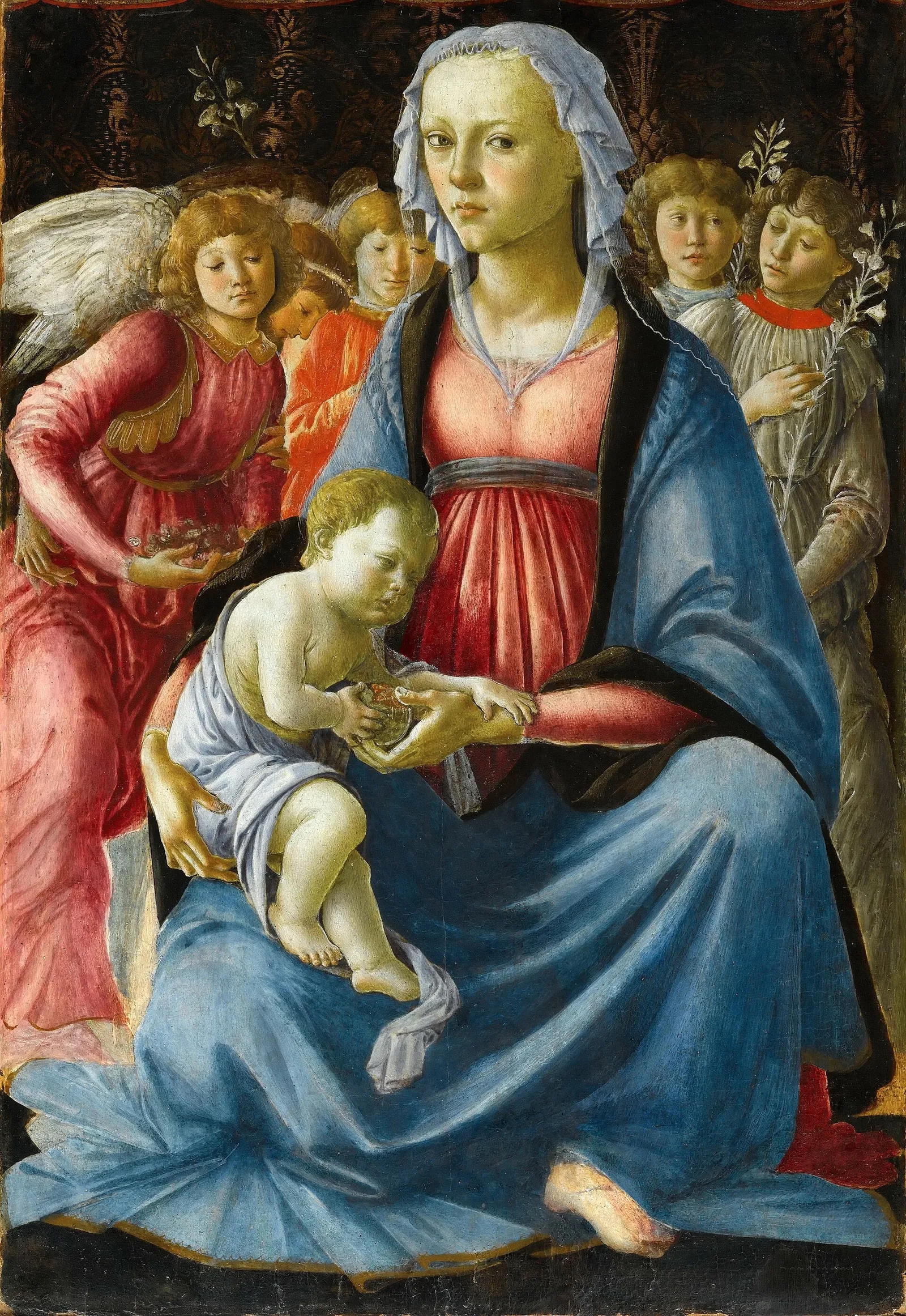
Madonna and Child with Five Angels is an early panel by Sandro Botticelli, dating from the 1470s and belonging to the Department of Paintings of the Louvre. Its listed location is La Galerie du temps, where visitors can study a small, intimate devotional image of the Virgin and Child framed by angels.
Where to see it
The painting belongs to the Department of Paintings of the Louvre and came from the Campana collection. Its recorded location is La Galerie du temps, the Louvre's long gallery at the Louvre-Lens site. Works can be moved, lent or taken off view, so check the Louvre's official website for current display status before you plan your visit.
What to look for in person
The Madonna of Humility
Start with how Mary is seated. Instead of a throne, she rests on a cushion placed on the ground, a pose known as the Madonna of Humility, which emphasises her modesty. Notice the quiet tension in the figure: her body faces you directly, while her gaze turns off to the right. She supports the Child on her right knee. On a panel only 58 by 40 centimetres, this close grouping fills much of the surface, so it rewards stepping in for a careful look.
Five angels, lilies and a crown
Behind the Virgin and Child stand five angels. Look for the lily branches they hold, a familiar emblem of Mary's purity in Florentine painting. At the front left, find the angel dressed in red, who holds a crown, a motif commonly linked to Mary's role as Queen of Heaven. Then look for the pomegranate shown with the Virgin and Child; its many seeds were widely understood in Renaissance art as an allusion to the Passion and Resurrection. Notice how the angels form a backdrop that frames the central pair.
A young painter's changes, and later layers
This is an early work, painted in tempera on a poplar panel. Infrared and X-ray examination showed that Botticelli reworked the design considerably, altering the position of Mary's feet and the pose of the Child. Keep those areas in mind as you look. Be aware, too, that much of the surface carries extensive overpainting added after Botticelli's time, which is why specialists find the picture difficult to assess. What you see today is partly the artist's own work and partly later additions.
About the painting
Botticelli painted this Madonna and Child with Five Angels in the 1470s, around 1470, when he was still a young artist at the start of his independent career. It is executed in tempera on a poplar panel and measures 58 by 40 centimetres, a size suited to private devotion rather than a church altar. The subject is a gentle, close-up image: the Virgin sits low on a cushion in the Madonna of Humility type, holding the Christ Child, while five angels gather behind them carrying lily branches, and the angel in red at front left holds a crown. For a long time the panel was attributed to Filippo Lippi, Botticelli's teacher, which helps explain its character; the soft modelling and the composition reflect the workshop tradition in which Botticelli trained. Technical studies using infrared and X-rays later showed that the painter changed his mind during the work, revising the placement of Mary's feet and the pose of the Child. Assessing the panel is complicated by extensive overpainting from later periods, so the surface does not fully reflect its original state. The painting's modern history runs through Rome and Paris. It was part of the collection of Marquis Giampietro Campana in Rome, which the French government purchased in 1861, and it entered the Louvre in 1863. Today it is catalogued in the Louvre's Department of Paintings, with its location recorded as La Galerie du temps at the Louvre-Lens, where works from many periods are shown together in a single chronological space.
Key facts
| Artist | Sandro Botticelli |
|---|---|
| Date | 1470s |
| Size | 58 × 40 cm |
| Medium | tempera, poplar panel |
| Collection | Campana collection / Department of Paintings of the Louvre |
How to visit: Louvre Museum
Paris, France · Museum guide
| Opening hours | Mon, Thu, Sat, Sun 09:00–18:00 Wed, Fri 09:00–21:00 (evening opening) Rooms are cleared 30 minutes before closing |
|---|---|
| Closed | Every Tuesday; 1 January, 1 May and 25 December. Other public holidays are open unless they fall on a Tuesday. |
| Last entry | 1 hour before closing |
| Admission | Adult (non-EEA visitors) EUR 32 Adult (EEA citizens and residents) EUR 22 Under 18 free (ID required) EEA citizens/residents under 26 free (photo ID; residents also need a residence permit of over 90 days) Audio guide rental EUR 6 (can be booked in advance online) Rates apply from 14 January 2026 |
| Free entry | Free for under-18s, EEA citizens/residents under 26, all visitors on the first Friday of the month after 18:00 (except July and August) and on 14 July, and disabled visitors plus one carer. Also free with proof for EEA art and art-history teachers, ICOM members, journalists, EEA job seekers and EEA residents on income support. |
| Booking | Entry is by timed slot, and booking in advance is recommended. |
The Cour Carrée entrance is currently closed. On Thursday 12 November 2026 the museum may open later and some exhibition rooms may remain closed.
Official ticket page
Official website
View on map
Hours and prices can change. Please check the official website before you go. (Checked on: 2026-11-11)
More by Sandro Botticelli
 Saint Augustine
 The Story of Nastagio Degli Onesti, part one — Museo del Prado
 Coronation of the Virgin — Uffizi Gallery
 The Birth of Venus — Uffizi Gallery
 Punishment of the Rebels
 Madonna of the Pomegranate — Uffizi Gallery
 Venus and Mars — National Gallery
 Madonna of the Magnificat — Uffizi Gallery
 Adoration of the Magi — Uffizi Gallery
 Primavera — Uffizi Gallery
 The Mystical Nativity — National Gallery
Sources
- Wikidata Q18572522
- Wikipedia (ja) (CC BY-SA 4.0)
- Wikipedia (fr) (CC BY-SA 4.0)
- www.louvre.fr
- contact.louvre.fr