Art! Art! Art! › Works
Saint Augustine
 Sandro Botticelli, 1480
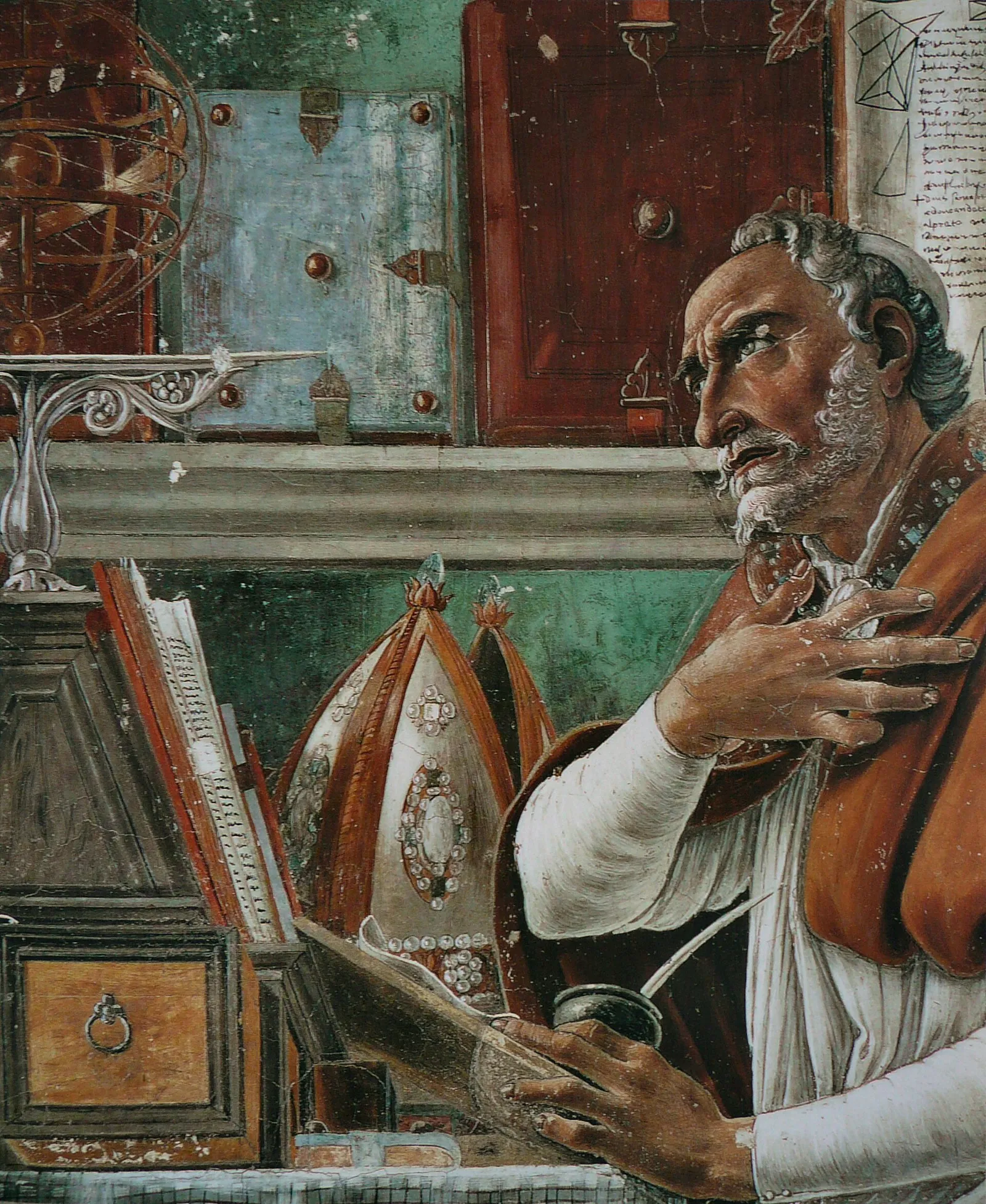
Sandro Botticelli's Saint Augustine, painted in 1480, is a fresco that still belongs to the church it was made for: Ognissanti in Florence. It shows the scholar-saint in his study at the moment a vision interrupts his writing, and it is regarded as Botticelli's earliest surviving fresco.
Where to see it
Saint Augustine is in Ognissanti Church in Florence, which is listed as both its collection and its location. The fresco has been moved within the church complex more than once, so check the church's official website or contact it directly for current access, opening hours and display status before you visit.
What to look for in person
A saint caught mid-task
The scene follows a legend in which Augustine, about to begin a letter to Jerome, becomes aware of Jerome's voice in a vision. Botticelli does not paint a calm portrait of a writer. He paints an interruption. Stand back first and take in the study as a frame for one figure whose attention has been pulled away from his work. Then move closer and spend time on the face, because the meaning of the whole composition depends on it. The surrounding objects place the saint among his books, a scholar at his desk at the instant his writing stops.
The clock and the open book
Two small details reward a slow look. Beside Augustine's head is a clock, which ties the vision to a particular hour, although how its dial should be read is debated. Then search the open book for a line of legible text in Italian: 'Dov'è Frate Martino? È scappato. E dov'è andato? È fuor dalla Porta al Prato.' Roughly, it asks where Brother Martino is and answers that he has slipped away, out beyond the Porta al Prato. It is a surprisingly everyday phrase to find in a learned saint's study, so take a moment to find it.
Patrons and a painted counterpart
Look toward the upper part of the fresco for the Vespucci coat of arms. It marks the family connected with the commission. Keep in mind too that this picture was planned as half of a pair. Domenico Ghirlandaio painted a facing fresco of Saint Jerome in his study as its counterpart, so two scholar-saints, each at work among his books, were meant to be seen together. If both are on view when you visit, compare them side by side to see how each painter handled the same theme of a learned man in his study.
About the painting
Botticelli painted Saint Augustine in 1480 for the church of Ognissanti in Florence, and it is regarded as his earliest surviving fresco. The commission is linked to the Vespucci family, most likely Nastagio Vespucci and his brother Giorgio Antonio, who were Botticelli's neighbours. Their coat of arms appears in the upper part of the painting. Domenico Ghirlandaio painted the companion fresco, Saint Jerome in his study, and the two images of learned saints were designed to face each other.
The frescoes did not stay where they were first painted. They originally decorated the church's choir screen. When that screen was demolished in 1564 to 1566, the paintings were detached and moved to the nave. Giorgio Vasari wrote that Botticelli's fresco was removed without damage in 1564. Four centuries later, the 1966 Arno flood slightly damaged the frescoes, and afterwards they were moved to the refectory. Because of this history, the work you see today is a detached mural painting, not one still on its original wall.
The subject comes from a legend about Augustine and Jerome. Augustine, beginning a letter to Jerome, experiences a vision of Jerome's voice. Botticelli presents the saint in a scholar's study, and details such as the clock beside his head and the readable line of text in an open book invite close looking. The recorded size is 152 by 112 centimetres. That is large enough to read from a distance, but the small details are best seen up close. Before travelling, confirm current arrangements with the church, since access and placement within the complex can change.
Key facts
| Artist | Sandro Botticelli |
|---|---|
| Date | 1480 |
| Size | 152 × 112 cm |
| Medium | tempera, plaster, fresco |
| Collection | Ognissanti Church |
How to visit: Ognissanti Church
Florence, Italy
Hours and prices can change. Please check the official website before you go.
More by Sandro Botticelli
 The Story of Nastagio Degli Onesti, part one — Museo del Prado
 Coronation of the Virgin — Uffizi Gallery
 The Birth of Venus — Uffizi Gallery
 Madonna and Child with Five Angels — Louvre Museum
 Punishment of the Rebels
 Madonna of the Pomegranate — Uffizi Gallery
 Venus and Mars — National Gallery
 Madonna of the Magnificat — Uffizi Gallery
 Adoration of the Magi — Uffizi Gallery
 Primavera — Uffizi Gallery
 The Mystical Nativity — National Gallery
Sources
- Wikidata Q1114329
- Wikipedia (en) (CC BY-SA 4.0)
- Wikipedia (it) (CC BY-SA 4.0)
- Wikipedia (fr) (CC BY-SA 4.0)