Art! Art! Art! › Works
Transfiguration
 Raphael, 16th century
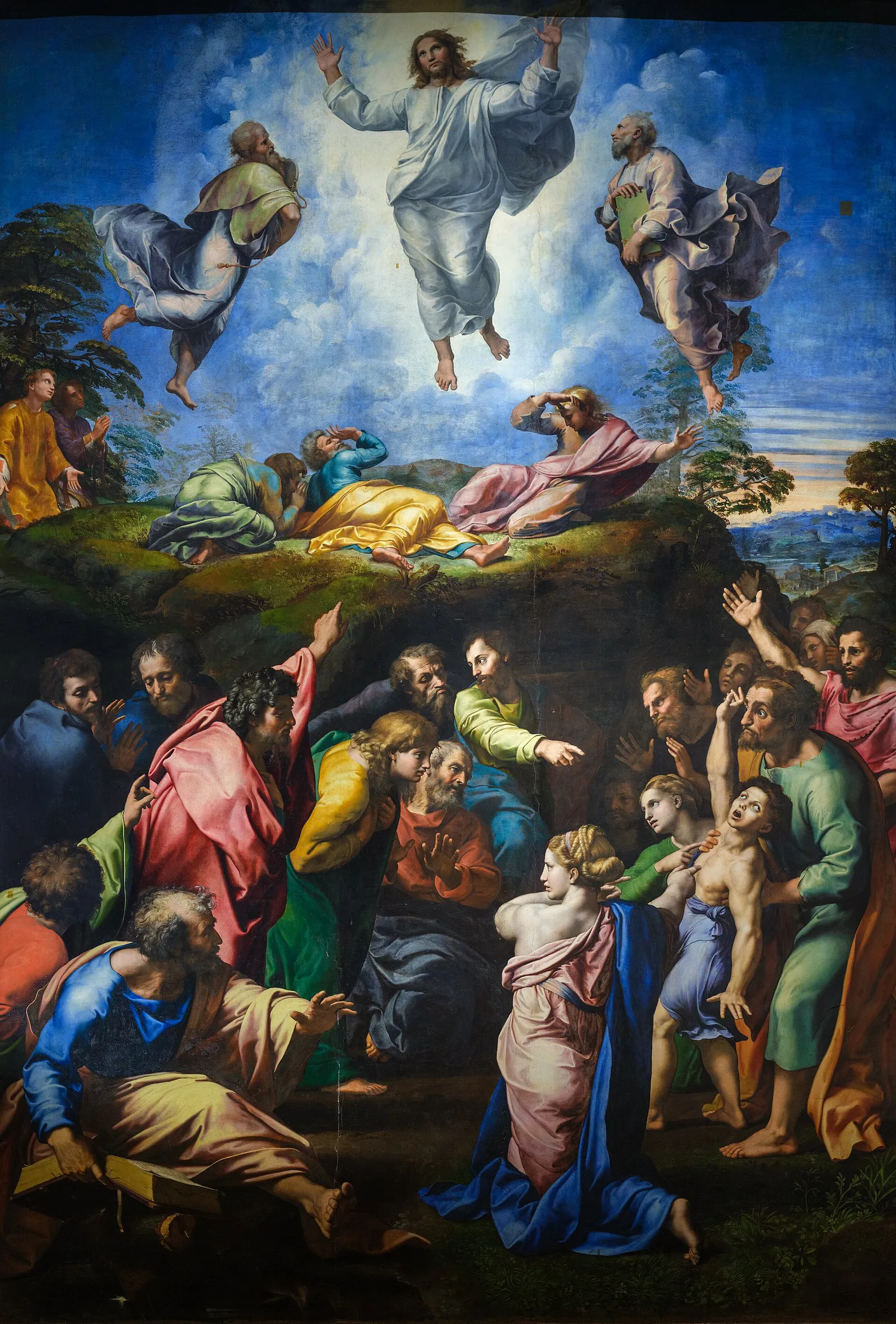
Raphael's Transfiguration is held by the Pinacoteca Vaticana. At 410 cm high and 279 cm wide, this 16th-century altarpiece places a radiant vision of Christ above a crowded, agitated scene on the ground. It is widely regarded as the last major painting Raphael worked on before his death.
Where to see it
Transfiguration is in the collection of the Pinacoteca Vaticana, which is also its listed location. Works can be moved, lent or taken off view for conservation, so check the museum's official website for current display status, opening hours and ticketing before you plan your visit.
What to look for in person
Two scenes in one picture
Stand back first and notice how the panel divides into two zones. At the top, Christ rises above a hilltop, flanked by two floating figures traditionally identified as Moses and Elijah, while three apostles lie dazzled beneath him. Below, a separate episode unfolds: the remaining apostles are confronted by a family bringing a possessed boy they cannot heal. Raphael combines two consecutive Gospel passages into a single tall composition, and much of the painting's meaning comes from reading the upper and lower halves against each other.
Light versus shadow
Look at how differently the two halves are lit. The upper scene is bathed in a pale, even glow centered on Christ's white garments, which seem to give off their own light. The lower scene is darker and more theatrical, with strong contrasts falling across faces and bodies. This contrast between calm radiance and earthly turmoil is one of the most discussed features of the work, and it is easiest to appreciate from a few steps back, where the full height of the panel is visible.
Gestures that connect the halves
Move closer to the lower group and follow the hands. Several apostles point, some toward the boy and some upward toward the hill, while the boy himself stretches his arms out with rolling eyes. A kneeling woman in the foreground, seen from behind, turns toward the apostles and directs attention into the scene. These pointing and reaching gestures act as visual links, guiding your eye from the human crisis below to the vision above and tying the two episodes into one argument about faith.
About the painting
Transfiguration is a large altarpiece by Raphael, dated in the fact sheet to the 16th century and measuring 410 by 279 centimetres. It is held by the Pinacoteca Vaticana. The painting was commissioned by Cardinal Giulio de' Medici, who later became Pope Clement VII, and Raphael was still at work on it when he died. Early accounts, notably by the biographer Giorgio Vasari, record that the painting was placed near the artist's body as he lay in state, which helped make it one of his best-known works. The subject comes from the Gospels. In the upper section, Christ appears transfigured on a mountain before Peter, James and John, accompanied by Moses and Elijah. In the lower section, the other apostles fail to cure a boy possessed by a spirit, an event the Gospel of Matthew places immediately after the Transfiguration. Bringing these two moments into one image was an unusual choice for an altarpiece, and viewers have long debated how the halves relate: one common reading is that the lower apostles' helplessness is answered by the divine presence above. For visitors, the picture rewards slow looking. Notice the variety of faces and poses in the lower group, the careful balance of the upper figures against the sky, and the way color and light shift as your eye moves upward. Many art historians see the work as pointing toward the more dramatic, emotionally charged styles that developed later in the century. Its scale makes it worth viewing both from a distance, to grasp the whole design, and up close, to study individual figures.
Key facts
| Artist | Raphael |
|---|---|
| Date | 16th century |
| Size | 410 × 279 cm |
| Medium | oil paint, panel |
| Collection | Pinacoteca Vaticana |
How to visit: Pinacoteca Vaticana
Vatican City, Vatican City
Hours and prices can change. Please check the official website before you go.
More by Raphael
 Madonna of the Pinks — National Gallery
 La fornarina
 The Marriage of the Virgin
 Saint Catherine of Alexandria — National Gallery
 Madonna of the Goldfinch — Uffizi Gallery
 Madonna del Prato — Kunsthistorisches Museum
 The Deposition — Galleria Borghese
 Alba Madonna — National Gallery of Art
 Portrait of Leo X
 Christ Falling on the Way to Calvary — Museo del Prado
 Ansidei Madonna — National Gallery
 Ceres — Louvre Museum