Art! Art! Art! › Works
The Deposition
 Raphael, 1507
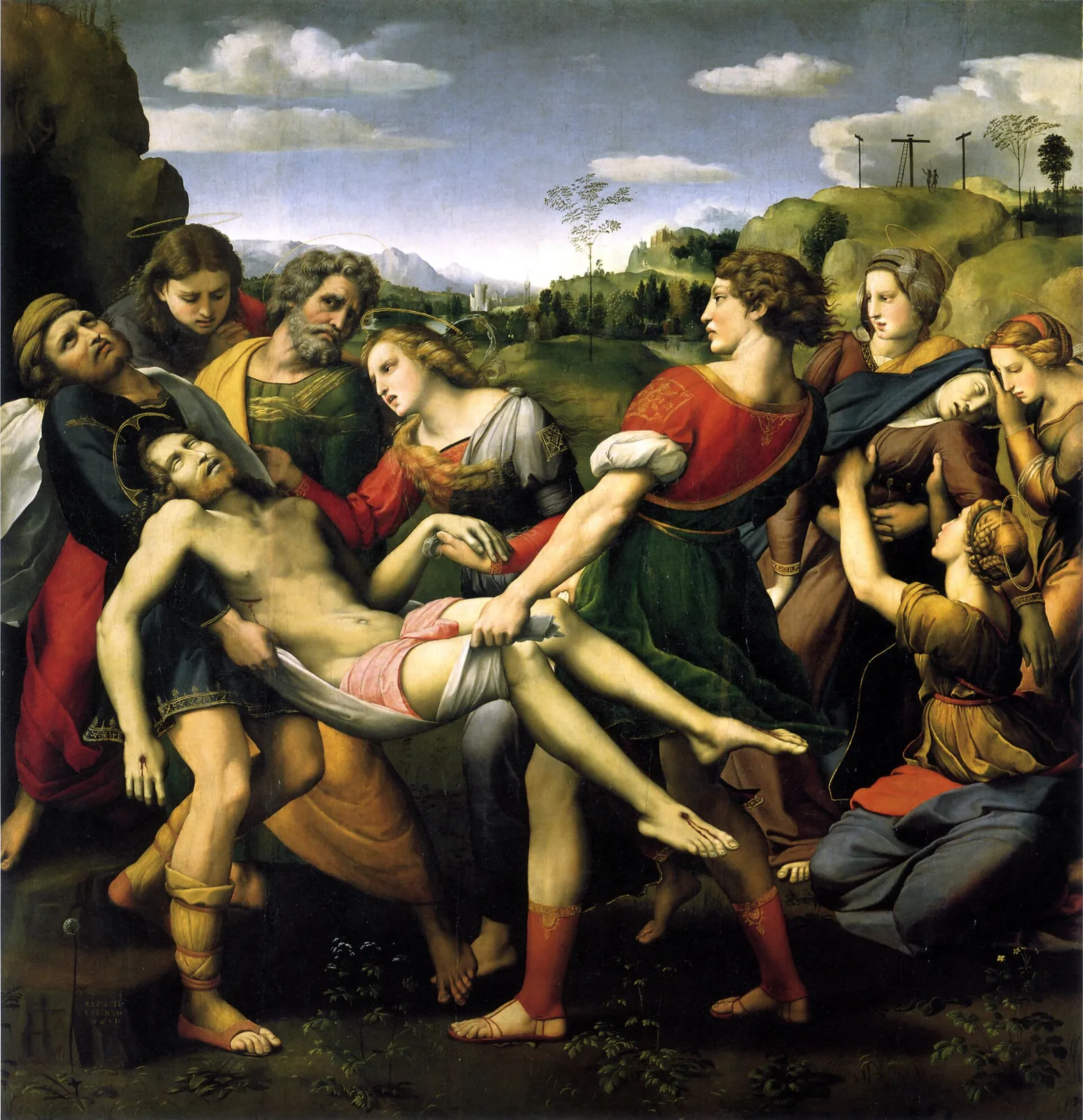
Raphael's The Deposition, dated 1507, belongs to the Galleria Borghese. It shows the dead Christ being carried toward the tomb while his mother collapses nearby. This makes it one of the young painter's most ambitious attempts at a dramatic, many-figured narrative.
Where to see it
The Deposition is held by the Galleria Borghese. The fact sheet lists its location as Room 9 (Dido). Displays can change because of conservation, rehanging or loans, so check the Galleria Borghese's official website for current display status, opening hours and ticketing before you plan your visit.
What to look for in person
The weight of the body
Start with the centre of the panel, where two men carry Christ's body in a cloth. The younger bearer on the right leans backward with his whole frame, and his straining pose makes the dead weight feel real. Christ's body hangs slack, one arm dropping toward the ground, a motif often linked to Michelangelo's Pietà. Mary Magdalene presses close and holds his hand. Notice how every figure in this group moves in a different direction, yet the eye keeps returning to the pale, still body at the heart of the action.
The fainting Virgin
Turn to the right side, where a second drama unfolds. The Virgin Mary collapses, and a group of women hurries to support her. The kneeling woman in front twists her body sharply to catch Mary, a turning pose that art historians often compare to the Virgin in Michelangelo's Doni Tondo. The painting therefore holds two events at once: the body carried toward burial and the mother overcome by grief. Look at the gap between the two groups and how a few turned heads and gestures bridge it.
Landscape, tomb and format
Behind the figures, a calm, open landscape stretches into the distance, in contrast to the tension in the foreground. On the hill at the right you can make out the crosses of Calvary, where the story began, while the dark opening of the tomb waits at the left, where it will end. The panel measures 174.5 by 178.5 cm, almost square, so the composition reads as a broad frieze of bodies moving from right to left. Step back to see the overall rhythm, then step closer for the faces.
About the painting
The Deposition was painted as an altarpiece, and its story is tied to grief within one family. It was commissioned by Atalanta Baglioni of Perugia in memory of her son Grifonetto, who was killed in 1500 during a violent feud inside the Baglioni family. The panel was made for the family chapel in the church of San Francesco al Prato in Perugia. The theme of a mother mourning her dead son therefore carried a personal meaning for the patron.
Raphael was working in Florence in these years, and the painting shows how much he was absorbing from the art around him, above all from Michelangelo. A large number of preparatory drawings survive. They show the design changing from a quieter Lamentation, with mourners gathered around the body, into the more energetic scene of Christ being carried to the tomb. This shift toward movement and physical effort makes the work a turning point in his development before he moved to Rome.
The altarpiece originally had further parts, including a predella with the Theological Virtues that is now held separately in the Vatican collections. In 1608 the main panel was removed from Perugia and taken for Cardinal Scipione Borghese, an avid collector, and it has remained with the Borghese collection ever since. A copy was installed in Perugia in its place. For visitors, knowing that this was once a family memorial in a church helps explain its mood: it combines the polish of a showpiece with real, intimate grief.
Key facts
| Artist | Raphael |
|---|---|
| Date | 1507 |
| Size | 174.5 × 178.5 cm |
| Medium | oil paint, panel |
| Collection | Galleria Borghese |
How to visit: Galleria Borghese
Rome, Italy · Museum guide
| Opening hours | Tue–Sun 09:00–19:00 (entry at the start of each hourly slot, max 180 visitors per slot; visits last 2 hours, last slot shorter) |
|---|---|
| Closed | Mondays; 25 December and 1 January |
| Last entry | 17:45 (some official information gives 17:50 for the last same-day slot) |
| Admission | Adults EUR 16 (plus EUR 2 reservation fee; may rise during temporary exhibitions) Adults, last time slot EUR 11 (plus reservation fee) Ages 18–25 EUR 2 (plus reservation fee; valid until 25th birthday) Under 18 free (EUR 2 reservation fee still applies) Reservation fee (all tickets) EUR 2 (mandatory, including free tickets) |
| Free entry | Free for under-18s, ICOM members, MiC staff, certain students and faculty (humanities, architecture, fine arts), EU school groups and authorised guides/interpreters. Free for everyone on the first Sunday of the month and on 25 Apr, 2 Jun and 4 Nov (EUR 2 reservation fee applies; tickets released 10 days ahead; no last-minute tickets). |
| Booking | Reservation is required for timed entry. Tickets for free days (first Sunday etc.) are released 10 days in advance. |
Official ticket page
Official website
View on map
Hours and prices can change. Please check the official website before you go. (Checked on: 2026-11-09)
More by Raphael
 Madonna of the Pinks — National Gallery
 La fornarina
 The Marriage of the Virgin
 Saint Catherine of Alexandria — National Gallery
 Transfiguration
 Madonna of the Goldfinch — Uffizi Gallery
 Madonna del Prato — Kunsthistorisches Museum
 Alba Madonna — National Gallery of Art
 Portrait of Leo X
 Christ Falling on the Way to Calvary — Museo del Prado
 Ansidei Madonna — National Gallery
 Ceres — Louvre Museum