Art! Art! Art! › Works
Ansidei Madonna
 Raphael, 1505
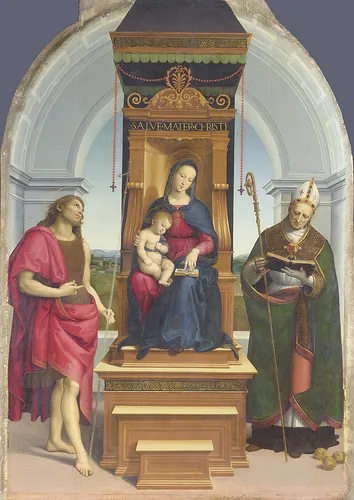
Raphael's Ansidei Madonna, dated to 1505, is a large altarpiece in the collection of the National Gallery. It shows the Virgin and Child enthroned between two saints, painted by a young artist still absorbing the calm, balanced style of his teacher's circle while moving toward his own.
Where to see it
The Ansidei Madonna is held by the National Gallery, which is also the location listed for the work. Display arrangements can change because of rehangs, conservation or other reasons, so check the National Gallery's official website for the painting's current display status before you plan your visit.
What to look for in person
A symmetrical stage for the figures
Stand back first and take in the overall structure. The Virgin sits high on a raised throne at the centre, with a saint standing on each side, and an architectural setting framing the group. The arrangement is strongly symmetrical and orderly, a hallmark of Umbrian altarpieces of this period. At 209.6 by 148.6 centimetres, the panel was designed to be read from a distance in a chapel, so notice how clearly the figures and their gestures register even from across the room.
The two saints and their attributes
On the left stands Saint John the Baptist, recognisable by his rough clothing and the slender cross he holds, his gaze turned upward toward it. On the right is Saint Nicholas of Bari in bishop's robes, absorbed in reading a book. Look at the ground near his feet for the three golden balls, his traditional attribute. The contrast between John's upward look and Nicholas's lowered, studious attention gives the quiet scene a gentle sense of movement and balance.
Small details worth a closer look
Move closer to study the finer touches. The Virgin holds an open book on her lap while the Christ Child sits with her, both turned toward its pages. Above the throne, look for the string of beads hanging from the canopy, a decorative detail that rewards patient viewing. Pay attention, too, to the soft modelling of faces and hands and the clear, even light across the scene, qualities that show the young Raphael's careful technique.
About the painting
The Ansidei Madonna takes its name from the Ansidei family, for whose chapel in a church in Perugia it is generally understood to have been painted. Its subject is a traditional one for altarpieces of the time: the Virgin and Child enthroned, flanked by saints, here Saint John the Baptist and Saint Nicholas of Bari. This kind of composition, in which holy figures share one unified space, was common in Italian religious painting of the late fifteenth and early sixteenth centuries.
The work dates to 1505, an early stage of Raphael's career. In these years he worked in the orbit of Umbrian painting, and the influence of Pietro Perugino, with whom he is closely associated, is widely recognised in the picture's calm mood, symmetrical design and graceful, idealised figures. At the same time, art historians often note a growing solidity and clarity in the figures that points toward the direction Raphael would take as his style developed.
For visitors, the painting is a good place to slow down. Its appeal lies less in drama than in harmony: the measured spacing of the figures, the steady light and the quiet exchange of glances and gestures. Spend a moment on each figure in turn, then step back to see how they combine into a single, balanced whole. Its considerable size, 209.6 by 148.6 centimetres, also reminds us that it was made for a specific sacred setting, where it would have been seen above an altar rather than at eye level in a gallery.
Key facts
| Artist | Raphael |
|---|---|
| Date | 1505 |
| Size | 209.6 × 148.6 cm |
| Medium | oil paint, panel |
| Collection | National Gallery |
How to visit: National Gallery
London, United Kingdom · Museum guide
| Opening hours | Mon–Thu, Sat, Sun 10:00–18:00 Fri 10:00–21:00 (Friday late) |
|---|---|
| Closed | 24–26 December and 1 January. |
| Admission | General admission (collection) free; donations invited Some exhibitions are charged (e.g. Renoir and Love, until 31 Jan 2027) |
| Free entry | General admission is always free. |
| Booking | No reservation or timed entry is required. Free timed booking gives fast-track entry. |
Building work and improvements are under way: some rooms are closed and some paintings have moved, so check the floorplans or collection search before visiting. A new Research Centre is due to open in 2028. On 17 November only, some east wing rooms and the Espresso Bar close from 16:00.
Official ticket page
Official website
View on map
Hours and prices can change. Please check the official website before you go. (Checked on: 2026-11-11)
More by Raphael
 Madonna of the Pinks — National Gallery
 La fornarina
 The Marriage of the Virgin
 Saint Catherine of Alexandria — National Gallery
 Transfiguration
 Madonna of the Goldfinch — Uffizi Gallery
 Madonna del Prato — Kunsthistorisches Museum
 The Deposition — Galleria Borghese
 Alba Madonna — National Gallery of Art
 Portrait of Leo X
 Christ Falling on the Way to Calvary — Museo del Prado
 Ceres — Louvre Museum