Art! Art! Art! › Works
The Marriage of the Virgin
 Raphael, 1504
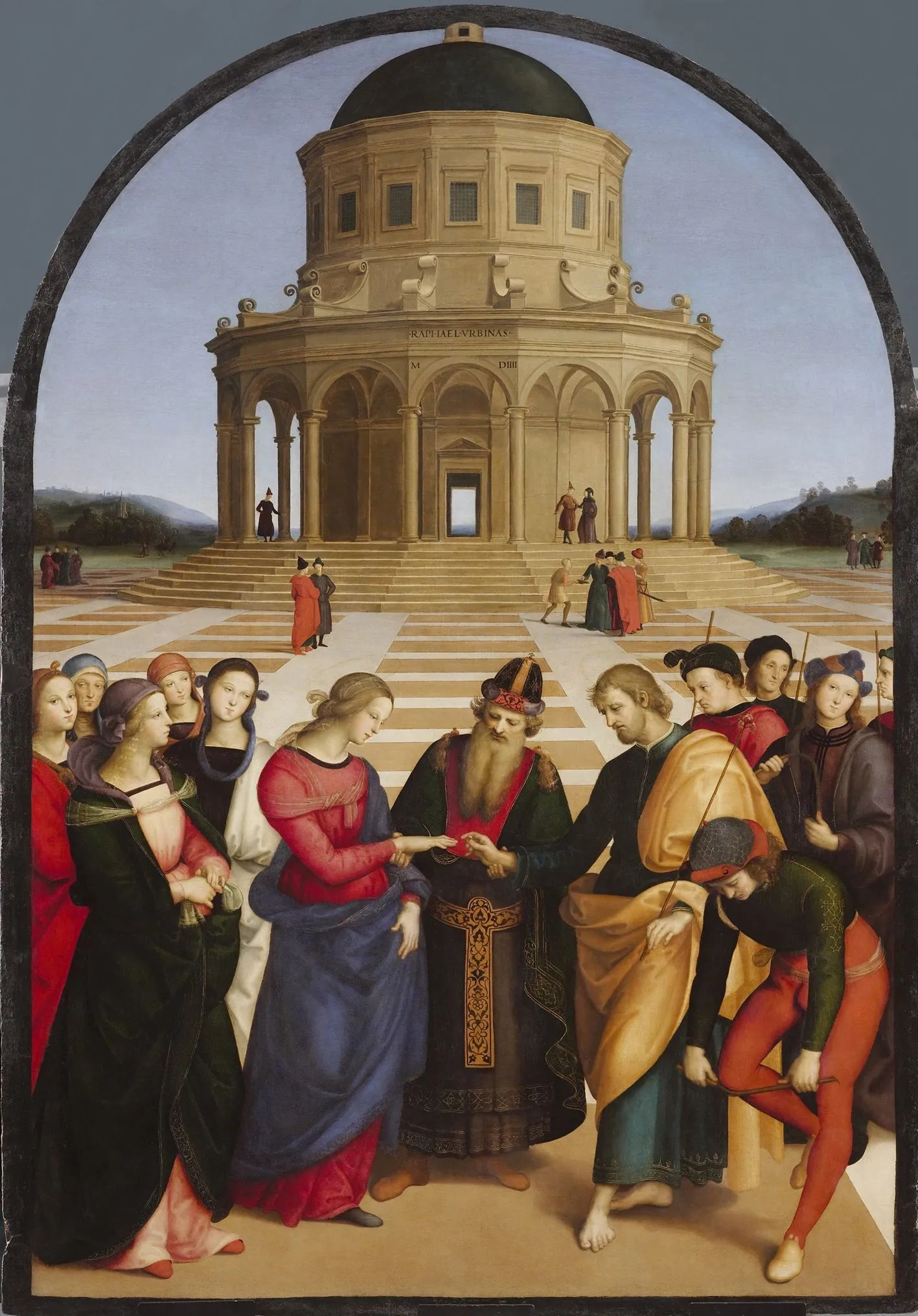
Raphael's The Marriage of the Virgin, dated 1504, is in the collection of the Pinacoteca di Brera. Painted when the artist was barely into his twenties, it shows the betrothal of Mary and Joseph in front of a domed temple, an image of order and calm that rewards slow looking.
Where to see it
The Marriage of the Virgin is held by the Pinacoteca di Brera, which is also its listed location. Display arrangements can change because of conservation work, rehanging or other museum activity, so check the Pinacoteca di Brera's official website for current display status, opening hours and ticketing before you plan your visit.
What to look for in person
The temple as the real centre
Before you look at the figures, let your eye travel up the paved square to the many-sided, domed temple in the background. It sits on the picture's central axis, and the lines of the paving lead straight to its open doorway, through which you can glimpse sky on the far side. The building is drawn with careful attention to proportion and symmetry. Step back and notice how the curved top of the panel echoes the dome, so the architecture and the shape of the picture work together.
The ring at the heart of the scene
In the foreground, the priest stands between Mary and Joseph and guides their hands as Joseph offers the ring. This small gesture falls very close to the vertical centre line that also runs through the temple door, linking the sacred building to the moment of the marriage. Look at how the hands are placed and how little movement there is: the event is shown as a quiet, solemn act rather than a dramatic one. Mary's group of women stands on one side, Joseph's group of men on the other.
The flowering rod and the broken one
Joseph holds a staff that has burst into bloom at its tip. In the traditional story, the suitors for Mary each brought a rod, and Joseph's flowering was the sign that he had been chosen. Now look among the men behind him: one young man bends a rod across his knee to break it, a sign of the disappointed suitors. It is an easily missed detail that gives a touch of human feeling to an otherwise composed and orderly scene.
About the painting
The Marriage of the Virgin is dated 1504 and measures 175 cm high by 118 cm wide, a size that lets you stand at a comfortable distance and take in both the figures and the architecture at once. It belongs to the early part of Raphael's career, before his years in Florence and Rome, and it is often discussed as the work in which he showed he could move beyond the manner of his older contemporary Pietro Perugino, who had painted the same subject. Comparing the two is a classic exercise in art history: Raphael's figures are more relaxed and varied in their poses, and the space feels more open and unified. The subject comes from traditions about the life of the Virgin rather than from the Gospels, and it centres on the moment Joseph is chosen as Mary's husband. Raphael signed the work on the temple itself; look for lettering on the building above the arches, where his name appears along with the date. In front of the painting, it is worth spending time on the way the space is built. The figures in the foreground form a gentle curve, while the square behind them recedes towards the temple, and small figures in the middle distance help you judge the depth. The light is even and clear, the colours are balanced across both sides, and nothing pulls hard against the calm symmetry. The result is a picture about harmony: between people, between the human and the sacred, and between figures and the space they stand in. Bring time rather than a checklist; the details reveal themselves gradually.
Key facts
| Artist | Raphael |
|---|---|
| Date | 1504 |
| Size | 175 × 118 cm |
| Medium | oil paint, panel |
| Collection | Pinacoteca di Brera |
How to visit: Pinacoteca di Brera
Milan, Italy
Hours and prices can change. Please check the official website before you go.
More by Raphael
 Madonna of the Pinks — National Gallery
 La fornarina
 Saint Catherine of Alexandria — National Gallery
 Transfiguration
 Madonna of the Goldfinch — Uffizi Gallery
 Madonna del Prato — Kunsthistorisches Museum
 The Deposition — Galleria Borghese
 Alba Madonna — National Gallery of Art
 Portrait of Leo X
 Christ Falling on the Way to Calvary — Museo del Prado
 Ansidei Madonna — National Gallery
 Ceres — Louvre Museum