Art! Art! Art! › Works
Madonna of the Goldfinch
 Raphael, 1500s
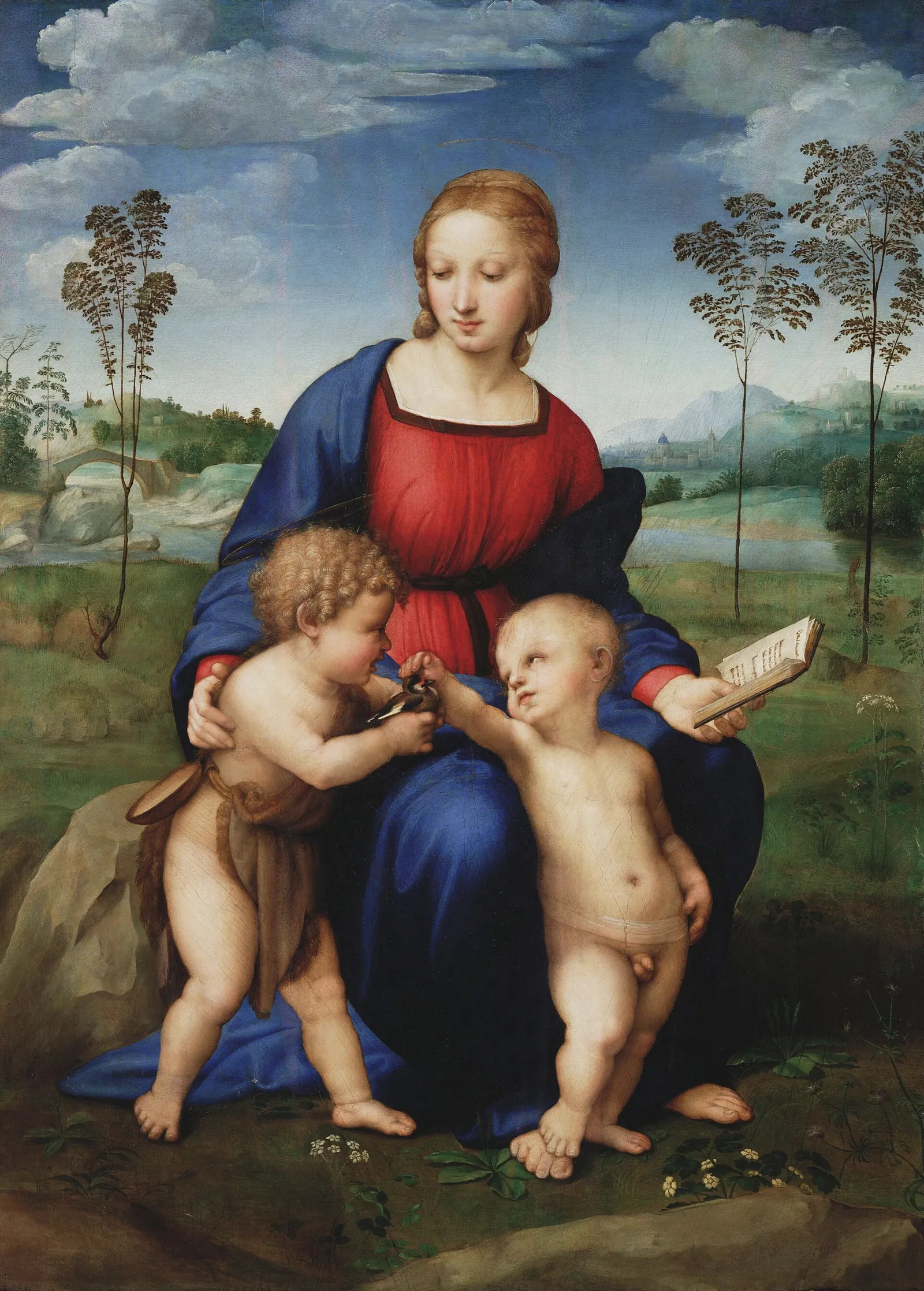
Raphael's Madonna of the Goldfinch is in the collection of the Uffizi Gallery. Painted in the 1500s and measuring 107 by 77 cm, it shows the Virgin Mary seated in a landscape with the infant Christ and the young John the Baptist, who holds a small bird between them.
Where to see it
The Madonna of the Goldfinch belongs to the Uffizi Gallery, which is also its recorded location. Works in major collections are sometimes moved between rooms, taken off view for conservation, or lent to other institutions, so check the Uffizi Gallery's official website for current display status before you visit.
What to look for in person
The goldfinch at the centre
Look to the middle of the picture, where the young John the Baptist offers a goldfinch to the infant Christ, who reaches out to stroke it. The bird is small, so step close to find it. In Christian art the goldfinch is traditionally read as a sign of Christ's future Passion, because it was associated with thorns and thistles. That gives the gentle exchange between the two children a more serious meaning, which Raphael keeps quiet rather than dramatic.
A stable, triangular group
Step back and notice how Mary and the two children form a broad triangle, with her head at the top and the children at the base. This pyramid-like arrangement is widely linked to Raphael's study of Leonardo da Vinci's compositions during his years in Florence. The shape makes the group feel calm and balanced. Follow the lines of the bodies and glances: Mary looks down at John, John looks at Christ, and the bird draws your eye back to the centre.
Mary's book and the open landscape
Mary holds a book in her left hand, as though she has just looked up from reading, a common way of presenting her as thoughtful and devout. Behind the figures, the view opens onto a soft landscape with trees, water and distant hills that fade into blue. Compare the clear, detailed foreground with the hazy background: this shift in colour and sharpness creates a sense of depth and gives the whole scene a quiet, open-air setting.
About the painting
Madonna of the Goldfinch is an oil painting on panel by Raphael, dating from the 1500s and measuring 107 by 77 cm. It is held by the Uffizi Gallery. The picture belongs to the group of Madonnas that Raphael painted while working in Florence early in his career, a period when he absorbed ideas from Leonardo da Vinci and other artists active in the city. In these works he explored how to arrange the Virgin and children into compact, harmonious groups set against open countryside.
The subject brings together three figures. Mary sits on a rock with a book, the infant Christ stands between her knees, and the young John the Baptist, identified by his simple garment and the small bowl at his waist, offers a goldfinch. The meeting of the two boys is a familiar theme in Renaissance devotional art, and the goldfinch adds a reminder of the Passion to an otherwise tender family scene.
According to the early biographer Giorgio Vasari, Raphael painted the work for a Florentine patron, Lorenzo Nasi, on the occasion of his marriage. Vasari also reports that the panel was badly damaged when the patron's house collapsed, and that the broken pieces were put back together. The painting has since undergone conservation, and when you look closely you may be able to make out traces of old damage in the panel's surface.
When you visit, give yourself time to look both close up and from a few steps back. Up close, notice the faces, the bird and the plants at the figures' feet; from a distance, the balance of the triangular group and the depth of the landscape become clearer.
Key facts
| Artist | Raphael |
|---|---|
| Date | 1500s |
| Size | 107 × 77 cm |
| Medium | oil paint, panel |
| Collection | Uffizi Gallery |
How to visit: Uffizi Gallery
Florence, Italy · Museum guide
| Opening hours | Tue–Sun 08:15–18:30 (visitors leave by 18:30) |
|---|---|
| Closed | Mondays, 1 January and 25 December. |
| Last entry | Ticket office closes at 17:30. |
| Admission | Regular, bought on the day EUR 25 Regular, bought in advance EUR 29 Regular, entry from 16:00 (from 1 January 2026) EUR 16 Reduced (EU citizens aged 18–25; citizens of Switzerland, Norway, Liechtenstein, Uruguay etc.; ID required) EUR 2 Under 18 free (under 12s must be accompanied) Uffizi + Vasari Corridor EUR 43 on the day / EUR 47 in advance; named ticket, reservation required, non-refundable PassePartout 5 days (Uffizi, Pitti Palace, Boboli) EUR 40 (EUR 58 with Vasari Corridor) Audio guide EUR 6 |
| Free entry | Free for under-18s; disabled visitors plus one companion; tour guides and interpreters, ICOM members, certain journalists, and university teachers/students on the official list. Admission is free on the first Sunday of each month (national museums), when reservations are not possible. |
| Booking | Reservation is not required, except for the Uffizi + Vasari Corridor ticket, which must be reserved. |
Restoration and rearrangement works mean some rooms are temporarily closed and some artworks are not on display. A staff assembly on 11–12 November 2026 may change opening times.
Official ticket page
Official website
View on map
Hours and prices can change. Please check the official website before you go. (Checked on: 2026-11-12)
More by Raphael
 Madonna of the Pinks — National Gallery
 La fornarina
 The Marriage of the Virgin
 Saint Catherine of Alexandria — National Gallery
 Transfiguration
 Madonna del Prato — Kunsthistorisches Museum
 The Deposition — Galleria Borghese
 Alba Madonna — National Gallery of Art
 Portrait of Leo X
 Christ Falling on the Way to Calvary — Museo del Prado
 Ansidei Madonna — National Gallery
 Ceres — Louvre Museum