Art! Art! Art! › Works
Madonna del Prato
 Raphael, 1500s
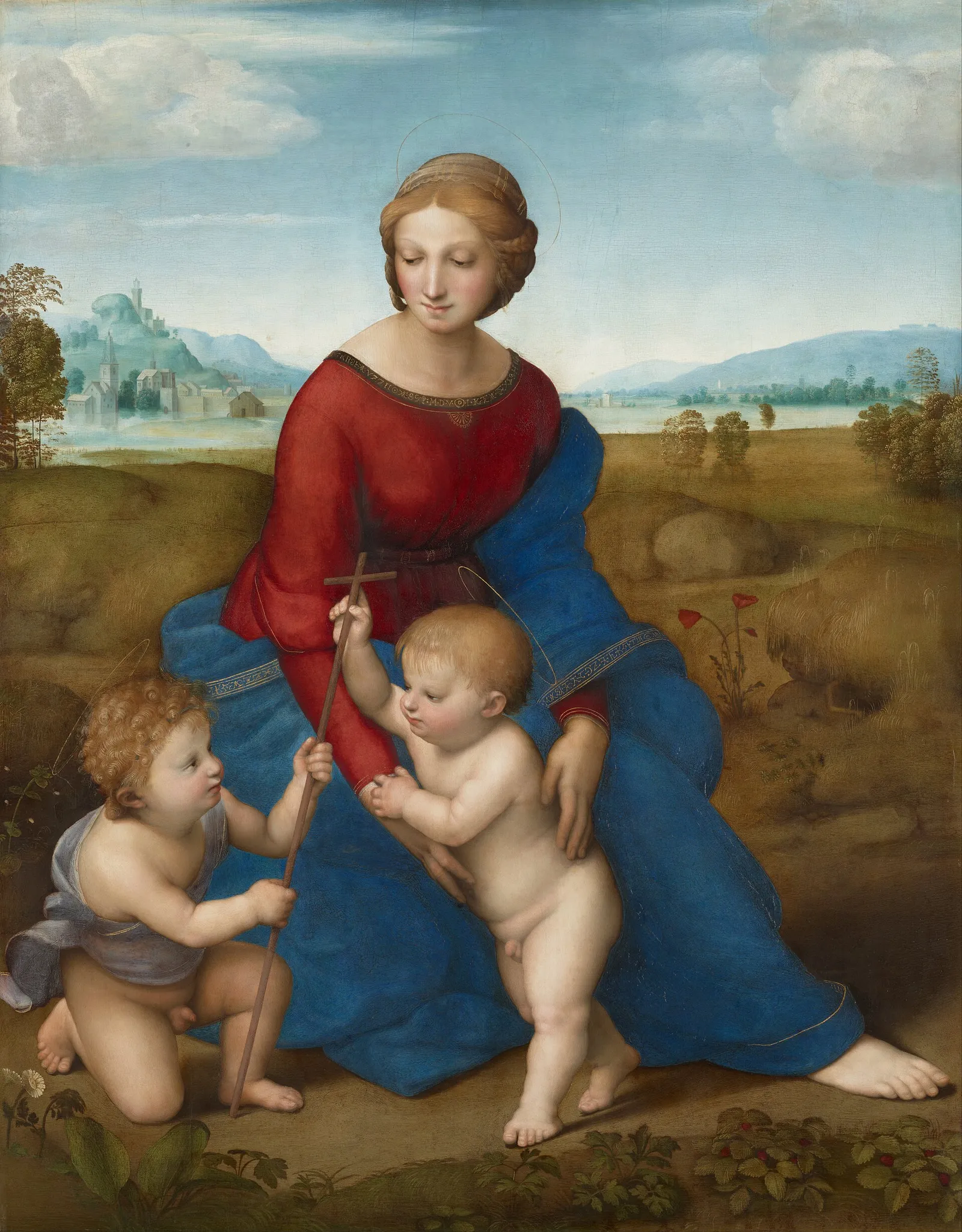
Raphael's Madonna del Prato, also known as the Madonna of the Meadow, is in the collection of the Kunsthistorisches Museum. The painting dates to the 1500s and measures 113 by 88.5 cm. It shows the Virgin Mary seated in an open landscape with the infant Christ and the young John the Baptist.
Where to see it
Madonna del Prato belongs to the Kunsthistorisches Museum. Its recorded locations include Ambras Castle, the Belvedere and the Kunsthistorisches Museum, which reflect where the work has been kept. Works can be moved, lent or taken off view for conservation, so check the Kunsthistorisches Museum's official website for current display status before you visit.
What to look for in person
A triangle of figures
Step back first and look at the overall shape. The Virgin and the two children are arranged so that they form a stable triangle, with Mary's head at the top and the children at her feet forming the base. This pyramidal grouping is closely associated with Leonardo da Vinci, whose work Raphael studied closely. Notice how the arrangement gives the scene a sense of calm and balance, while the turning bodies, tilted heads and linked glances keep it from feeling stiff or posed.
The small cross
Look at the thin cross between the two children. The infant John the Baptist, kneeling at the left, holds it, and the Christ Child reaches toward it. To viewers of Raphael's time, this detail pointed ahead to the Crucifixion, giving a quiet, gentle scene a deeper meaning. Follow the Virgin's gaze downward to the children: her calm expression and protective gesture frame the exchange. It is a small element, easy to overlook at first, but it carries the painting's central religious idea.
The meadow and distant landscape
The painting takes its name from the meadow where Mary sits. Move closer to see the plants painted in the foreground, then let your eye travel back across the water and hills to the pale, hazy horizon. Colours grow softer and bluer with distance, a technique that creates a convincing sense of depth. Notice also the strong reds and blues of the Virgin's clothing, traditional colours for Mary, which stand out clearly against the greens and soft blues of the landscape.
About the painting
Madonna del Prato is a devotional painting by Raphael, dated in the fact sheet to the 1500s. At 113 by 88.5 cm, it is a fairly large panel for a private devotional image, large enough that the figures read clearly from across a room, yet detailed enough to reward close looking. The subject is the Virgin Mary with the infant Christ and the infant John the Baptist, a theme Raphael returned to several times. Art historians generally place this work in the period when Raphael was active in Florence, where he absorbed the ideas of Leonardo da Vinci and Michelangelo. The influence of Leonardo is often noted in the triangular grouping of the figures and in the soft modelling of faces and bodies, where light shades gradually into shadow rather than being outlined sharply. Raphael combined these lessons with his own clarity and sense of harmony. When you stand in front of the painting, it helps to read it in layers: the closely linked group of mother and children in the foreground, the flowering meadow around them, and the open, light-filled landscape behind. The calm mood is deliberate, but the cross held by John adds a note of foreboding that viewers would have recognised. The painting is held by the Kunsthistorisches Museum. Its recorded locations, Ambras Castle, the Belvedere and the Kunsthistorisches Museum, trace places where the work has been housed. Before planning a trip specifically to see it, confirm on the museum's official website that it is currently on view.
Key facts
| Artist | Raphael |
|---|---|
| Date | 1500s |
| Size | 113 × 88.5 cm |
| Medium | oil paint, poplar panel |
| Collection | Kunsthistorisches Museum |
How to visit: Kunsthistorisches Museum
Vienna, Austria · Museum guide
| Opening hours | Mon–Wed, Fri–Sun 10:00–18:00 Thu 10:00–21:00 (late opening) 24 December 10:00–15:00 31 December 10:00–21:00 |
|---|---|
| Closed | Open daily with no regular closing day. Rooms 24, VIII, 14 and IX are currently closed. |
| Admission | Adult (online) EUR 22 (EUR 24 on site) Reduced (online) EUR 19 (EUR 20 on site; EUR 23 with Vienna City Card) Under 19 free (registered at the entrance, no online booking needed) Combined Ticket “Habsburg Treasures” EUR 32 Masterticket EUR 37 |
| Free entry | Free for under-19s and accredited media (register 2 working days ahead). |
| Booking | Reservation is required, with timed entry. |
Official ticket page
Official website
View on map
Hours and prices can change. Please check the official website before you go. (Checked on: 2026-11-09)
More by Raphael
 Madonna of the Pinks — National Gallery
 La fornarina
 The Marriage of the Virgin
 Saint Catherine of Alexandria — National Gallery
 Transfiguration
 Madonna of the Goldfinch — Uffizi Gallery
 The Deposition — Galleria Borghese
 Alba Madonna — National Gallery of Art
 Portrait of Leo X
 Christ Falling on the Way to Calvary — Museo del Prado
 Ansidei Madonna — National Gallery
 Ceres — Louvre Museum