Art! Art! Art! › Works
Alba Madonna
 Raphael, 1510
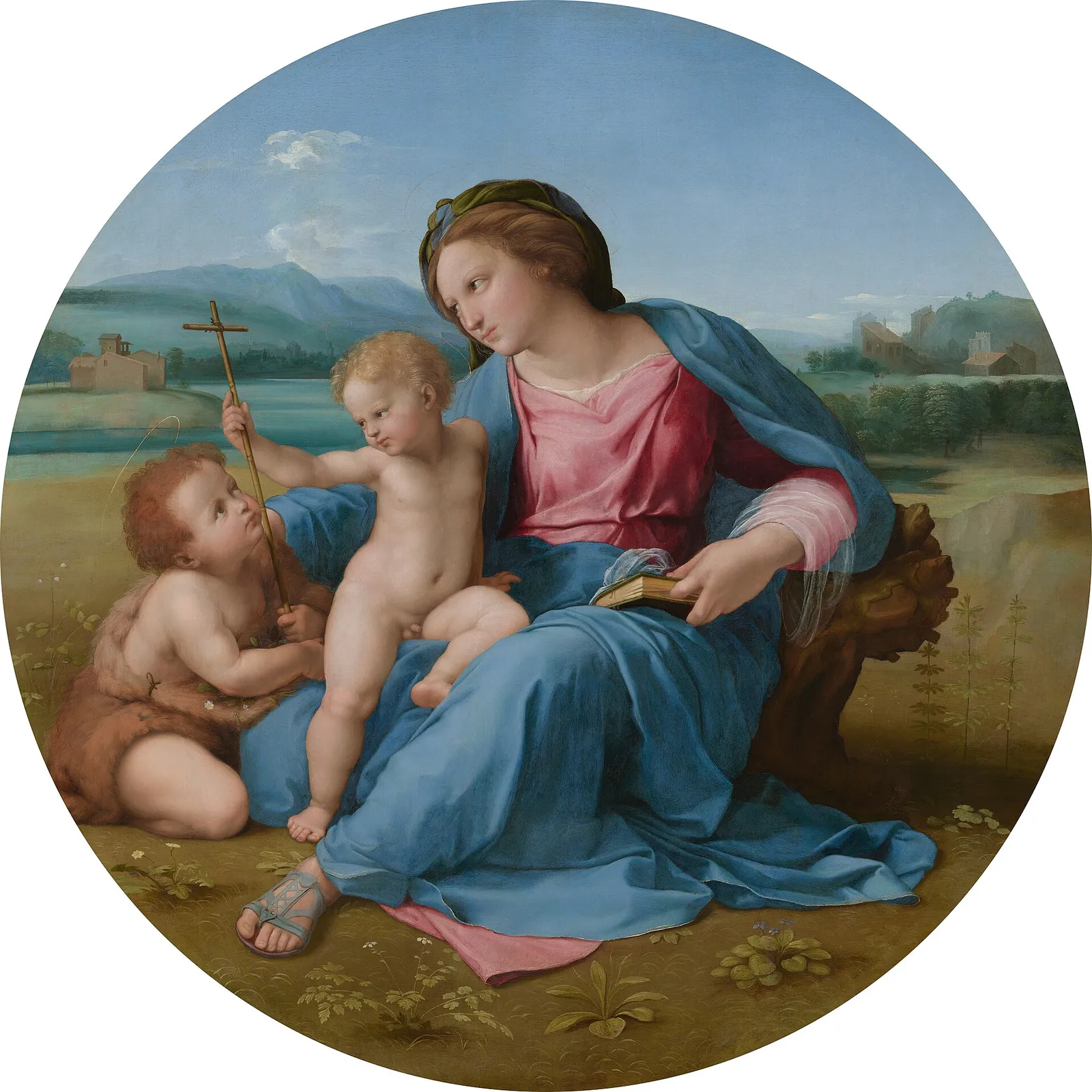
Raphael's Alba Madonna, dated 1510, shows the Virgin, the Christ Child and the young John the Baptist in an open landscape, arranged within a circular format. Our fact sheet records its collection history as including the Hermitage Museum and the Andrew W. Mellon collection. Its current location is recorded only as the Wikidata item Q214867, so confirm the holding museum before you plan a visit.
Where to see it
Our source lists the painting's location only by the Wikidata identifier Q214867, not by a museum name, so we cannot name the current holding museum from our verified facts. The collection record lists the Andrew W. Mellon collection, Q214867 and the Hermitage Museum. These read as a sequence of owners rather than a single current home, so do not assume the Hermitage holds it today. Before visiting, look up Q214867 (https://www.wikidata.org/wiki/Q214867) to identify the institution. Then check that museum's official website for whether the painting is on display, its opening hours and its ticketing.
What to look for in person
Three figures bound into a circle
Start by stepping back and taking in the whole round composition. Raphael fits the Virgin, the Christ Child and the young John the Baptist into a compact group whose poses follow the curve of the frame. The Virgin's body, the turn of her head and the positions of the children create a gentle, circling movement. Notice how no figure feels cramped despite the tight format. The shape of the panel and the arrangement of the bodies work together, which is a large part of why the picture reads as calm and balanced.
The exchange of the cross
Move closer to the centre of the group. The Christ Child reaches for a small cross held by the infant John the Baptist, and the Virgin's gaze follows this moment. Look at the hands and eyes: they draw your attention to the cross, a reference to Christ's future Passion. The scene stays quiet and intimate. It is not dramatic, and much of its meaning rests in this small gesture. Take time to follow the lines of sight between the three figures. Together they form the emotional core of the painting.
A Madonna seated on the ground in a landscape
Instead of placing the Virgin on a throne, Raphael seats her low on the ground, in a type often called the Madonna of Humility. Behind the group a broad landscape opens towards a distant horizon, with soft light and space receding into the background. Compare the solid, sculptural figures in the foreground with the airy distance behind them. Also look at the drapery of the Virgin's garments, whose folds help give her body weight and volume. All of this sits within a work recorded as 98 by 98 centimetres.
About the painting
The Alba Madonna is a devotional painting by Raphael, recorded in our fact sheet with the date 1510 and dimensions of 98 by 98 centimetres. The work dates from the years when Raphael was active in Rome. During that period his figure compositions became fuller and more monumental than in his earlier Florentine Madonnas. Its subject is a familiar one in Renaissance devotional art: the Virgin Mary with the Christ Child and the infant John the Baptist, set outdoors rather than in an interior or heavenly setting.
The painting's circular format, known as a tondo, was popular for private devotional images in Renaissance Italy. Raphael uses it to unify the figures, letting their poses echo the curved edge. The painting's popular name comes from the Dukes of Alba in Spain, who are traditionally associated with its ownership history.
Our fact sheet lists the painting's collection record as the Andrew W. Mellon collection, the Wikidata item Q214867 and the Hermitage Museum. This reflects a history of changing ownership across different collections and countries. The fact sheet gives no dates or details for these transfers, so we do not describe them here.
For visitors, the picture rewards slow looking. Follow the gestures towards the small cross, the glances between the figures, and the contrast between the weighty foreground group and the open landscape. Because the current holding institution is identified in our source only by a Wikidata identifier, confirm the museum and current display status through official sources before you travel.
Key facts
| Artist | Raphael |
|---|---|
| Date | 1510 |
| Size | 98 × 98 cm |
| Medium | oil paint, panel, transferred on canvas |
| Collection | Andrew W. Mellon collection / Q214867 / Hermitage Museum |
| Gallery | West Building, Main Floor, Gallery 20 Checked in the museum's open data on 2026-11-12 (galleries can change) Source |
How to visit: National Gallery of Art
Washington, D.C., United States · Museum guide
| Opening hours | Mon–Sun 10:00–17:00 (open daily) |
|---|---|
| Closed | 25 December and 1 January |
| Admission | All visitors: free (including special exhibitions) |
| Free entry | Admission is always free. No passes or tickets are needed for the galleries, exhibitions or guided tours; some events require free registration. |
| Booking | No reservation is required and there is no timed entry. |
Hours and prices can change. Please check the official website before you go. (Checked on: 2026-11-11)
More by Raphael
 Madonna of the Pinks — National Gallery
 La fornarina
 The Marriage of the Virgin
 Saint Catherine of Alexandria — National Gallery
 Transfiguration
 Madonna of the Goldfinch — Uffizi Gallery
 Madonna del Prato — Kunsthistorisches Museum
 The Deposition — Galleria Borghese
 Portrait of Leo X
 Christ Falling on the Way to Calvary — Museo del Prado
 Ansidei Madonna — National Gallery
 Ceres — Louvre Museum