Art! Art! Art! › Works
Christ Falling on the Way to Calvary
 Raphael, 1510s
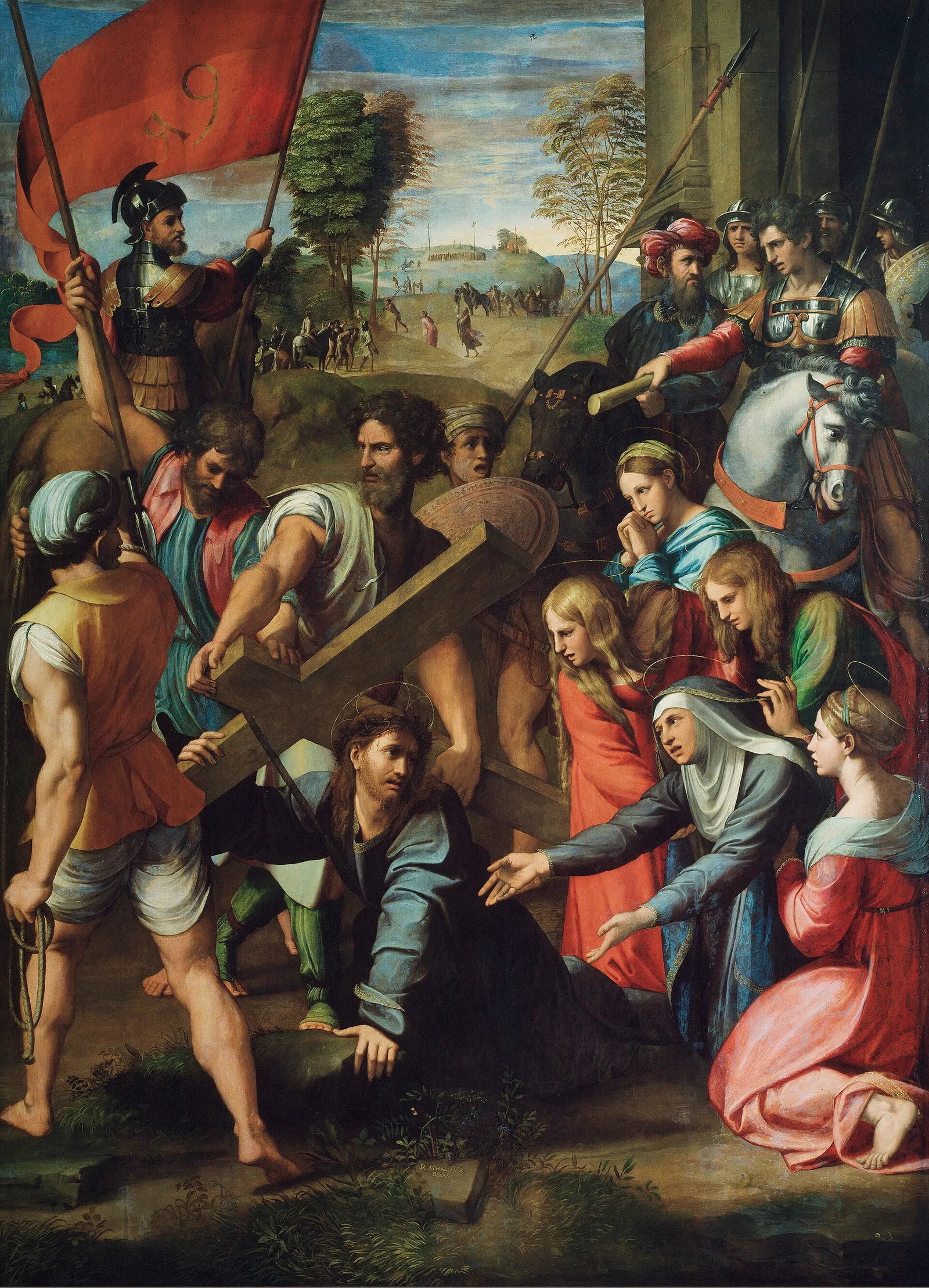
Raphael's Christ Falling on the Way to Calvary is a large altarpiece from the 1510s, held by the Museo del Prado. It shows Christ collapsing under the cross while his mother reaches toward him, a moment of grief set amid a crowded procession. At more than three metres tall, it is a painting best experienced in person.
Where to see it
Christ Falling on the Way to Calvary is in the collection of the Museo del Prado, and the Museo del Prado is listed as its location. Display arrangements can change because of rehangs, conservation work or loans, so check the Museo del Prado's official website for current display status before you plan your visit around this painting.
What to look for in person
The exchange of glances
Start with the centre of the picture. Christ has fallen to the ground under the weight of the cross, yet he turns his head back toward his mother. Mary, supported by companions, reaches out toward him. Follow the line between their faces and hands: Raphael makes this silent connection the emotional core of the scene, cutting through the noise of soldiers and onlookers. Notice how restrained the gestures are. The grief is shown through posture, glance and outstretched arms rather than exaggerated expression, which rewards a slow, close look.
Simon of Cyrene and the crowd
Look at the figure straining to lift the heavy beam of the cross from Christ's shoulders. In the Gospel accounts, Simon of Cyrene was made to help carry the cross, and here his effort gives the composition a strong physical diagonal. Around him, armed men, horses and banners fill the space, pushing the procession onward. Step back and see how the busy, forceful movement of the crowd contrasts with the stillness of the mourning women. That tension between action and pause is one of the main ways the painting tells its story.
Scale and the distant hill
The painting measures 318 cm high and 229 cm wide, so many figures appear close to life-size. Stand at a distance first to take in the full vertical composition, then move closer to study faces, armour and fabric. Let your eye travel toward the background, where the landscape opens up and the procession is heading toward the hill of execution. This distant destination quietly reminds the viewer of what is to come, while the foreground holds the immediate human drama of the fall.
About the painting
Christ Falling on the Way to Calvary dates from the 1510s, the period when Raphael was working in Rome and producing some of his most ambitious religious compositions. The painting depicts an episode from the Passion: Christ, carrying his cross to the place of crucifixion, stumbles and falls. The Gospels describe the procession to Calvary and the role of Simon of Cyrene, while the encounter between Christ and his grieving mother on the road belongs to later devotional tradition. The work is often known by the Italian name Lo Spasimo, a reference to the anguish of the Virgin Mary, and it was painted as an altarpiece for a church dedicated to Santa Maria dello Spasimo in Palermo, Sicily. For visitors, the painting is a clear example of how Raphael organised a large, crowded narrative. He places the key figures in the foreground, uses the diagonal of the cross to bind the group together, and opens the background into landscape so the eye can rest and understand where the procession is going. The emotional register is heightened compared with his calmer Madonnas, yet it remains controlled and legible. The dimensions, 318 by 229 cm, reflect its original function as a church altarpiece meant to be seen from a distance by a congregation. When you stand before it, consider how it would have read above an altar: the fallen Christ at eye level for worshippers, the mother's gesture inviting their own compassion.
Key facts
| Artist | Raphael |
|---|---|
| Date | 1510s |
| Size | 318 × 229 cm |
| Medium | oil paint, canvas |
| Collection | Museo del Prado |
How to visit: Museo del Prado
Madrid, Spain · Museum guide
| Opening hours | Mon–Sat 10:00–20:00 Sun and public holidays 10:00–19:00 6 Jan, 24 Dec, 31 Dec 10:00–14:00 (limited opening) |
|---|---|
| Closed | Closed on 1 January, 1 May and 25 December. |
| Last entry | Last entry 30 minutes before closing; visitors are asked to leave the galleries 10 minutes before closing. |
| Admission | General EUR 15 (includes the Collection and temporary exhibitions) Reduced (over 65, youth card holders, members of large families) EUR 7.5 Under 18, students aged 18–25, people with a disability of 33% or more, and other listed groups: free (official proof required at the ticket office on the day) Audio guide EUR 5 (added to the ticket; over 250 works in 15 languages) |
| Free entry | The Collection is free during the last two hours before closing (tickets at the ticket office, subject to capacity; 50% off temporary exhibitions). Always free for under-18s, students aged 18–25 and other listed groups with official proof at the ticket office. |
| Booking | Entry is by timed ticket. |
Official ticket page
Official website
View on map
Hours and prices can change. Please check the official website before you go. (Checked on: 2026-11-11)
More by Raphael
 Madonna of the Pinks — National Gallery
 La fornarina
 The Marriage of the Virgin
 Saint Catherine of Alexandria — National Gallery
 Transfiguration
 Madonna of the Goldfinch — Uffizi Gallery
 Madonna del Prato — Kunsthistorisches Museum
 The Deposition — Galleria Borghese
 Alba Madonna — National Gallery of Art
 Portrait of Leo X
 Ansidei Madonna — National Gallery
 Ceres — Louvre Museum