Art! Art! Art! › Works
Portrait of Leo X
 Raphael, 1518
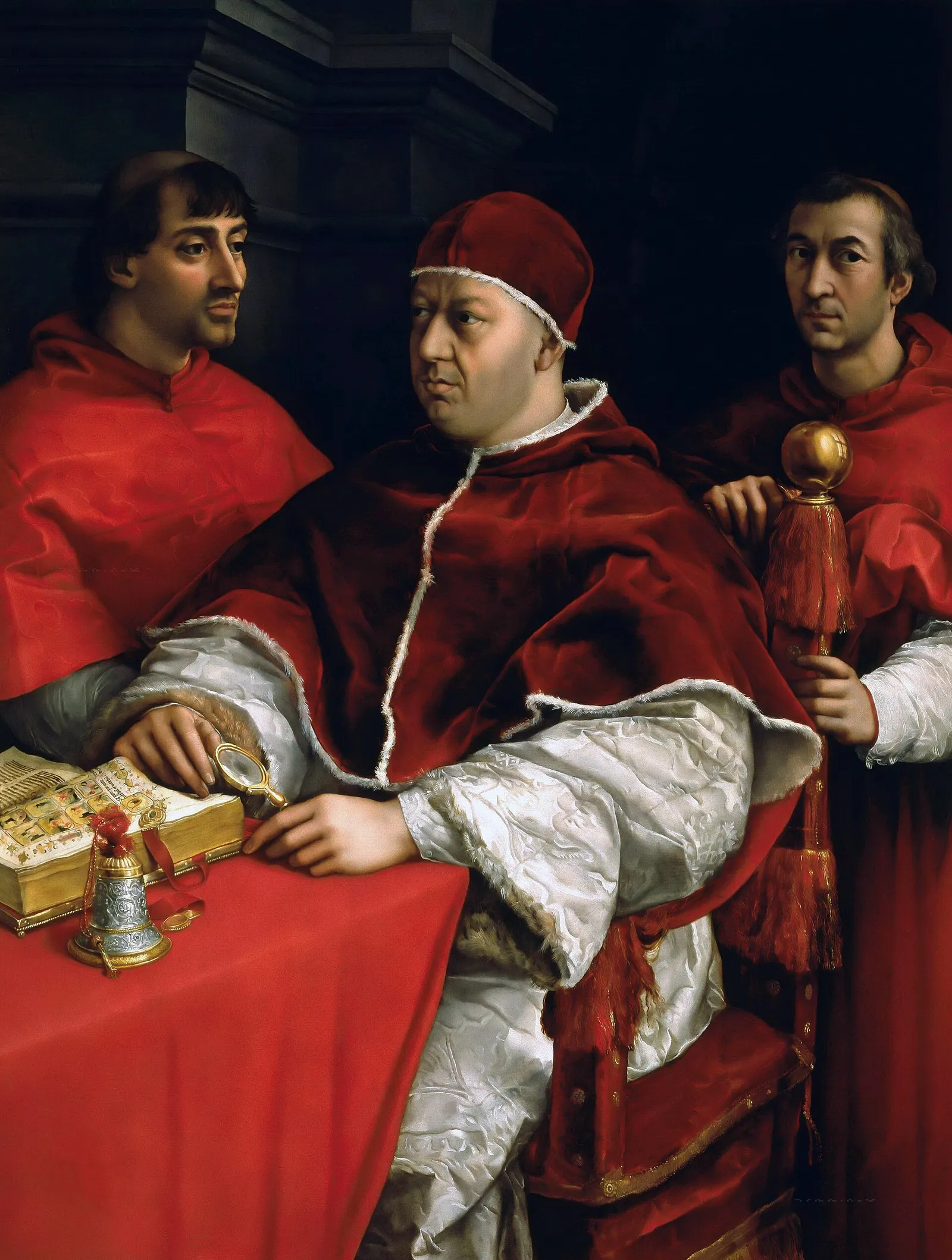
Raphael's Portrait of Leo X, dated 1518, shows the Medici pope seated at a table with two cardinals standing behind him. The painting is in the collection of the Galleria Palatina, where it can be studied up close for its rich reds, careful textures and quiet psychological tension.
Where to see it
The Portrait of Leo X is held by the Galleria Palatina. Display arrangements can change because of conservation, rehanging or loans, so check the museum's official website for current display status, opening hours and ticketing before you visit. The canvas measures 155.5 x 119.5 cm, so plan to view it from a few steps back for the group composition, then move closer to study the small details on the table and chair.
What to look for in person
A window caught in the chair knob
Look at the round, polished finial on the back of the pope's chair, near the lower right of the group. Raphael painted a tiny reflection on its surface, usually read as a window and the light of the room the sitters occupy. It is easy to miss from a distance, so step closer. This small passage shows how carefully Raphael observed light on metal, and it quietly places the viewer in the same space as the pope and his companions.
Red against red
Much of the canvas is built from shades of red: the pope's velvet cape and cap, the cardinals' robes, the cloth covering the table and the dark background behind them. Instead of contrasting colors, Raphael separates forms through texture and light. Compare the soft sheen of velvet, the fur trim, and the pale, patterned silk of the pope's sleeves. Standing in front of the painting, notice how the warm, closed palette makes the scene feel intimate and heavy at once.
Objects of a learned collector
On the table lies an open illuminated manuscript, and Leo X holds a magnifying glass, as if he has just paused while examining the pages. Beside the book sits a small, finely worked bell. These objects present the pope not only as a church leader but as a cultivated patron of books and fine craftsmanship, an image associated with the Medici family. Look at how the pope's hand, the lens and the page are lit, drawing your eye toward this moment of study.
About the painting
Raphael painted the Portrait of Leo X in 1518, when he was one of the leading artists working for the papal court in Rome. Leo X, born Giovanni de' Medici, was the son of Lorenzo the Magnificent and became pope in 1513. He was a major patron of Raphael, and this portrait reflects both his authority and his reputation for learning and collecting. The composition breaks with the tradition of the single papal portrait by adding two cardinals, generally identified as the pope's cousin Giulio de' Medici, at the left, and Luigi de' Rossi, behind the chair at the right. Both were members of the pope's family circle, so the picture also presents the Medici as a group holding power within the Church. Neither cardinal meets the viewer directly in a simple way, and the three men seem absorbed in their own thoughts, which gives the scene a restrained, watchful mood. For visitors, the painting rewards slow looking. The large canvas, 155.5 x 119.5 cm, places the figures at close to life size, and the dense treatment of fabric, metal and paper invites you to compare surfaces across the picture. Raphael avoids flattery in the pope's heavy face, yet the setting, the costly materials and the open manuscript frame him as a serious and cultivated ruler. The work is often cited as an influential model for later group and state portraits, especially in the way it combines likeness, status and personal objects in one carefully lit interior.
Key facts
| Artist | Raphael |
|---|---|
| Date | 1518 |
| Size | 155.5 × 119.5 cm |
| Medium | oil paint, panel |
| Collection | Galleria Palatina |
How to visit: Galleria Palatina
Florence, Italy
Hours and prices can change. Please check the official website before you go.
More by Raphael
 Madonna of the Pinks — National Gallery
 La fornarina
 The Marriage of the Virgin
 Saint Catherine of Alexandria — National Gallery
 Transfiguration
 Madonna of the Goldfinch — Uffizi Gallery
 Madonna del Prato — Kunsthistorisches Museum
 The Deposition — Galleria Borghese
 Alba Madonna — National Gallery of Art
 Christ Falling on the Way to Calvary — Museo del Prado
 Ansidei Madonna — National Gallery
 Ceres — Louvre Museum