Art! Art! Art! › Works
Saint Catherine of Alexandria
 Raphael, 1507
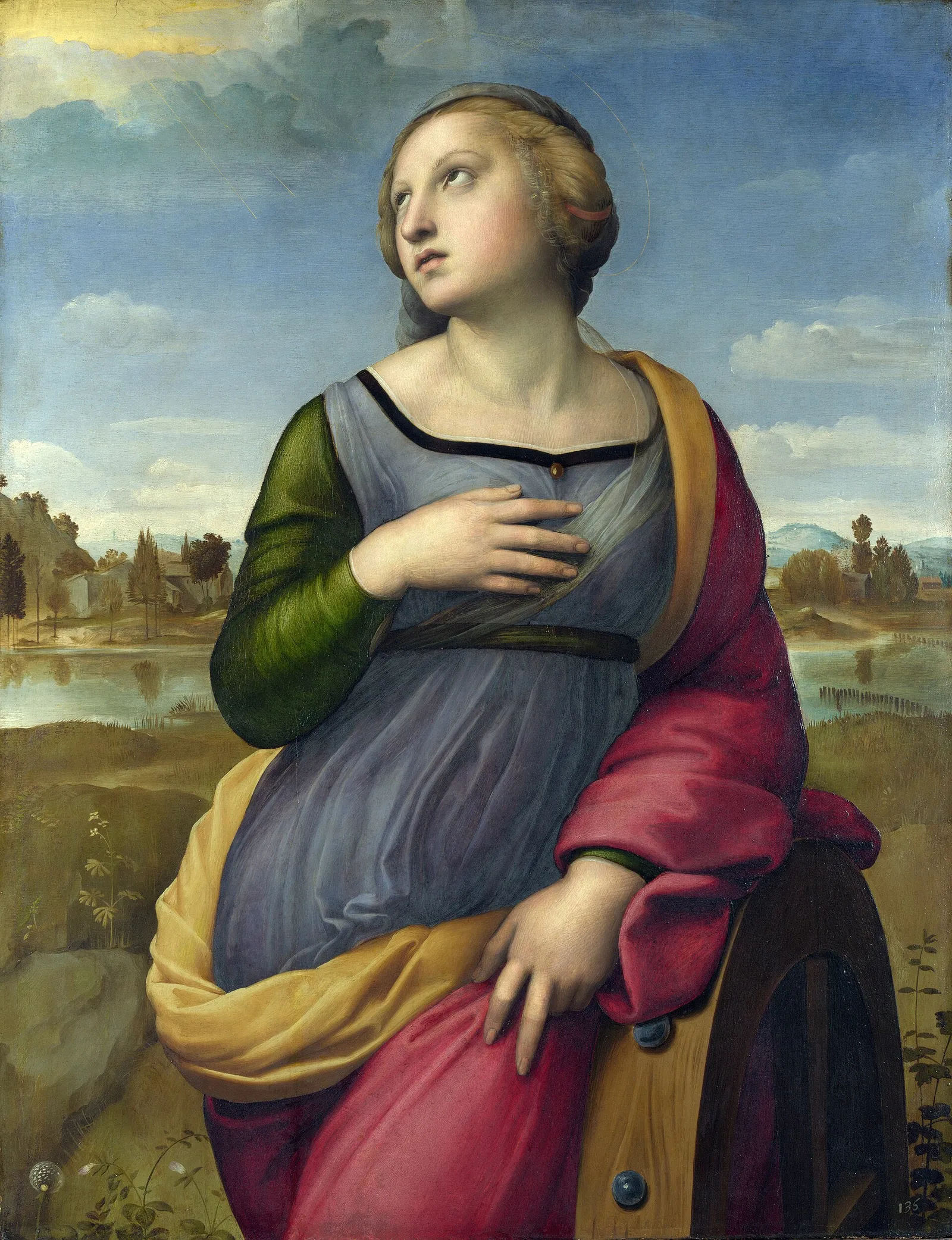
Raphael's Saint Catherine of Alexandria, from 1507, is in the collection of the National Gallery. The picture shows the early Christian saint leaning on the wheel of her martyrdom and looking up toward a burst of heavenly light. It is a compact work of 72.2 by 55.7 cm, so it rewards a close, unhurried look.
Where to see it
Saint Catherine of Alexandria is held by the National Gallery, and that is where it is located. Works in major collections can be moved between rooms, taken off view for conservation, or lent to other institutions. Before you plan a visit around this painting, check the National Gallery's official website for its current display status. The painting measures 72.2 cm high by 55.7 cm wide, which is roughly the size of a large window pane. Give yourself time to stand close and see the detail.
What to look for in person
The turning pose
Start with the figure as a whole. Catherine's body twists: her lower body and the arm resting on the wheel point one way, while her shoulders and head turn and lift the other way. This spiralling movement gives a single standing figure a sense of motion and inner feeling. Follow the line from her hip, up through her torso, to her raised face. The pose reflects the interest in complex, graceful movement that Raphael developed while working in Florence in the years around this painting.
The wheel and the light
Look at what Catherine leans on. The wheel is her traditional attribute. According to her legend, she was condemned to be broken on a spiked wheel, which was said to shatter before the punishment could be carried out. Here Raphael makes the wheel a quiet support for her arm rather than a scene of violence. Then follow her upward gaze to the upper part of the panel, where rays of light break through the sky. The link between her eyes and that light is the emotional centre of the picture.
Colour and landscape
Notice how the strong colours of Catherine's clothing stand out against a calm, open background. The draperies are built up in rich, clear hues, with folds that catch and lose the light as they wrap around her body. Behind her, a soft landscape of water, gentle hills and trees fades into a hazy distance. This bluish, atmospheric recession was a technique Raphael used in many works of these years. It sets the saint apart from the world below while still placing her within it.
About the painting
Saint Catherine of Alexandria is a painting by Raphael from 1507, in the collection of the National Gallery. It belongs to the period when the young artist was working mainly in Florence. In these years he absorbed the achievements of older contemporaries, especially Leonardo da Vinci and Michelangelo, and combined them with the clarity and sweetness of his own early style.
Catherine was one of the most popular saints in Renaissance Europe. Tradition describes her as a learned young woman of Alexandria who refused to give up her Christian faith. She was sentenced to death on a spiked wheel, and when the wheel broke she was beheaded. Painters usually identified her by the wheel, and Raphael follows that convention here. He does not show the drama of the martyrdom. Instead he presents a single figure in a moment of devotion, with her hand pressed to her breast and her eyes turned toward the light from above.
For visitors, the painting is a good place to see how Raphael could make a single figure feel both monumental and graceful within a modest format. Measuring 72.2 by 55.7 cm, the panel is intended for close viewing. Spend a moment on the twist of the body. Then study the way the drapery folds describe the form beneath. Finally, look into the luminous landscape, which opens out behind the saint and leads the eye into the distance.
If you visit the National Gallery to see it, confirm on the museum's official website that the painting is currently on display.
Key facts
| Artist | Raphael |
|---|---|
| Date | 1507 |
| Size | 72.2 × 55.7 cm |
| Medium | oil paint |
| Collection | National Gallery |
How to visit: National Gallery
London, United Kingdom · Museum guide
| Opening hours | Mon–Thu, Sat, Sun 10:00–18:00 Fri 10:00–21:00 (Friday late) |
|---|---|
| Closed | 24–26 December and 1 January. |
| Admission | General admission (collection) free; donations invited Some exhibitions are charged (e.g. Renoir and Love, until 31 Jan 2027) |
| Free entry | General admission is always free. |
| Booking | No reservation or timed entry is required. Free timed booking gives fast-track entry. |
Building work and improvements are under way: some rooms are closed and some paintings have moved, so check the floorplans or collection search before visiting. A new Research Centre is due to open in 2028. On 17 November only, some east wing rooms and the Espresso Bar close from 16:00.
Official ticket page
Official website
View on map
Hours and prices can change. Please check the official website before you go. (Checked on: 2026-11-11)
More by Raphael
 Madonna of the Pinks — National Gallery
 La fornarina
 The Marriage of the Virgin
 Transfiguration
 Madonna of the Goldfinch — Uffizi Gallery
 Madonna del Prato — Kunsthistorisches Museum
 The Deposition — Galleria Borghese
 Alba Madonna — National Gallery of Art
 Portrait of Leo X
 Christ Falling on the Way to Calvary — Museo del Prado
 Ansidei Madonna — National Gallery
 Ceres — Louvre Museum