Art! Art! Art! › Works
Ceres
 Raphael, 1516
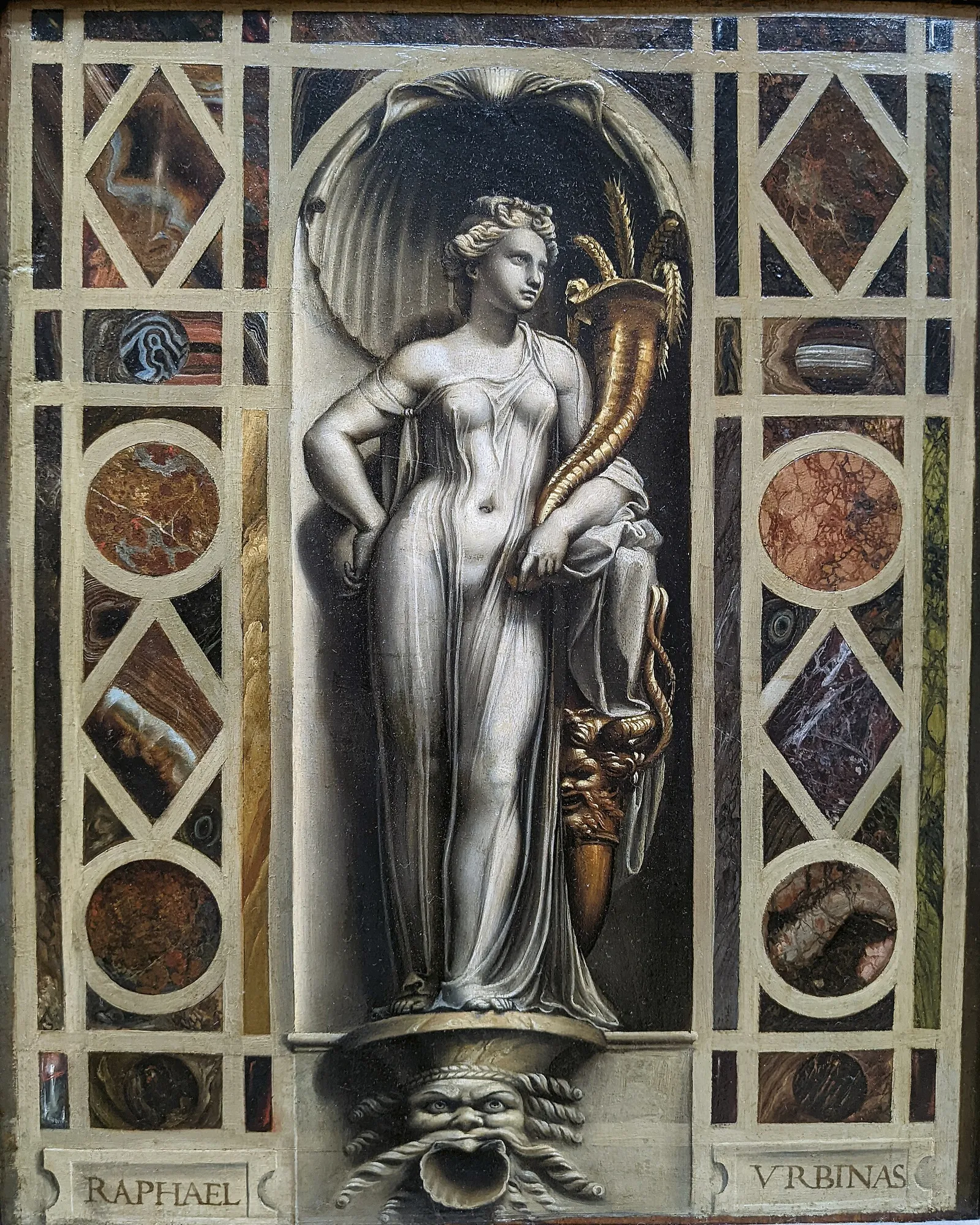
Ceres is a small panel from 1516, credited to Raphael, painted entirely in shades of grey to look like a carved statue standing in a niche. It once served as a protective cover for a portable devotional picture. Today it belongs to the Department of Paintings of the Louvre.
Where to see it
Ceres is held by the Department of Paintings of the Louvre in Paris, and the fact sheet lists its location as Room 710. The panel is small, 38.4 cm high and 31.3 cm wide, so it rewards a close look rather than a view from across the room. Works can be moved, rehung or lent, so check the Louvre's official website for current display status before you visit.
What to look for in person
A goddess painted as sculpture
Start with the figure itself. Ceres, goddess of the harvest, is painted in grisaille, a technique that uses only greys to imitate stone. She stands inside a niche crowned by a scallop shell, her head covered with a veil. She leans on her elbow, and in her bent left arm she holds a cornucopia from which six ears of wheat rise. These are her traditional attributes. The work is also known as Abundance, which suits a figure defined by grain and plenty.
The carved base beneath her feet
Look down at what supports the goddess. She does not stand on a plain ledge. Her feet rest on a cup-shaped base, and that base sits on a carved head. The head has a mouth shaped like a scallop shell, with twisted strands of hair and a curling moustache. The shell motif repeats the shell at the top of the niche, framing the figure above and below. Spend a moment on this small, playful detail, which is easy to miss at first glance.
Painted lettering that imitates inscription
At the bottom of the panel, painted lettering is designed to look as if it were cut into stone. The left side reads RAPHAEL and the right reads VRBINAS, a Latin form meaning 'from Urbino', the artist's home town. Like the figure, the letters are a trompe-l'oeil effect, a painted illusion of carved relief. Notice how the inscription, the niche and the base work together to make a flat panel read as a piece of architecture and sculpture.
About the painting
This panel was made as a protective cover. It would have closed over a devotional painting of the same size, made to travel with its owner, so that the image inside stayed shielded on the road. That practical purpose helps explain both the modest scale and the restrained palette: a cover in shades of grey reads as a sculptural object rather than as a second, competing picture.
The pose was not invented from scratch. The composition follows the Este Aphrodite, a sculpture that originally stood in the Loggia dei Marmi of the ducal palace in Mantua and is now in the Kunsthistorisches Museum in Vienna. Turning a real statue into a painted statue in a painted niche is part of the work's appeal, and it is worth keeping in mind as you study the figure's weight and stance.
The panel's later history runs through French collections. It came to belong to the Gouffier family, most likely to Claude Gouffier, Grand Equerry of France and a collector. Around 1663 Loménie de Brienne sold it to the royal collections of Louis XIV. An inventory of 1683 still described it as a grisaille cover by the same hand as The Small Holy Family. At some point between 1683 and 1695, however, the cover and the painting it accompanied were separated. Seeing Ceres on its own today, remember that it was once one half of a portable pair, meant to be opened, closed and carried.
Key facts
| Artist | Raphael |
|---|---|
| Date | 1516 |
| Size | 38.4 × 31.3 cm |
| Medium | oil paint |
| Collection | Department of Paintings of the Louvre |
How to visit: Louvre Museum
Paris, France · Museum guide
| Opening hours | Mon, Thu, Sat, Sun 09:00–18:00 Wed, Fri 09:00–21:00 (evening opening) Rooms are cleared 30 minutes before closing |
|---|---|
| Closed | Every Tuesday; 1 January, 1 May and 25 December. Other public holidays are open unless they fall on a Tuesday. |
| Last entry | 1 hour before closing |
| Admission | Adult (non-EEA visitors) EUR 32 Adult (EEA citizens and residents) EUR 22 Under 18 free (ID required) EEA citizens/residents under 26 free (photo ID; residents also need a residence permit of over 90 days) Audio guide rental EUR 6 (can be booked in advance online) Rates apply from 14 January 2026 |
| Free entry | Free for under-18s, EEA citizens/residents under 26, all visitors on the first Friday of the month after 18:00 (except July and August) and on 14 July, and disabled visitors plus one carer. Also free with proof for EEA art and art-history teachers, ICOM members, journalists, EEA job seekers and EEA residents on income support. |
| Booking | Entry is by timed slot, and booking in advance is recommended. |
The Cour Carrée entrance is currently closed. On Thursday 12 November 2026 the museum may open later and some exhibition rooms may remain closed.
Official ticket page
Official website
View on map
Hours and prices can change. Please check the official website before you go. (Checked on: 2026-11-11)
More by Raphael
 Madonna of the Pinks — National Gallery
 La fornarina
 The Marriage of the Virgin
 Saint Catherine of Alexandria — National Gallery
 Transfiguration
 Madonna of the Goldfinch — Uffizi Gallery
 Madonna del Prato — Kunsthistorisches Museum
 The Deposition — Galleria Borghese
 Alba Madonna — National Gallery of Art
 Portrait of Leo X
 Christ Falling on the Way to Calvary — Museo del Prado
 Ansidei Madonna — National Gallery