Art! Art! Art! › Works
Madonna of the Pinks
 Raphael, 1500s
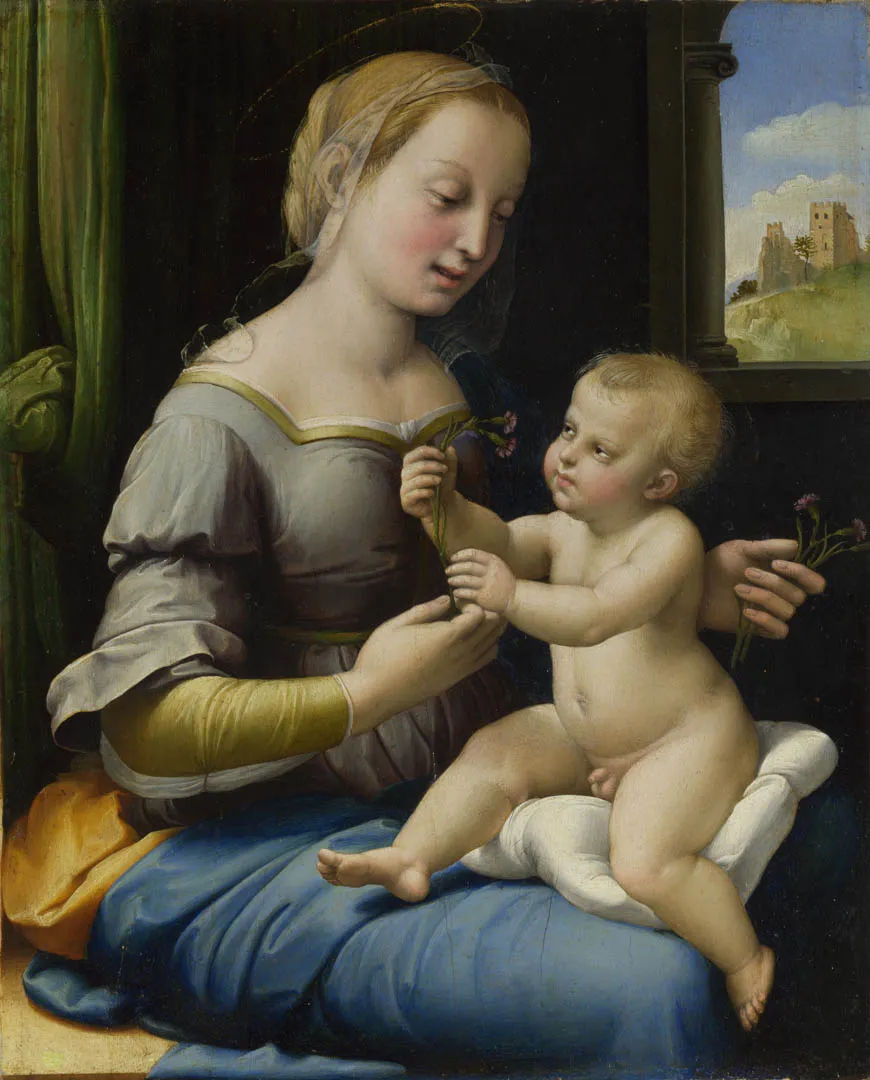
Raphael's Madonna of the Pinks is a small devotional painting in the collection of the National Gallery. Measuring just 27.9 by 22.4 cm, it shows the young Virgin and the Christ Child passing carnations between them, and it rewards a close, unhurried look.
Where to see it
Madonna of the Pinks belongs to the National Gallery, which is also listed as its location. Paintings can be moved, lent or temporarily taken off view, so check the National Gallery's official website for the current display status before you plan your visit. Because the panel is very small, allow time to stand close and study the details.
What to look for in person
The exchange of carnations
Start at the centre of the panel, where mother and child hold small pink carnations between them. The gesture is quiet and playful rather than formal: the Virgin appears as a young woman, and the Child reaches toward the flowers, so the scene reads as an intimate, almost domestic moment. Because the painting is so small, stand close enough to follow the hands and the blossoms, which form the emotional focus of the composition. Notice too how the figures sit within an interior, keeping your attention on this private exchange.
The window and the distant landscape
Look to the arched window that opens behind the figures. Through it you can make out a landscape with a ruined building standing on a hill. This glimpse of the outside world gives depth to an otherwise enclosed room and sets the close, sheltered interior against the open distance beyond. On a panel of this size the view is easy to overlook, so take a moment to let your eye travel from the figures out through the opening and back again to the mother and child.
Blues, pigments and hidden changes
The colour deserves attention. The blue of the sky and of the Virgin's drapery was made with natural ultramarine and azurite, both mineral pigments, and technical study has also identified lead-tin yellow, malachite, verdigris and bismuth grey. The picture is painted in oil on a panel of yew wood. Infrared examination found an underdrawing, made partly with a metal point, and showed that the design of the Virgin's dress was changed as work progressed. You cannot see these layers directly, but they help explain the careful finish visible on the surface.
About the painting
Madonna of the Pinks is a work by Raphael from the 1500s, painted in oil on a small panel of yew wood measuring 27.9 by 22.4 cm. Its modest size suggests a picture meant for close viewing, and the subject, the Virgin and Child sharing carnations in a room with a window onto a hilly landscape, suits that kind of personal contemplation. The painting's later history is well documented. In the nineteenth century it was owned by the Roman painter Vincenzo Camuccini, who sold it in 1854 to Algernon Percy, 4th Duke of Northumberland. It then remained at Alnwick Castle for many years. Its attribution was not always secure: it was the art historian Nicholas Penny who identified it as a work by Raphael in 1991, a judgement supported by later technical study, including the discovery of an underdrawing and changes to the composition beneath the paint. In 2004 the National Gallery acquired the painting from the Duke of Northumberland for £34.88 million, with funding help from the Heritage Lottery Fund and the National Art Collections Fund. Following the acquisition, the panel travelled to Manchester, Cardiff, Edinburgh and Barnard Castle, giving audiences outside the gallery a chance to see it. For visitors today, the appeal lies in looking slowly: the small scale draws you in toward the flowers, the faces, the deep blues of the drapery and sky, and the little landscape framed by the window.
Key facts
| Artist | Raphael |
|---|---|
| Date | 1500s |
| Size | 27.9 × 22.4 cm |
| Medium | oil paint, canvas |
| Collection | National Gallery |
How to visit: National Gallery
London, United Kingdom · Museum guide
| Opening hours | Mon–Thu, Sat, Sun 10:00–18:00 Fri 10:00–21:00 (Friday late) |
|---|---|
| Closed | 24–26 December and 1 January. |
| Admission | General admission (collection) free; donations invited Some exhibitions are charged (e.g. Renoir and Love, until 31 Jan 2027) |
| Free entry | General admission is always free. |
| Booking | No reservation or timed entry is required. Free timed booking gives fast-track entry. |
Building work and improvements are under way: some rooms are closed and some paintings have moved, so check the floorplans or collection search before visiting. A new Research Centre is due to open in 2028. On 17 November only, some east wing rooms and the Espresso Bar close from 16:00.
Official ticket page
Official website
View on map
Hours and prices can change. Please check the official website before you go. (Checked on: 2026-11-11)
More by Raphael
 La fornarina
 The Marriage of the Virgin
 Saint Catherine of Alexandria — National Gallery
 Transfiguration
 Madonna of the Goldfinch — Uffizi Gallery
 Madonna del Prato — Kunsthistorisches Museum
 The Deposition — Galleria Borghese
 Alba Madonna — National Gallery of Art
 Portrait of Leo X
 Christ Falling on the Way to Calvary — Museo del Prado
 Ansidei Madonna — National Gallery
 Ceres — Louvre Museum
Sources
- Wikidata Q1245388
- Wikipedia (en) (CC BY-SA 4.0)
- Wikipedia (ja) (CC BY-SA 4.0)
- Wikipedia (it) (CC BY-SA 4.0)
- www.nationalgallery.org.uk