Art! Art! Art! › Works
Titus as a Monk
 Rembrandt, 1660
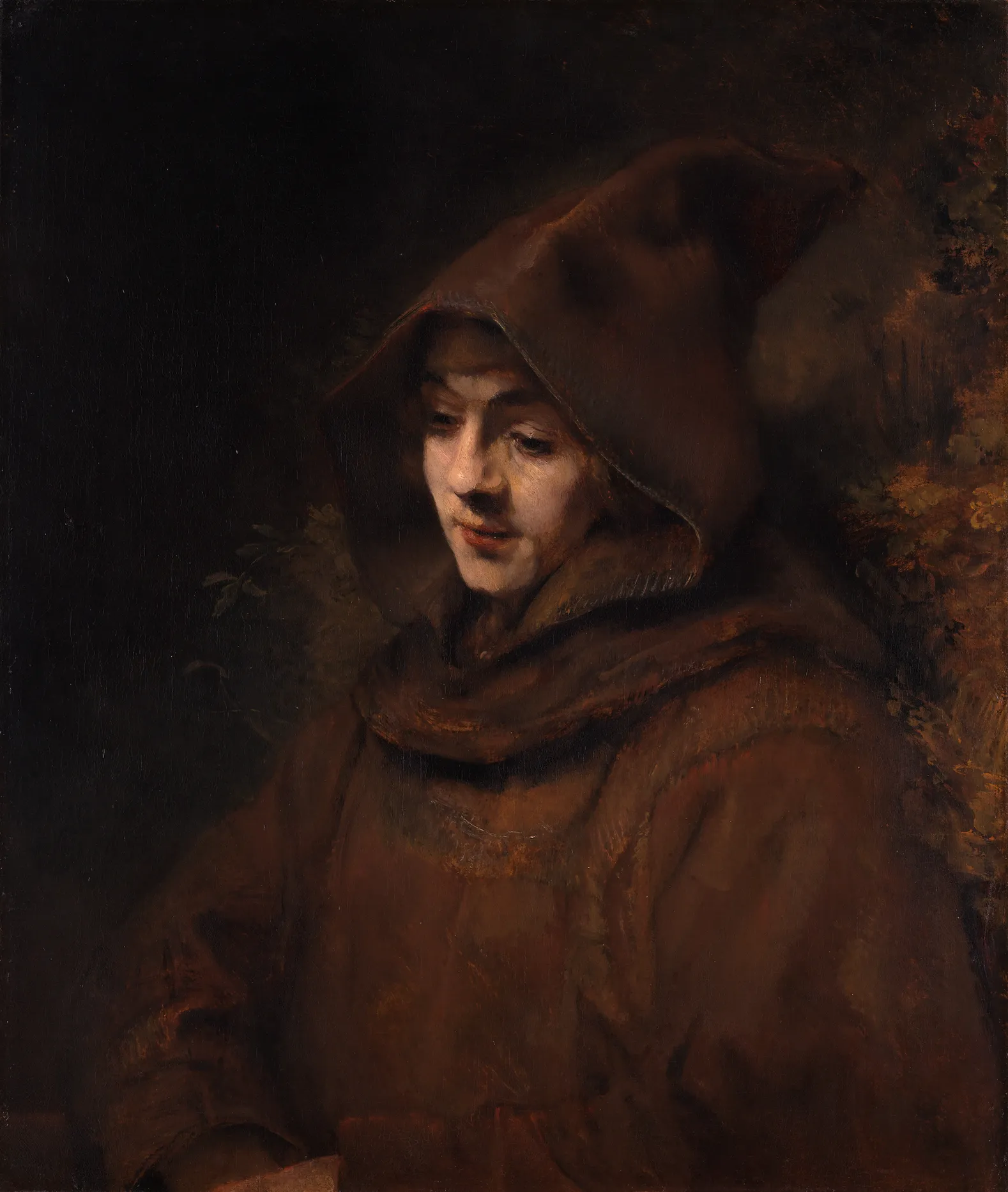
Titus as a Monk is a painting by Rembrandt dated 1660, showing his son Titus wearing a monk's habit with the hood drawn up around his face. The canvas is held by the Rijksmuseum and is a clear example of the quiet, broadly painted portraits of Rembrandt's later years.
Where to see it
Titus as a Monk is listed in the Rijksmuseum, which holds the painting. The collection record also names the Pushkin Museum of Fine Arts, but the recorded location is the Rijksmuseum, so that is where to plan your visit. Display arrangements can change because of conservation, rehanging or loans, so check the Rijksmuseum's official website for the painting's current display status before you go. The work measures 79.5 by 67.7 cm, a moderate size best appreciated by viewing it both up close and from a few steps back.
What to look for in person
The face lit within the hood
Start with the face. Rembrandt sets it inside the deep frame of the cowl, so the light falls on the forehead, nose and cheeks while the surrounding habit sinks into shadow. The eyes are lowered rather than meeting yours, which gives the figure an inward, absorbed mood. Notice how few sharp edges there are: the features emerge softly from the dark, and the contrast between lit skin and shaded cloth does most of the work. Spend a moment here before moving outward, as the rest of the picture is built around this glow.
Brushwork in the monk's habit
Move in close to the robe and hood. In his late works Rembrandt often applied paint in broad, loose strokes, and here the coarse fabric of the habit is suggested rather than described thread by thread. Look for the varied browns and the textured surface, where the paint itself seems to stand in for heavy woollen cloth. Then step back: at a distance the strokes resolve into folds and weight. Comparing these two viewing distances is one of the most rewarding ways to understand how Rembrandt painted in this period.
A son cast in a role
This is a family portrait as well as an image of religious life. Titus, the only one of Rembrandt's children with his wife Saskia to survive infancy, appears in several of his father's works. Here he is not shown in everyday clothes but dressed in a monastic habit, so the painting sits between a portrait of a real young man and a study of a devout figure. Look for the balance between the individual features of the sitter and the simplicity of the costume, which removes almost every distraction from his face.
About the painting
Rembrandt painted Titus as a Monk in 1660, during the later part of his career in Amsterdam. By this time his personal circumstances had changed considerably: he had faced serious financial difficulties in the late 1650s, and his son Titus was closely involved in the family's affairs. Titus also served as a model for his father on a number of occasions, and these images are often seen as among the most personal works Rembrandt produced. In this canvas, measuring 79.5 by 67.7 cm, Titus is shown at half-length in the plain habit of a monk, with the hood raised. Dressing sitters in costume was a familiar practice for Rembrandt, who frequently painted family members and models in historical, biblical or exotic clothing. The result here is a picture that works on two levels at once. It records the appearance of a particular young man, yet the simple religious garment and the downcast gaze give it the character of a devotional image. Stylistically, the painting reflects the features associated with Rembrandt's late manner: a restricted, warm palette dominated by browns, strong contrasts between light and shadow, and paint handled freely so that the texture of the surface remains visible. Rather than precise detail, he concentrates on mood and on the effect of light falling on the face. For visitors, the painting rewards slow looking. Its subject is undramatic, but the treatment of light, cloth and expression makes it a concentrated introduction to how Rembrandt approached portraiture at the end of his career.
Key facts
| Artist | Rembrandt |
|---|---|
| Date | 1660 |
| Size | 79.5 × 67.7 cm |
| Medium | oil paint, canvas |
| Collection | Rijksmuseum / Pushkin Museum of Fine Arts |
How to visit: Rijksmuseum
Amsterdam, Netherlands · Museum guide
| Opening hours | Mon–Sun 09:00–17:00 (every day, incl. public holidays) Gardens 09:00–18:00 (summer only) |
|---|---|
| Closed | Open every day of the year, including public holidays. |
| Admission | Adults EUR 25 (from 2027: EUR 26.50) CJP / EYCA members (half price) EUR 11.25 (from 2027: EUR 13.25) 18 and under free |
| Free entry | Free for those aged 18 and under, Friends of the Rijksmuseum, Amsterdam City Card holders, and holders of ICOM, Vereniging Rembrandt, KOG, VVAK and VriendenLoterij VIP-KAART cards. The gardens are free. |
| Booking | Advance reservation is required, with timed entry. |
Official ticket page
Official website
View on map
Hours and prices can change. Please check the official website before you go. (Checked on: 2026-11-09)
More by Rembrandt
 Rembrandt and Saskia in the parable of the Prodigal Son — Staatliche Kunstsammlungen Dresden
 Belshazzar's Feast — National Gallery
 Syndics of the Drapers' Guild — Rijksmuseum
 The Abduction of Europa — J. Paul Getty Museum
 Juno
 The Night Watch — Rijksmuseum
 The Conspiracy of Claudius Civilis — Rijksmuseum
 The Storm on the Sea of Galilee
 Danaë
 Aristotle with a Bust of Homer — Metropolitan Museum of Art
 The Stoning of Saint Stephen
 The Mill — National Gallery of Art