Art! Art! Art! › Works
Danaë
 Rembrandt, 1636
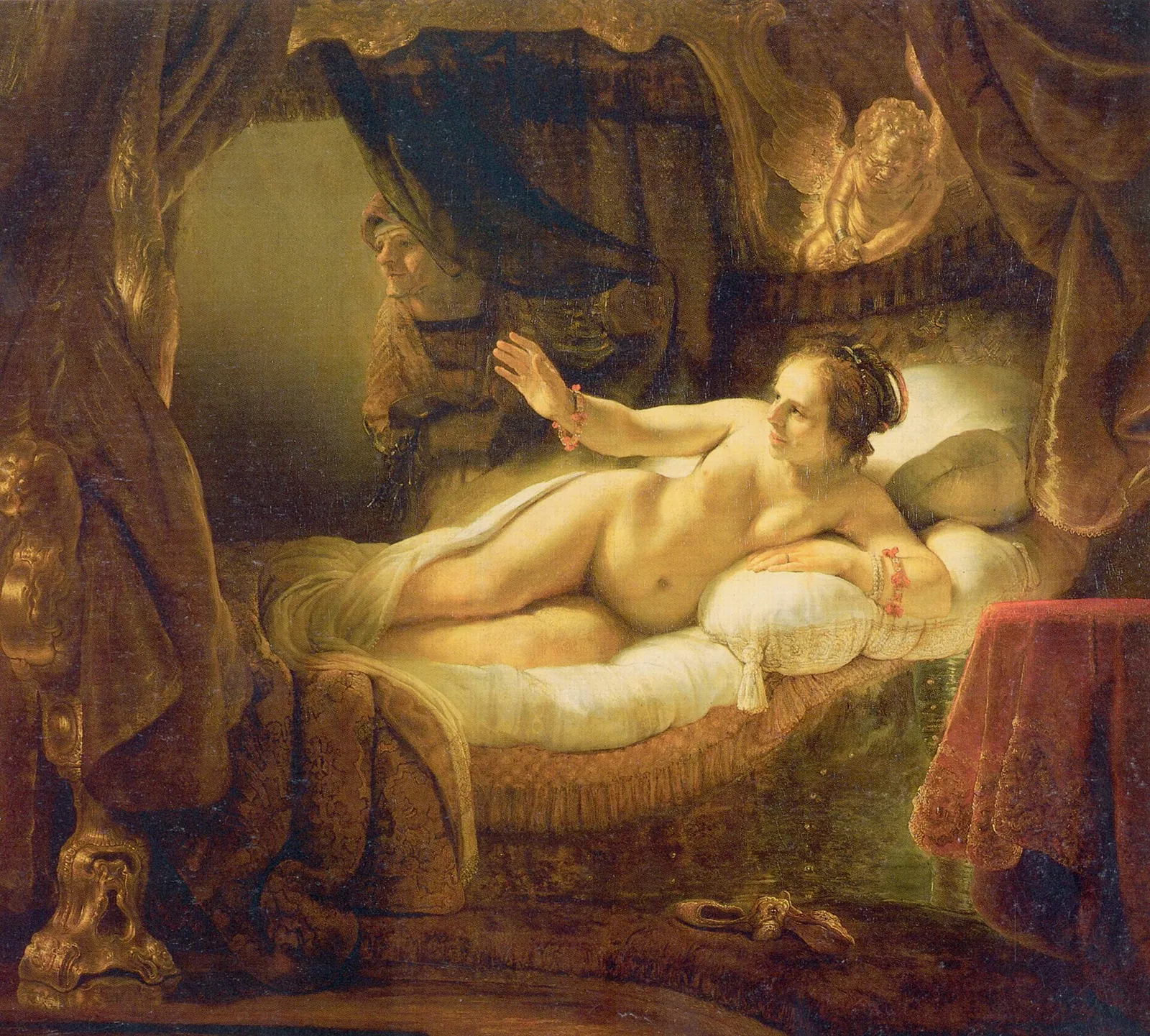
Rembrandt's Danaë, dated 1636, belongs to the Hermitage Museum, which acquired it through the Crozat Collection. At 185 × 202.5 cm, it presents a nearly life-size nude in a warm, enclosed bedchamber, where the god's arrival is suggested by light rather than by the traditional shower of gold.
Where to see it
Danaë is held by the Hermitage Museum, where it entered the collection by way of the Crozat Collection. Display arrangements can change because of conservation work, rehanging or temporary closures, so please check the Hermitage Museum's official website for current display status and visitor information before planning your trip.
What to look for in person
Light in place of a shower of gold
In the myth, Jupiter visits the imprisoned Danaë as a shower of gold, and many painters show coins or golden drops falling from the sky. Rembrandt does something quieter. Stand back and notice how a warm glow enters from the left and spreads across the bed and the woman's body. Her raised right hand reaches toward that light, as if greeting someone just beyond the edge of the picture. The divine visitor is never shown; you sense him only through illumination and her response.
The golden cupid and the watching servant
Look up above the bed's headboard. A gilded carved cupid hangs there with his hands bound, his face twisted as though weeping. He is one of the painting's most discussed details and seems to comment on the scene below. Then turn to the background on the right, where an elderly servant pulls back the heavy curtain and peers in. These two secondary figures frame the main action and help turn a private room into a stage on which a story is unfolding.
Textures, fabrics and signs of change
Move closer to study the surfaces. Rembrandt contrasts the soft, pale flesh with crisp white linen, deep red and gold hangings, a fringed coverlet and a pair of slippers left on the floor. The gold of the bed fittings catches light differently from the skin. Technical study has shown that Rembrandt reworked parts of the composition after first painting it, including the main figure. The canvas also carries the history of serious damage and long restoration, a reminder that what you see has been carefully conserved.
About the painting
Danaë is one of Rembrandt's largest mythological paintings, and its scale matters when you see it in person. At 185 cm high and 202.5 cm wide, the reclining figure is close to life size, so the viewer seems to stand at the foot of the bed, almost in the position of the unseen visitor. The fact sheet gives 1636 as the painting's date, from the period when Rembrandt was establishing himself as a leading painter in Amsterdam.
The subject comes from Greek myth. Danaë's father, warned by an oracle that his grandson would kill him, locked her away. Jupiter reached her nonetheless in the form of golden rain, and she became the mother of the hero Perseus. Rembrandt turns the moment into an intimate interior scene: a curtained bed, a servant at the edge, and a woman who seems both startled and welcoming.
Rather than idealising the body in the classical manner, Rembrandt paints a naturalistic figure with individual features, and he uses warm light to carry the emotion of the scene. This approach is typical of his interest in how light can describe both form and feeling.
The painting passed through the Crozat Collection, a celebrated French private collection, before becoming part of the Hermitage Museum. In more recent times it was severely damaged in a deliberate attack and underwent a long, difficult restoration. Some areas reflect that conservation work, but the composition, the play of light and the overall atmosphere remain clearly readable. When you visit, allow time to view it both from a distance, to take in the arrangement, and up close, to follow the brushwork in the fabrics and gilded details.
Key facts
| Artist | Rembrandt |
|---|---|
| Date | 1636 |
| Size | 185 × 202.5 cm |
| Medium | oil paint, canvas |
| Collection | Crozat Collection / Hermitage Museum |
How to visit: Hermitage Museum
Saint Petersburg, Russia
Hours and prices can change. Please check the official website before you go.
More by Rembrandt
 Rembrandt and Saskia in the parable of the Prodigal Son — Staatliche Kunstsammlungen Dresden
 Belshazzar's Feast — National Gallery
 Syndics of the Drapers' Guild — Rijksmuseum
 The Abduction of Europa — J. Paul Getty Museum
 Juno
 The Night Watch — Rijksmuseum
 The Conspiracy of Claudius Civilis — Rijksmuseum
 The Storm on the Sea of Galilee
 Aristotle with a Bust of Homer — Metropolitan Museum of Art
 The Stoning of Saint Stephen
 The Mill — National Gallery of Art
 Bathsheba at Her Bath — Louvre Museum