Art! Art! Art! › Works
Rembrandt and Saskia in the parable of the Prodigal Son
 Rembrandt, 1635
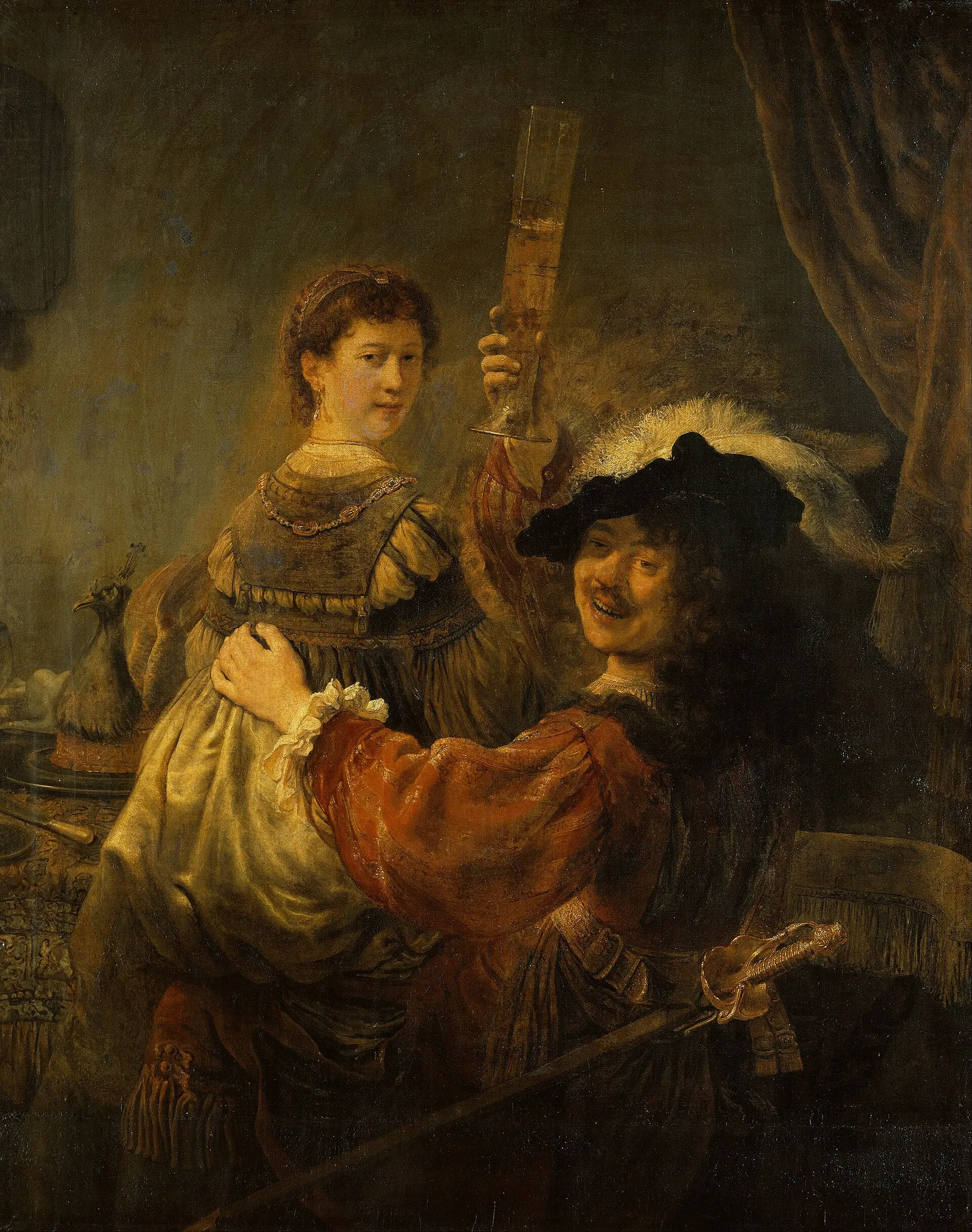
Rembrandt painted himself and Saskia as a carousing couple from the parable of the Prodigal Son, a large canvas dated 1635. The painting belongs to the Staatliche Kunstsammlungen Dresden and is held in the Gemäldegalerie Alte Meister. In front of it, a lively tavern scene sits alongside a moral story about wasted fortune.
Where to see it
The painting is part of the Staatliche Kunstsammlungen Dresden and is held in the Gemäldegalerie Alte Meister in Dresden, Germany. Displays can change because of rehanging, conservation or loans, so check the museum's official website for current display status before you visit.
What to look for in person
A toast aimed at you
The man turns toward the viewer as if inviting you to join the party. He wears a red jacket with puffed sleeves and a velvet beret topped with a feather, carries a sword at his belt, and lifts a tall glass of beer high. The woman sits on his lap, adorned with pearls. Read through the parable, this is the son spending his inheritance on pleasure before his downfall, so notice how the cheerful mood and the moral warning share the same canvas.
Layered reds and golds
Take time with the surface. Technical analysis has identified red ochre, lead-tin yellow, madder lake and smalt in the paint, built up in several layers rather than applied in a single pass. Step close to the costume and jewellery to see how layered colour gives depth and glow to fabric and highlights, then step back to see how the warm palette holds the two figures together against the darker surroundings. The oil-on-canvas format measures 161 × 131 cm, so the couple appear close to life size.
Traces of a changed picture
What you see is not exactly what Rembrandt first painted. Technical study shows that the canvas was trimmed along its left side and that figures from an earlier stage were painted out. X-ray examination revealed a figure of a brothel keeper originally placed between the couple, which would have made the tavern setting far more explicit. Knowing this helps explain the tight framing of the pair. Look also for the signature, which reads REMBRANDT F., the F standing for fecit, Latin for 'made it'.
About the painting
Rembrandt and Saskia in the parable of the Prodigal Son is dated 1635 and painted in oil on canvas, measuring 161 × 131 cm. It belongs to the Staatliche Kunstsammlungen Dresden and is held in the Gemäldegalerie Alte Meister. The picture joins a self-portrait with a biblical subject: the artist casts himself and Saskia as the reckless young man of the parable and a companion in a tavern, a theme that let painters combine scenes of merrymaking with a lesson about squandered wealth.
The work entered the Saxon collection in 1749, when it was bought for Elector Friedrich August II through the Paris art dealer Noël Araignon. Eighteenth-century inventories did not use the biblical title; they described it simply as a seated officer caressing a lady while raising a glass of beer, a reminder of how the subject could be read as a genre scene.
The painting's twentieth-century history mirrors that of the Dresden collections as a whole. During the Second World War it was taken for safekeeping first to Albrechtsburg castle in Meissen and then to a railway tunnel near Rottwerndorf, close to Pirna. From July 1945 the Dresden holdings, this canvas among them, were moved to the Soviet Union. The Soviet government ordered their return in 1955, and before the rebuilt Semper gallery reopened on 3 June 1956 the painting was exhibited at the Pushkin Museum in Moscow and then at the Alte Nationalgalerie in Berlin.
Key facts
| Artist | Rembrandt |
|---|---|
| Date | 1635 |
| Size | 161 × 131 cm |
| Medium | oil paint, canvas |
| Collection | Staatliche Kunstsammlungen Dresden |
How to visit: Staatliche Kunstsammlungen Dresden
Dresden, Germany · Museum guide
| Opening hours | Tue–Sun 10:00–17:00 (closed Mon) Day of Repentance and Prayer (18/11/2026) 10:00–17:00 Fri–Sun, 27/11/2026–30/12/2026 10:00–18:00 (extended hours) Christmas Eve (24/12/2026) 10:00–14:00 Christmas Day (25/12/2026) 10:00–18:00 Boxing Day (26/12/2026) 10:00–18:00 New Year's Eve (31/12/2026) 10:00–16:00 New Year's Day (01/01/2027) 12:00–17:00 |
|---|---|
| Closed | Monday |
| Admission | Zwinger ticket, standard EUR 18 (Old Masters Picture Gallery, Sculpture Collection up to 1800, Mathematisch-Physikalischer Salon, Porcelain Collection; excludes the Correggio special exhibition) Zwinger ticket, reduced EUR 13.5 Zwinger ticket, pupils (under 20) EUR 2 Zwinger ticket, groups (10+) EUR 16 per person Zwinger ticket, children up to school age free Correggio. Movingly Human timed ticket, standard EUR 14 (reduced EUR 10.50, pupils EUR 2, groups EUR 12.50) Correggio. Movingly Human combined ticket, standard EUR 23 (includes all other Old Masters exhibitions; reduced EUR 17.50, pupils EUR 4, groups EUR 20.50) SKD Day Ticket, standard EUR 28 (all SKD museums except the Historic Green Vault; Sparkassencard holders EUR 21, pupils EUR 2) SKD 2-Day Ticket, standard EUR 32 (all SKD museums incl. special exhibitions, except the Historic Green Vault; Sparkassencard holders EUR 24, pupils EUR 4) SKD Annual Ticket, standard EUR 95 (reduced EUR 45, students EUR 25, seniors EUR 70, Sparkassencard holders EUR 85) |
| Free entry | Children up to school age go free. |
| Booking | No reservation is required. |
The Old Masters Picture Gallery is open as usual; the Kunsthalle im Lipsiusbau and the Kunstgewerbemuseum (Schloss Pillnitz), other SKD venues, are currently closed.
Hours and prices can change. Please check the official website before you go. (Checked on: 2026-11-12)
More by Rembrandt
 Belshazzar's Feast — National Gallery
 Syndics of the Drapers' Guild — Rijksmuseum
 The Abduction of Europa — J. Paul Getty Museum
 Juno
 The Night Watch — Rijksmuseum
 The Conspiracy of Claudius Civilis — Rijksmuseum
 The Storm on the Sea of Galilee
 Danaë
 Aristotle with a Bust of Homer — Metropolitan Museum of Art
 The Stoning of Saint Stephen
 The Mill — National Gallery of Art
 Bathsheba at Her Bath — Louvre Museum
Sources
- Wikidata Q1111394
- Wikipedia (en) (CC BY-SA 4.0)
- Wikipedia (ja) (CC BY-SA 4.0)
- Wikipedia (it) (CC BY-SA 4.0)
- Wikipedia (fr) (CC BY-SA 4.0)
- www.skd.museum
- gemaeldegalerie.skd.museum