Art! Art! Art! › Works
The Conspiracy of Claudius Civilis
 Rembrandt, 1660s
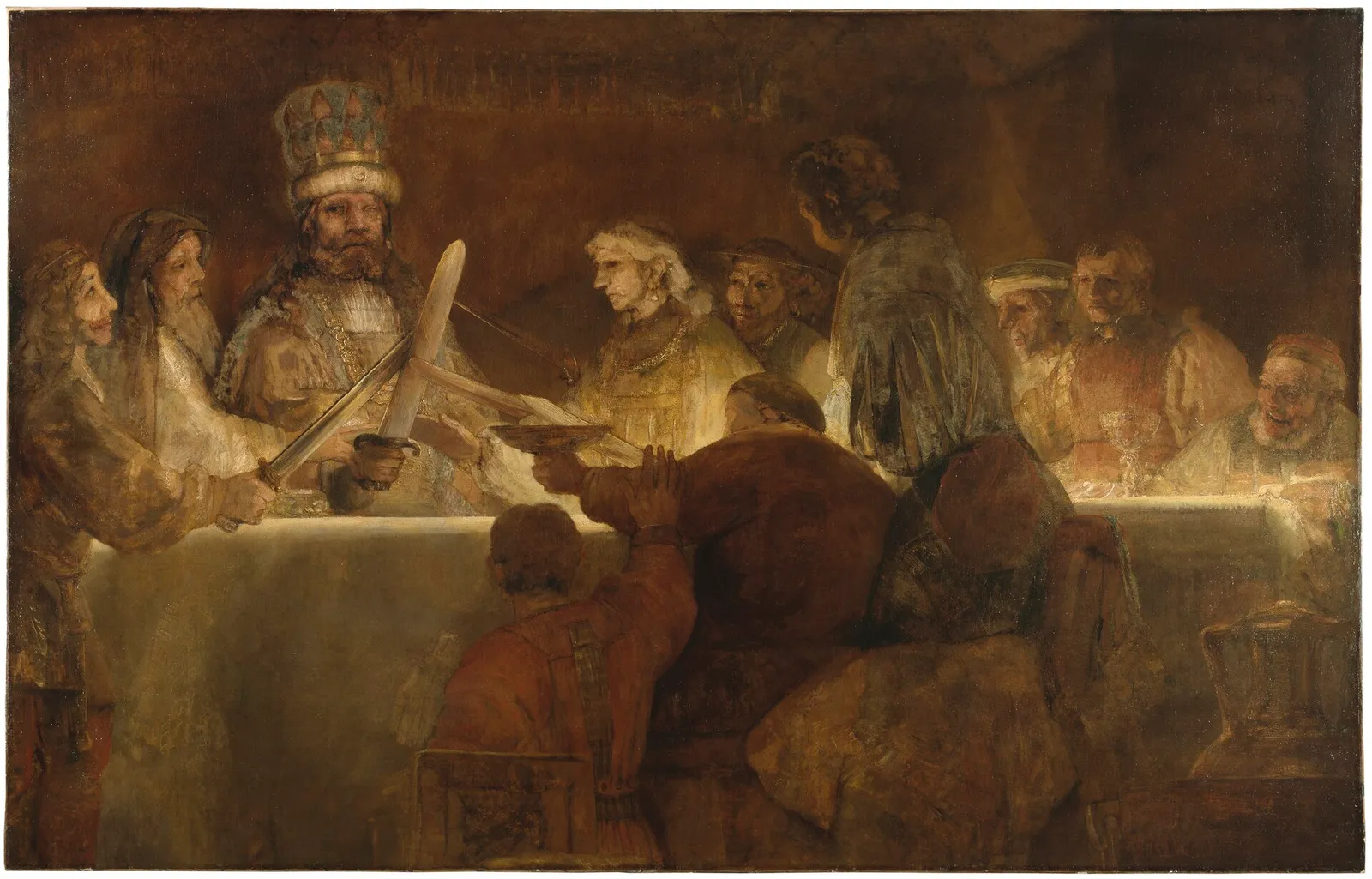
The Conspiracy of Claudius Civilis is a late history painting by Rembrandt, dating from the 1660s, showing a night-time oath among conspirators gathered around a glowing table. It is held by the Nationalmuseum, where the surviving canvas, 196 cm high and 309 cm wide, gives visitors a close look at the broad, rough handling of paint typical of Rembrandt's late work.
Where to see it
The painting is held by the Nationalmuseum, which the fact sheet lists as its location; the Rijksmuseum is also named in the collection record. Before planning a visit, check the Nationalmuseum's official website for current display status, opening hours and ticket information, as works can be moved, rehung or temporarily taken off view.
What to look for in person
The one-eyed leader at the centre
Look first at the large figure seated at the middle of the table, wearing a tall, wide headdress. This is Claudius Civilis, the Batavian leader who, according to the Roman historian Tacitus, had lost an eye. Rembrandt does not hide this: he paints him facing the viewer, with the damaged eye plainly visible. Stand back and notice how his bulk and the height of his headdress make him the anchor of the whole group, with the other figures arranged around him.
Light rising from the table
The scene takes place at night, and the main source of light seems to come from the tabletop itself, as if from a lamp or candles hidden among the figures. The cloth glows a pale yellow, and the light catches faces, hands and raised blades from below. Follow the swords crossing over Civilis's own weapon at the centre: this is the oath being sworn. Around the edges, figures and background dissolve into dark brown shadow, so the eye keeps returning to the lit centre.
Bold, rough brushwork up close
Move closer and the surface changes character. Faces and costumes are built up with broad strokes and thick paint, and in places the forms are only roughly indicated rather than finished in detail. This loose handling is characteristic of Rembrandt's late style. Then step back again to see how those rough marks resolve into faces and gestures at a distance. The canvas, 196 by 309 cm, is still large, which makes this contrast between near and far viewing especially noticeable.
About the painting
The Conspiracy of Claudius Civilis illustrates an episode from the history of the Batavians, a people of the Rhine delta whom the Dutch of Rembrandt's time regarded as their ancestors. As told by Tacitus, the Batavian leader Claudius Civilis gathered his followers at a feast and bound them by oath to rise against Roman rule. For a seventeenth-century Dutch audience, the story echoed their own recent struggle for independence, which made it a fitting civic subject. Rembrandt painted the work in the 1660s as part of a series of scenes from the Batavian revolt intended for the new town hall of Amsterdam. His painting is generally understood to have hung there only briefly before being removed, and it did not remain part of the building's decoration. What survives today is a cut-down portion of a much larger original composition, and it is widely accepted that the canvas was reduced after it left the town hall, leaving the central group around the table. Even in this reduced form, the painting measures 196 by 309 cm. The surviving canvas is valued as one of the key examples of Rembrandt's late approach to history painting: a monumental subject treated with dramatic lighting, an unidealised hero and freely worked paint. When you stand in front of it, it helps to remember that you are seeing the heart of a larger scene; the cropped edges and the close grouping of figures partly reflect that history. The painting is held by the Nationalmuseum, with the Rijksmuseum also named in its collection record.
Key facts
| Artist | Rembrandt |
|---|---|
| Date | 1660s |
| Size | 196 × 309 cm |
| Medium | oil paint, canvas |
| Collection | Nationalmuseum / Rijksmuseum |
How to visit: Rijksmuseum
Amsterdam, Netherlands · Museum guide
| Opening hours | Mon–Sun 09:00–17:00 (every day, incl. public holidays) Gardens 09:00–18:00 (summer only) |
|---|---|
| Closed | Open every day of the year, including public holidays. |
| Admission | Adults EUR 25 (from 2027: EUR 26.50) CJP / EYCA members (half price) EUR 11.25 (from 2027: EUR 13.25) 18 and under free |
| Free entry | Free for those aged 18 and under, Friends of the Rijksmuseum, Amsterdam City Card holders, and holders of ICOM, Vereniging Rembrandt, KOG, VVAK and VriendenLoterij VIP-KAART cards. The gardens are free. |
| Booking | Advance reservation is required, with timed entry. |
Official ticket page
Official website
View on map
Hours and prices can change. Please check the official website before you go. (Checked on: 2026-11-09)
More by Rembrandt
 Rembrandt and Saskia in the parable of the Prodigal Son — Staatliche Kunstsammlungen Dresden
 Belshazzar's Feast — National Gallery
 Syndics of the Drapers' Guild — Rijksmuseum
 The Abduction of Europa — J. Paul Getty Museum
 Juno
 The Night Watch — Rijksmuseum
 The Storm on the Sea of Galilee
 Danaë
 Aristotle with a Bust of Homer — Metropolitan Museum of Art
 The Stoning of Saint Stephen
 The Mill — National Gallery of Art
 Bathsheba at Her Bath — Louvre Museum