Art! Art! Art! › Works
Aristotle with a Bust of Homer
 Rembrandt, 1653
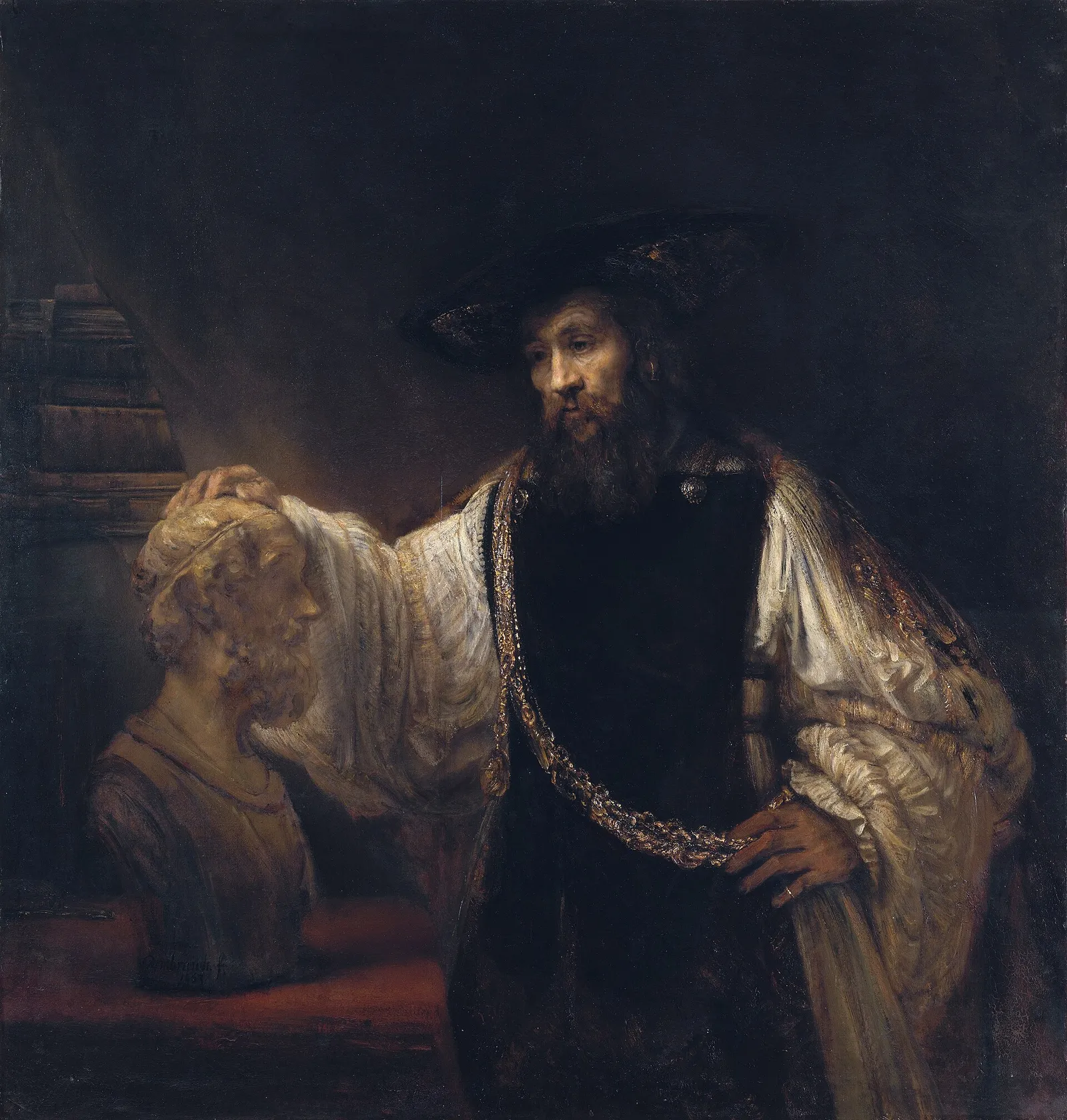
Rembrandt's Aristotle with a Bust of Homer, dated 1653, is held by the Metropolitan Museum of Art. It shows a philosopher in quiet thought, one hand resting on a sculpted head of the poet Homer. In front of the canvas, the pleasure lies in following Rembrandt's light as it moves between face, hand, chain and marble.
Where to see it
Aristotle with a Bust of Homer is in the collection of the Metropolitan Museum of Art, and its listed location is the Metropolitan Museum of Art. Works in large collections can be moved, rehung, lent or temporarily taken off view, so check the museum's official website for the painting's current display status before you plan your visit.
What to look for in person
The hand on the bust
Start with the centre of the composition: Aristotle's right hand resting lightly on the head of a marble bust of Homer. His fingers touch the sculpture, but his eyes do not look at it. His gaze drifts away, heavy-lidded and inward. That gap between touch and attention is what gives the picture its mood of reflection. Notice how Rembrandt lets light catch the top of the bust and the back of the hand, so the two surfaces, living skin and cool stone, sit side by side for comparison.
The gold chain and medallion
Look next at the heavy gold chain slung across Aristotle's body from shoulder to hip. His left hand holds it, and from it hangs a medallion bearing a small profile head, commonly identified as Alexander the Great, Aristotle's pupil. If that reading is accepted, the painting links three figures: a poet of the past, a philosopher in the present moment, and a ruler. Step closer to see how the chain is built from thick, raised dabs of paint that catch real light from the room.
Light, costume and shadow
Step back to take in the whole canvas, which at 143.5 by 136.5 centimetres is almost square. Light falls from the upper left onto the broad-brimmed black hat, the face, and especially the wide white sleeves, which Rembrandt paints with loose, quick strokes that turn to texture close up. Much of the background dissolves into warm darkness, with books and a curtain only partly visible. Let your eyes adjust: details emerge gradually from the shadows, rewarding a slow, patient look.
About the painting
Rembrandt painted Aristotle with a Bust of Homer in 1653, during his mature years in Amsterdam, when his handling of paint had become broad and richly textured. The work is generally understood to have been painted for a collector in Sicily, Antonio Ruffo, who later acquired further works from the artist. This makes it one of the Dutch painter's well-documented commissions from outside the Netherlands. The subject is unusual. Rather than a portrait from life or a narrative scene, Rembrandt presents a historical thinker in contemplation, dressed in an imaginative costume that mixes contemporary and timeless elements. The philosopher stands beside a table, his hand on the head of Homer, the ancient poet whose works Aristotle studied and wrote about. The gold chain he holds is often read as a sign of worldly honour, which can be contrasted with the intellectual and poetic value represented by the bust. Many viewers and writers have read the picture as a meditation on fame, learning and the relationship between material reward and lasting achievement, though the painting itself states nothing outright. Its meaning is carried by gesture, gaze and light rather than by symbols that demand decoding. For a visitor, the work is a good place to see Rembrandt's late technique at work: thin, dark passages in the background give way to thick, sculpted paint in the sleeves and chain. Viewing it first from a distance and then from closer up shows how the surface shifts from a coherent image to visible brushwork.
Key facts
| Artist | Rembrandt |
|---|---|
| Date | 1653 |
| Size | 143.5 × 136.5 cm |
| Medium | oil paint, canvas |
| Collection | Metropolitan Museum of Art |
| Gallery | Gallery 616 Checked in the museum's open data on 2026-11-12 (galleries can change) Source |
How to visit: Metropolitan Museum of Art
New York City, United States · Museum guide
| Opening hours | Sun, Mon, Tue, Thu 10:00–17:00 Fri, Sat 10:00–21:00 |
|---|---|
| Closed | Wednesdays; Thanksgiving Day, 25 December, 1 January and the first Monday in May |
| Admission | Adults USD 30 Seniors (65 and over) USD 22 Visitors with a disability (in person only) USD 22 Students USD 17 Children (12 and under) free Care partners of visitors with a disability (in person only) free New York State residents; NY, NJ and CT students: pay what you wish (minimum USD 0.01). Online requires a NY State billing address; NJ/CT students in person with student ID |
| Free entry | Free for children 12 and under, Members and Patrons, and care partners of visitors with a disability. Pay what you wish for New York State residents and NY/NJ/CT students. |
| Booking | No reservation is required and there is no timed entry. |
The Cantor Roof Garden, the Modern and Contemporary Galleries, and the Ancient West Asia and Ancient Cyprus Galleries are closed for renovation.
Official ticket page
Official website
View on map
Hours and prices can change. Please check the official website before you go. (Checked on: 2026-11-09)
More by Rembrandt
 Rembrandt and Saskia in the parable of the Prodigal Son — Staatliche Kunstsammlungen Dresden
 Belshazzar's Feast — National Gallery
 Syndics of the Drapers' Guild — Rijksmuseum
 The Abduction of Europa — J. Paul Getty Museum
 Juno
 The Night Watch — Rijksmuseum
 The Conspiracy of Claudius Civilis — Rijksmuseum
 The Storm on the Sea of Galilee
 Danaë
 The Stoning of Saint Stephen
 The Mill — National Gallery of Art
 Bathsheba at Her Bath — Louvre Museum