Art! Art! Art! › Works
Bathsheba at Her Bath
 Rembrandt, 1654
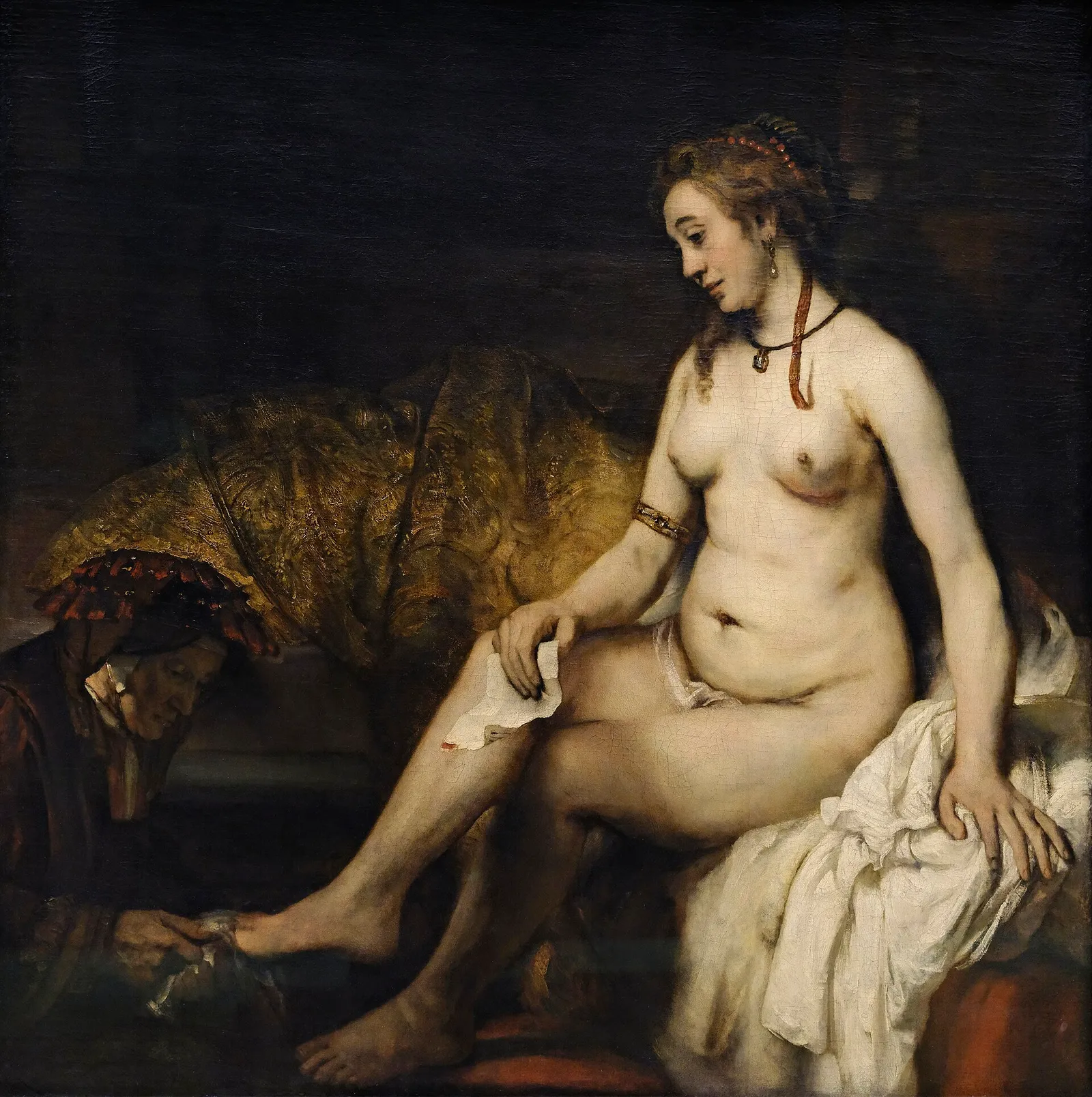
Rembrandt's Bathsheba at Her Bath, painted in 1654, is held by the Department of Paintings of the Louvre. The nearly life-size, square canvas shows the biblical Bathsheba seated and undressed, holding a letter, her face turned inward in thought.
Where to see it
Bathsheba at Her Bath belongs to the Department of Paintings of the Louvre, and the fact sheet lists its location as Room 844. Rooms can change, and works are sometimes moved, rehung or taken off view, so check the Louvre's official website for the painting's current display status before you visit.
What to look for in person
The letter in her hand
Look first at the folded letter resting in Bathsheba's right hand. In the biblical story, King David has seen her bathing and summons her, and the letter is generally read as his message. Rembrandt does not show David at all. Instead, the whole drama is concentrated in this small piece of paper and in the woman holding it. Notice how lightly she grips it and how her hand lies almost idle on her thigh, as if she has already read it and is now weighing what it means.
A face turned inward
Bathsheba does not look at the viewer or at the letter. Her head tilts slightly, her gaze drifts down and away, and her expression is quiet and unreadable. Stand back and spend a moment on the face: it carries the emotional weight of the picture without any dramatic gesture. Rembrandt leaves the viewer to sense her uncertainty and reflection rather than spelling it out, which is why the painting is often discussed as a study of a private, inner moment rather than a scene of seduction.
Light, skin and the kneeling servant
Light falls warmly on Bathsheba's body against a dark background, and up close you can see how freely the paint is handled in the fabrics and jewelry compared with the softer modelling of her skin. Rembrandt paints her body naturally, without idealizing it. Then look to the lower left, where an older servant kneels in shadow, tending to Bathsheba's feet. Her busy, practical task contrasts with Bathsheba's stillness and helps anchor the composition within the square format.
About the painting
Rembrandt painted Bathsheba at Her Bath in 1654, during the mature phase of his career. The canvas measures 142 by 142 centimetres, a square format that is unusual for a single figure, and it now belongs to the Department of Paintings of the Louvre. The subject comes from the Old Testament: King David sees Bathsheba, the wife of his soldier Uriah, bathing, and sends for her. The episode leads to adultery and to David arranging Uriah's death. Many earlier painters treated the story as an occasion to show a beautiful nude being spied upon, often including David watching from a distance. Rembrandt takes a different approach. He removes David from the scene and moves in close, so the figure of Bathsheba fills most of the picture at near life-size. The letter in her hand stands in for the king's summons, and her absorbed expression suggests the difficult position she is in. Standing in front of the painting, it is worth noticing how little action there is. The servant works, but Bathsheba simply sits and thinks. The contrast between her lit body and the dark surroundings, the rich textures of the cloth beside her, and the frank, unidealized way her body is painted all focus attention on her as a person rather than as an ideal. This combination of a familiar biblical story with a quiet, psychological treatment is a large part of why the work is so often singled out among Rembrandt's paintings of biblical subjects. Give yourself time with it: the meaning comes through slowly, mainly through the face and the hands.
Key facts
| Artist | Rembrandt |
|---|---|
| Date | 1654 |
| Size | 142 × 142 cm |
| Medium | oil paint, canvas |
| Collection | Department of Paintings of the Louvre |
| Gallery | Room 844, Richelieu wing, level 2 Checked in the museum's open data on 2026-11-12 (galleries can change) Source |
How to visit: Louvre Museum
Paris, France · Museum guide
| Opening hours | Mon, Thu, Sat, Sun 09:00–18:00 Wed, Fri 09:00–21:00 (evening opening) Rooms are cleared 30 minutes before closing |
|---|---|
| Closed | Every Tuesday; 1 January, 1 May and 25 December. Other public holidays are open unless they fall on a Tuesday. |
| Last entry | 1 hour before closing |
| Admission | Adult (non-EEA visitors) EUR 32 Adult (EEA citizens and residents) EUR 22 Under 18 free (ID required) EEA citizens/residents under 26 free (photo ID; residents also need a residence permit of over 90 days) Audio guide rental EUR 6 (can be booked in advance online) Rates apply from 14 January 2026 |
| Free entry | Free for under-18s, EEA citizens/residents under 26, all visitors on the first Friday of the month after 18:00 (except July and August) and on 14 July, and disabled visitors plus one carer. Also free with proof for EEA art and art-history teachers, ICOM members, journalists, EEA job seekers and EEA residents on income support. |
| Booking | Entry is by timed slot, and booking in advance is recommended. |
The Cour Carrée entrance is currently closed. On Thursday 12 November 2026 the museum may open later and some exhibition rooms may remain closed.
Official ticket page
Official website
View on map
Hours and prices can change. Please check the official website before you go. (Checked on: 2026-11-11)
More by Rembrandt
 Rembrandt and Saskia in the parable of the Prodigal Son — Staatliche Kunstsammlungen Dresden
 Belshazzar's Feast — National Gallery
 Syndics of the Drapers' Guild — Rijksmuseum
 The Abduction of Europa — J. Paul Getty Museum
 Juno
 The Night Watch — Rijksmuseum
 The Conspiracy of Claudius Civilis — Rijksmuseum
 The Storm on the Sea of Galilee
 Danaë
 Aristotle with a Bust of Homer — Metropolitan Museum of Art
 The Stoning of Saint Stephen
 The Mill — National Gallery of Art