Art! Art! Art! › Works
Belshazzar's Feast
 Rembrandt, 1636
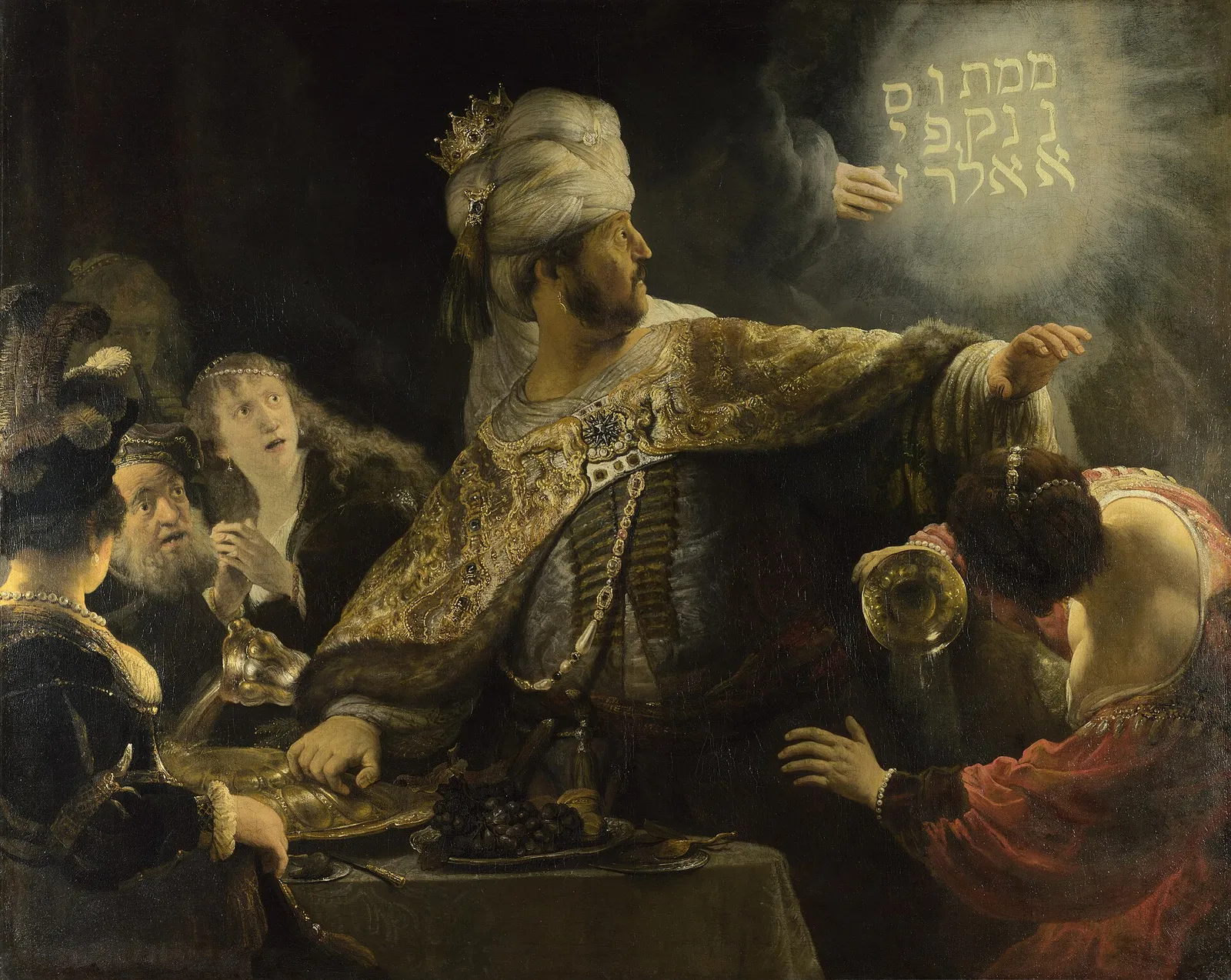
Rembrandt's Belshazzar's Feast captures the moment when a mysterious hand writes a warning on the wall during a Babylonian king's banquet. Painted in oil on canvas and dated 1636, the large picture belongs to the National Gallery in London.
Where to see it
Belshazzar's Feast is in the collection of the National Gallery, London. Display arrangements can change, so check the National Gallery's official website for the painting's current display status before you plan your visit.
What to look for in person
The writing on the wall
Start with the glowing Hebrew letters that a hand traces out of a burst of light. The episode comes from the Book of Daniel, where a divine message appears during King Belshazzar's feast. Rembrandt did not invent the lettering: he took its form from a book by his friend Menasseh ben Israel and arranged the characters in vertical columns instead of a straight line. Look at the last letter at the foot of the leftmost column. It is a small slip, a zayin painted where a final nun should stand.
A banquet thrown into alarm
Next, turn to the king at the centre of the composition. Richly dressed and crowned, Belshazzar twists toward the apparition, and his body language carries the shock of the scene. Let your eye move outward to the guests around the table and compare how each one responds to the sudden intrusion. Rembrandt stages the whole story in a single instant, so the drama is read through faces, gestures and the turning of bodies rather than through a sequence of events. Standing back helps you see how the figures are grouped around the light.
Colour, light and materials
Spend time with the surface. Technical study has identified vermilion, smalt, lead-tin yellow, yellow and red lakes, ochres and azurite on this canvas. Watch for where the warm reds and yellows gather in the costumes and metalwork, and how they stand out against the darker surroundings. The strongest light is reserved for the supernatural writing, which makes the inscription the natural focus of the room. Near the edges, look for the signature, which reads 'Rembrandt f. 163.' with the final digit no longer legible.
About the painting
Belshazzar's Feast is an oil painting on canvas by Rembrandt, measuring 167.6 by 209.2 cm, and it is dated 1636. The signature on the picture includes only the first three digits of a year, so the date cannot be confirmed from the inscription alone. The canvas itself was assembled from two pieces of cloth, and the same fabric has been found in Rembrandt's Minerva in Her Study and in a copy of The Sacrifice of Isaac in the Alte Pinakothek, Munich, a link that helps place the work within his studio practice of the period. The subject is drawn from the Book of Daniel. During a lavish feast held by the Babylonian king Belshazzar, a hand appears and writes words on the wall that announce his downfall. Rembrandt's version of the Hebrew text relied on a book by his friend Menasseh ben Israel, though one character was copied incorrectly. The painting's recorded history begins in 1736, when it was noted at Knowsley Hall, the seat of the Earls of Derby. In 1857 it was lent to the Art Treasures Exhibition in Manchester. Its reception there was not entirely warm: the curator George Scharf considered the handling tame and inadequate. Opinion has changed considerably since. The National Gallery acquired the work in 1964 with support from the Art Fund, and by 2014 it ranked as the third most licensed image in the Gallery's collection, a sign of how familiar its composition has become well beyond the museum walls.
Key facts
| Artist | Rembrandt |
|---|---|
| Date | 1636 |
| Size | 167.6 × 209.2 cm |
| Medium | oil paint, canvas |
| Collection | National Gallery |
How to visit: National Gallery
London, United Kingdom · Museum guide
| Opening hours | Mon–Thu, Sat, Sun 10:00–18:00 Fri 10:00–21:00 (Friday late) |
|---|---|
| Closed | 24–26 December and 1 January. |
| Admission | General admission (collection) free; donations invited Some exhibitions are charged (e.g. Renoir and Love, until 31 Jan 2027) |
| Free entry | General admission is always free. |
| Booking | No reservation or timed entry is required. Free timed booking gives fast-track entry. |
Building work and improvements are under way: some rooms are closed and some paintings have moved, so check the floorplans or collection search before visiting. A new Research Centre is due to open in 2028. On 17 November only, some east wing rooms and the Espresso Bar close from 16:00.
Official ticket page
Official website
View on map
Hours and prices can change. Please check the official website before you go. (Checked on: 2026-11-11)
More by Rembrandt
 Rembrandt and Saskia in the parable of the Prodigal Son — Staatliche Kunstsammlungen Dresden
 Syndics of the Drapers' Guild — Rijksmuseum
 The Abduction of Europa — J. Paul Getty Museum
 Juno
 The Night Watch — Rijksmuseum
 The Conspiracy of Claudius Civilis — Rijksmuseum
 The Storm on the Sea of Galilee
 Danaë
 Aristotle with a Bust of Homer — Metropolitan Museum of Art
 The Stoning of Saint Stephen
 The Mill — National Gallery of Art
 Bathsheba at Her Bath — Louvre Museum
Sources
- Wikidata Q1167932
- Wikipedia (en) (CC BY-SA 4.0)
- Wikipedia (ja) (CC BY-SA 4.0)
- Wikipedia (it) (CC BY-SA 4.0)
- Wikipedia (fr) (CC BY-SA 4.0)
- www.nationalgallery.org.uk