Art! Art! Art! › Works
The Abduction of Europa
 Rembrandt, 1632
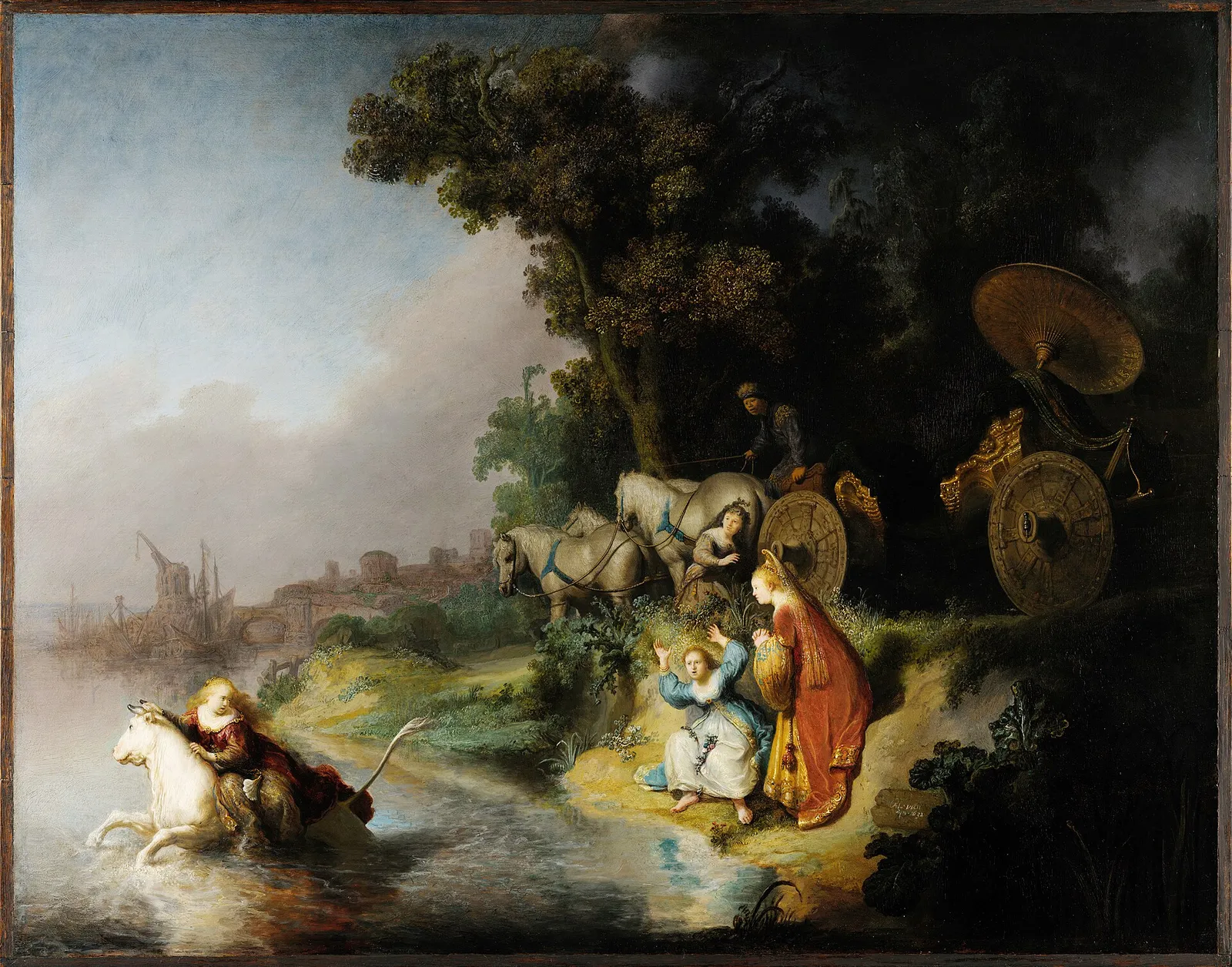
Rembrandt painted The Abduction of Europa in 1632, turning a story from Ovid's Metamorphoses into a compact, dramatic scene on a single oak panel. Today it belongs to the J. Paul Getty Museum and is listed at the Getty Center in Los Angeles. It is a small picture, so plan to stand close and take your time.
Where to see it
The Abduction of Europa is in the collection of the J. Paul Getty Museum, with its location given as the Getty Center in Los Angeles. The panel measures 64.6 x 78.7 cm, small enough that its details reward close viewing. Display arrangements can change, so check the J. Paul Getty Museum's official website for the painting's current display status before you visit.
What to look for in person
Europa and the bull in the light
Start with Europa herself, held on the back of the bull as it carries her out into the water. Rembrandt lets the light fall from the left, so her figure and the fabrics around her catch the brightest highlights, drawing your eye straight to the moment of the abduction. Notice how her body twists back toward the shore rather than facing where she is being taken, which makes the scene feel sudden and unresolved. On a panel of this size, it pays to look slowly at how light and shadow shape the group.
The companions left on the shore
On the coast, Europa's companions react with visible horror. Look at their faces and gestures: each figure responds a little differently, so the group reads as a chorus of alarm rather than a row of identical onlookers. Their clothing is worth a second look too. Instead of ancient costume, Rembrandt dressed the figures in the Dutch clothing of his own day, which brings a classical myth into a seventeenth-century world. The fabrics also show how carefully he handled surface texture in oil paint on oak.
Details hidden in the shadows
Then let your eyes adjust to the darker right side of the picture. In the shadows you can make out an African coach driver and a carriage of non-European type, details that are easy to overlook on a first glance. Farther back, a harbour with a crane appears in the distance. None of these elements comes from Ovid's story, which is one reason art historians have looked to the painting's first owner for an explanation. Keep them in mind as you read the background below.
About the painting
The subject comes from Ovid's Metamorphoses, which tells how Zeus, taking the form of a bull, carried off Europa. Rembrandt shows the episode on a coastline: the bull wades into the water with Europa on its back, while the women who were with her remain on the shore in dismay. He completed the painting in 1632, working in oil on a single oak panel measuring 64.6 x 78.7 cm.
The picture was commissioned by Jacques Specx, a figure connected with the Dutch East India Company. In his collection it hung alongside five portraits by Rembrandt. The art historians Mariet Westermann and Gary Schwartz have read the painting as an allusion to Specx's career, which offers one way to understand the unexpected details on the right: the African coach driver, the non-European carriage and the harbour with its crane. For visitors, this reading turns the panel into more than a mythological scene; it becomes a picture shaped by the interests of the person who paid for it.
The painting passed through many hands over the following centuries. It was sold in 1737, the year after the death of its owner Jeanne Baptiste d'Albert de Luynes. On 31 May 1865 the Duke of Morny sold it to the sugar industrialist Constant Andre Say for 9,100 francs. It was later owned by the German banker Leopold Koppel, and in 1995 it was sold to the J. Paul Getty Museum through the London dealer Deborah Gage.
Key facts
| Artist | Rembrandt |
|---|---|
| Date | 1632 |
| Size | 64.6 × 78.7 cm |
| Medium | oil paint, panel |
| Collection | J. Paul Getty Museum |
How to visit: J. Paul Getty Museum
Los Angeles, United States · Museum guide
| Opening hours | Tue, Wed, Thu, Fri, Sun 10:00–18:30 Sat 10:00–21:00 (late opening) |
|---|---|
| Closed | Closed on Mondays, and on New Year's Day, Independence Day, Thanksgiving Day and Christmas Day. Closes early on Christmas Eve and New Year's Eve. |
| Admission | Museum admission (everyone) free (timed-entry reservation required) Parking per car or motorcycle USD 25 (cashless; includes LA parking tax) Parking after 15:00 USD 15 Parking after 18:00 USD 10 |
| Free entry | Admission is always free (reservation required). Parking is free on Saturdays after 18:00. Bicycles park free. |
| Booking | A timed-entry reservation is required. |
The South Pavilion, the East Pavilion plaza-level galleries and the North Pavilion galleries are closed for renovation as part of the Getty Center modernisation. The Getty Villa Museum (a separate site in Pacific Palisades) is open daily 10:00–17:00, closed Tuesdays.
Official ticket page
Official website
View on map
Hours and prices can change. Please check the official website before you go. (Checked on: 2026-11-09)
More by Rembrandt
 Rembrandt and Saskia in the parable of the Prodigal Son — Staatliche Kunstsammlungen Dresden
 Belshazzar's Feast — National Gallery
 Syndics of the Drapers' Guild — Rijksmuseum
 Juno
 The Night Watch — Rijksmuseum
 The Conspiracy of Claudius Civilis — Rijksmuseum
 The Storm on the Sea of Galilee
 Danaë
 Aristotle with a Bust of Homer — Metropolitan Museum of Art
 The Stoning of Saint Stephen
 The Mill — National Gallery of Art
 Bathsheba at Her Bath — Louvre Museum
Sources
- Wikidata Q1243299
- Wikipedia (en) (CC BY-SA 4.0)
- Wikipedia (ja) (CC BY-SA 4.0)
- Wikipedia (it) (CC BY-SA 4.0)
- www.getty.edu